
The UPSC Public Administration Syllabus covers one of the most popular and scoring optional subjects in the Civil Services Examination. Furthermore, it is directly relevant to both the General Studies papers and the actual practice of governance in which civil servants engage. Moreover, for aspirants with a background in Political Science, Sociology, Law, or Economics, it offers significant content overlap, thereby reducing the overall preparation burden.
This article provides the complete Public Administration optional syllabus as prescribed by UPSC — Paper I (Administration Theory) and Paper II (Indian Administration) — along with the recommended NCERT foundation and the standard reference books for each paper. All content is aligned with the current UPSC examination pattern.
Public Administration Optional: Examination Structure
| Component | Details |
| Number of Papers | Two — Paper I and Paper II |
| Marks per Paper | 250 marks each |
| Total Marks | 500 marks (counted in final merit) |
| Nature of Questions | Descriptive — analytical essays and short answers |
| Overlap with GS | Significant — governance (GS 2), administration, polity, RTI, social audit, CAG, financial administration |
| Medium | English or Hindi — aspirant’s choice |
Why Aspirants Choose Public Administration Optional
Public Administration is a well-structured optional with clearly defined boundaries and consistent examination patterns. The reasons aspirants choose it:
- High overlap with GS Paper 2 (governance, accountability, administrative law, financial administration) reduces the total preparation volume
- Importantly, the syllabus is finite and well-defined; consequently, aspirants can focus on mastering core concepts without worrying about excessive expansion through current affairs.
- Additionally, since Public Administration requires structured analysis and application of concepts, it naturally strengthens the analytical abilities needed to score better in General Studies.
- Strong mentorship and guidance resources are available — the subject is well-covered in India’s preparation ecosystem
- The subject directly builds the administrative thinking that UPSC values in the Interview stage
UPSC Public Administration Syllabus Paper I: Administration Theory
Paper I covers the theoretical foundations of public administration — the evolution of the discipline, major administrative thinkers, organisational behaviour, accountability mechanisms, and contemporary governance concepts. It is the conceptual paper that provides the analytical framework for Paper II.
1. Introduction
Meaning, scope and significance of Public Administration; Wilson’s vision of Public Administration; Evolution of the discipline and its present status; New Public Administration; Public Choice approach; Challenges of liberalisation, Privatisation, Globalisation; Good Governance: concept and application; New Public Management.
2. Administrative Thought
Scientific Management and Scientific Management movement; Classical Theory; Weber’s bureaucratic model, its critique and post-Weberian Developments; Dynamic Administration (Mary Parker Follett); Human Relations School (Elton Mayo and others); Functions of the Executive (C.I. Barnard); Simon’s decision-making theory; Participative Management (R. Likert, C. Argyris, D. McGregor).
3. Administrative Behaviour
Process and techniques of decision-making; Communication; Morale; Motivation Theories — content, process and contemporary; Theories of Leadership: Traditional and Modern.
4. Organisations
Theories — systems, contingency; Structure and forms: Ministries and Departments, Corporations, Companies, Boards and Commissions; Ad hoc and advisory bodies; Headquarters and Field relationships; Regulatory Authorities; Public-Private Partnerships.
5. Accountability and Control
Concepts of accountability and control; Legislative, Executive and judicial control over administration; Citizen and Administration; Role of media, interest groups, voluntary organizations; Civil society; Citizen’s Charters; Right to Information; Social audit.
6. Administrative Law
Meaning, scope and significance; Dicey on Administrative law; Delegated legislation; Administrative Tribunals.
7. Comparative Public Administration
Historical and sociological factors affecting administrative systems; Administration and politics in different countries; Current status of Comparative Public Administration; Ecology and administration; Riggsian models and their critique.
8. Development Dynamics
Concept of development; Changing profile of development administration; ‘Anti-development thesis’; Bureaucracy and development; Strong state versus the market debate; Impact of liberalisation on administration in developing countries; Women and development — the self-help group movement.
9. Personnel Administration
Importance of human resource development; Recruitment, training, career advancement, position classification, discipline, performance appraisal, promotion, pay and service conditions; employer-employee relations, grievance redressal mechanism; Code of conduct; Administrative ethics.
10. Public Policy
Models of policy-making and their critique; Processes of conceptualisation, planning, implementation, monitoring, evaluation and review and their limitations; State theories and public policy formulation.
11. Techniques of Administrative Improvement
Organisation and methods; Work study and work management; e-governance and information technology; Management aid tools like network analysis, MIS, PERT, CPM.
12. Financial Administration
Monetary and fiscal policies; Public borrowings and public debt; Budgets — types and forms; Budgetary process; Financial accountability; Accounts and audit.
| Riyasat IAS Mentorship — Optional Subject Guidance Available Personalised mentorship for UPSC optional preparation. Riyasat Ali Sir direct guidance. 100% online. → Book Your Free Strategy Session |
Paper II: Indian Administration — Complete Syllabus
Paper II applies the theoretical frameworks of Paper I to the specific context of Indian administration — its constitutional basis, institutional structures, reform history, and contemporary challenges. This paper has strong overlap with GS Paper 2 and is directly relevant to the Interview stage.



1. Evolution of Indian Administration
Kautilya Arthashastra; Mughal administration; Legacy of British rule in politics and administration; Indianization of Public services; Revenue administration; District administration; Local self-government.
2. Philosophical and Constitutional Framework of Government
Salient features and value premises; Constitutionalism; Political culture; Bureaucracy and democracy; Bureaucracy and development.
3. Public Sector Undertakings
Public sector in modern India; Forms of Public Sector Undertakings; Problems of autonomy, accountability and control; Impact of liberalisation and privatisation.
4. Union Government and Administration
Executive, Parliament, Judiciary — structure, functions, work processes; Recent trends; Intra-governmental relations; Cabinet Secretariat; Prime Minister’s Office; Central Secretariat; Ministries and Departments; Boards; Commissions; Attached offices; Field organisations.
5. Plans and Priorities
Machinery of planning; Role, composition and functions of the Planning Commission and the National Development Council; ‘Indicative’ planning; Process of plan formulation at Union and State levels; Constitutional Amendments (1992) and decentralised planning for economic development and social justice.
6. State Government and Administration
Union-State administrative, legislative and financial relations; Role of the Finance Commission; Governor; Chief Minister; Council of Ministers; Chief Secretary; State Secretariat; Directorates.
7. District Administration since Independence
Changing role of the Collector; Union-State-local relations; Imperatives of development management and law and order administration; District administration and democratic decentralisation.
8. Civil Services
Constitutional position; Structure, recruitment, training and capacity building; Good governance initiatives; Code of conduct and discipline; Staff associations; Political rights; Grievance redressal mechanism; Civil service neutrality; Civil service activism.
9. Financial Management
Budget as a political instrument; Parliamentary control of public expenditure; Role of finance ministry in monetary and fiscal area; Accounting techniques; Audit; Role of Controller General of Accounts and Comptroller and Auditor General of India.
10. Administrative Reforms since Independence
Major concerns; Important Committees and Commissions; Reforms in financial management and human resource development; Problems of implementation.
11. Rural Development
Furthermore, this section examines the evolution of institutions and agencies established for rural development since Independence. It also focuses on various rural development programmes, their objectives, and implementation strategies. Additionally, the topic covers decentralisation as a governance mechanism, the structure and functioning of Panchayati Raj Institutions, and the significance of the 73rd Constitutional Amendment in strengthening grassroots democracy and local self-government.
12. Urban Local Government
Municipal governance — main features, structures, finance and problem areas; 74th Constitutional Amendment; Global-local debate; New localism; Development dynamics, politics and administration with special reference to city management.
13. Law and Order Administration
Furthermore, the study of Police Administration covers the British legacy and the recommendations of the National Police Commission. Additionally, it examines investigative agencies and the role of Central and State agencies, including paramilitary forces, in maintaining law and order as well as countering insurgency and terrorism. Moreover, the syllabus addresses critical issues such as the criminalisation of politics and administration, police-public relations, and the need for comprehensive police reforms.
14. Significant Issues in Indian Administration
Values in public service; Regulatory Commissions; National Human Rights Commission; Problems of administration in coalition regimes; Citizen-administration interface; Corruption and administration; Disaster management.
Recommended Booklist for UPSC Public Administration Optional
The following booklist is curated for aspirants targeting UPSC Public Administration optional. It is organised in the order of reading priority — start with NCERTs and foundational texts before moving to advanced references.
Stage 1: NCERT Foundation (Start Here)
NCERTs provide the conceptual base for Public Administration. These are non-negotiable for building the foundational understanding that advanced texts build upon.
| NCERT Text | Relevance to Pub Ad Syllabus |
| Class IX — Political Science: Democratic Politics Part I | Democratic institutions, governance basics, elections |
| Class X — Political Science: Democratic Politics Part II | Political parties, outcomes of democracy, challenges |
| Class XI — Political Science: Indian Constitution at Work | Constitutional framework, Parliament, Executive, Judiciary |
| Class XI — Political Science: Political Theory | Political thought, rights, justice, equality — Paper I Theory |
| Class XII — Political Science I: Contemporary World Politics | International relations context — IR and comparative |
| Class XII — Political Science II: Politics in India Since Independence | Post-independence political and administrative history |
Stage 2: Core Reference Books for Paper I (Administration Theory)
These are the primary texts for Paper I. Cover these before supplementary readings.
- Introduction to Public Administration — M.P. Sharma and B.L. Sadana (Foundation text — covers the full Paper I scope)
- Public Administration — F.A. Nigro and L.G. Nigro (Administrative thought, behaviour, and organisational theory)
- The Study of Public Administration — Dwight Waldo (Conceptual evolution of the discipline; essential for Unit 1)
- A Handbook of Public Administration — Brian C. Smith (Good Governance, NPM, accountability mechanisms)
- Public Administration: Theory and Practice — Richard J. Stillman (New Public Administration, Public Choice — Unit 1 depth)
- Simon’s Administrative Behaviour — Herbert Simon (Primary source for decision-making theory; Unit 3)
- Barnard’s Functions of the Executive — Chester Barnard (Primary source; essential for Unit 2 Administrative Thought)
Stage 3: Core Reference Books for Paper II (Indian Administration)
These texts build the Indian administration knowledge base for Paper II.
- Indian Administration — Ramesh K. Arora and Rajni Goyal (Primary text for Paper II — covers all units systematically)
- Public Administration in India — S.R. Maheshwari (District administration, civil services, administrative reforms)
- Indian Government and Politics — B.L. Fadia (Constitutional framework, Union and State administration)
- Kautilya’s Arthashastra — R. Shamasastry translation (Unit 1: Evolution of Indian Administration — original source)
- The Collector and the Collected — selected readings (District administration and democratic decentralisation)
- 2nd Administrative Reforms Commission Reports (selected) — Ministry of Personnel (Administrative reforms — Unit 10)
Stage 4: Supplementary and Advanced Reading
Use these after completing the core texts. They provide depth for high-scoring answers on specific topics.
- Riggsian Models — Fred Riggs (Comparative Public Administration — Unit 7 Paper I; Sala and Bazaar-Canteen models)
- Development Administration — V.A. Pai Panandikar (Development Dynamics — Unit 8 Paper I)
- Right to Information Act, 2005 — official text and amendments (Accountability and Control — Unit 5 Paper I)
- Citizens’ Charter and Social Audit — Government of India guidelines (Units 5 and 14)
- Comptroller and Auditor General of India — annual reports and mandate documents (Financial Management)
- National Police Commission Reports — selected (Law and Order Administration — Paper II Unit 13)
- 73rd and 74th Constitutional Amendment — official text with commentary (Rural and Urban local government)
Overlap Between Public Administration and GS Paper 2
One of the strongest advantages of choosing Public Administration optional is the direct overlap with GS Paper 2. Aspirants who have studied Pub Ad optional answer governance, accountability, and administrative law questions in GS 2 with significantly greater depth and analytical sophistication than those who rely on GS 2 preparation alone.
| Pub Ad Optional Topic | Directly Overlapping GS 2 Topics |
| Accountability and Control (Unit 5, Paper I) | RTI, Social Audit, Parliamentary oversight, CAG |
| Administrative Law (Unit 6, Paper I) | Delegated legislation, Tribunals, rule of law |
| Civil Services (Unit 8, Paper II) | Civil service reforms, lateral entry, ARC recommendations |
| Financial Administration (Unit 12, Paper I) | CAG, Union Budget, Parliamentary financial control |
| Urban Local Government (Unit 12, Paper II) | 74th Amendment, municipal governance, smart cities |
| Rural Development (Unit 11, Paper II) | 73rd Amendment, Panchayati Raj, gram sabha powers |
| Union Government and Administration (Unit 4, Paper II) | PMO, Cabinet, Union-State relations |
| Good Governance and NPM (Unit 1, Paper I) | e-governance, Digital India, governance indicators |
How Riyasat IAS Mentorship Supports Public Administration Optional
At Riyasat IAS Mentorship, aspirants who choose Public Administration optional receive direct guidance from Riyasat Ali Sir on both the optional subject strategy and the GS-optional integration that maximises marks across both components of the examination.
The mentorship for optional subjects covers:
- Personalised reading sequence — which texts to cover in which order based on your background and timeline
- Answer writing review specific to Pub Ad — the analytical frameworks that UPSC evaluators reward in optional answers
- GS-optional integration — building answers for GS Paper 2 governance questions that draw on Pub Ad depth
- High-yield topic identification — the topics within the Pub Ad syllabus that have consistently appeared in recent examinations
- Current affairs integration — identifying recent governance and administrative developments that are directly relevant to Pub Ad answers
The programme is available 100% online, in Hindi and English, at Rs. 23,500 (RIM) and Rs. 29,500 (RIM+). Optional subject mentorship guidance is included as part of the comprehensive programme.
Frequently Asked Questions: Public Administration Optional
Is Public Administration a good optional for non-Political Science graduates?
Yes. Public Administration has been successfully attempted by aspirants from engineering, science, commerce, and humanities backgrounds. The subject does not require a Political Science undergraduate degree. What it requires is an interest in governance and administration, willingness to engage with administrative theory, and the analytical writing skill that Mains rewards — all of which are teachable and learnable regardless of educational background.
How much time does Public Administration optional require?
A well-structured Pub Ad preparation typically requires 4-5 months of sustained study alongside GS preparation — covering NCERTs and foundation texts in the first two months, deepening Paper I and Paper II in months 3-4, and consolidating with answer writing practice in month 5. Aspirants with a Political Science or Governance background may move faster through the foundation phase.
Which paper — Paper I or Paper II — should be prioritised?
Paper I provides the conceptual framework that Paper II applies. Cover Paper I first — the administrative theory, thinkers, and accountability mechanisms. Then cover Paper II’s Indian administration topics with the Paper I framework in mind. The integration between the two papers is one of the subject’s strengths — answer quality improves significantly when both papers are understood as parts of one analytical system.
Are there optional subjects with better overlap with GS?
Public Administration has among the strongest GS overlap of any optional — particularly with GS Paper 2 (governance, accountability, federalism) and GS Paper 4 (ethics, administrative ethics, public service values). This overlap makes Pub Ad one of the most efficient optional choices for aspirants who want to maximise total examination marks relative to total preparation time.
Conclusion
Public Administration is a well-structured, GS-overlapping, and scoring optional subject that rewards analytical thinking and clear answer writing. The syllabus is manageable, the booklist is well-defined, and the subject directly builds the administrative understanding that UPSC tests at every stage — Prelims current affairs, GS Mains governance questions, and the Interview.
If you are considering Public Administration as your optional or have already chosen it, building a preparation strategy that integrates both papers with your GS preparation — and getting expert feedback on your answer writing — is the highest-leverage investment you can make.
Riyasat IAS Mentorship provides exactly this guidance, directly from Riyasat Ali Sir, for aspirants in both Hindi and English medium.
| Prepare Public Administration with Expert Mentorship. → Explore Riyasat IAS Mentorship Programs |


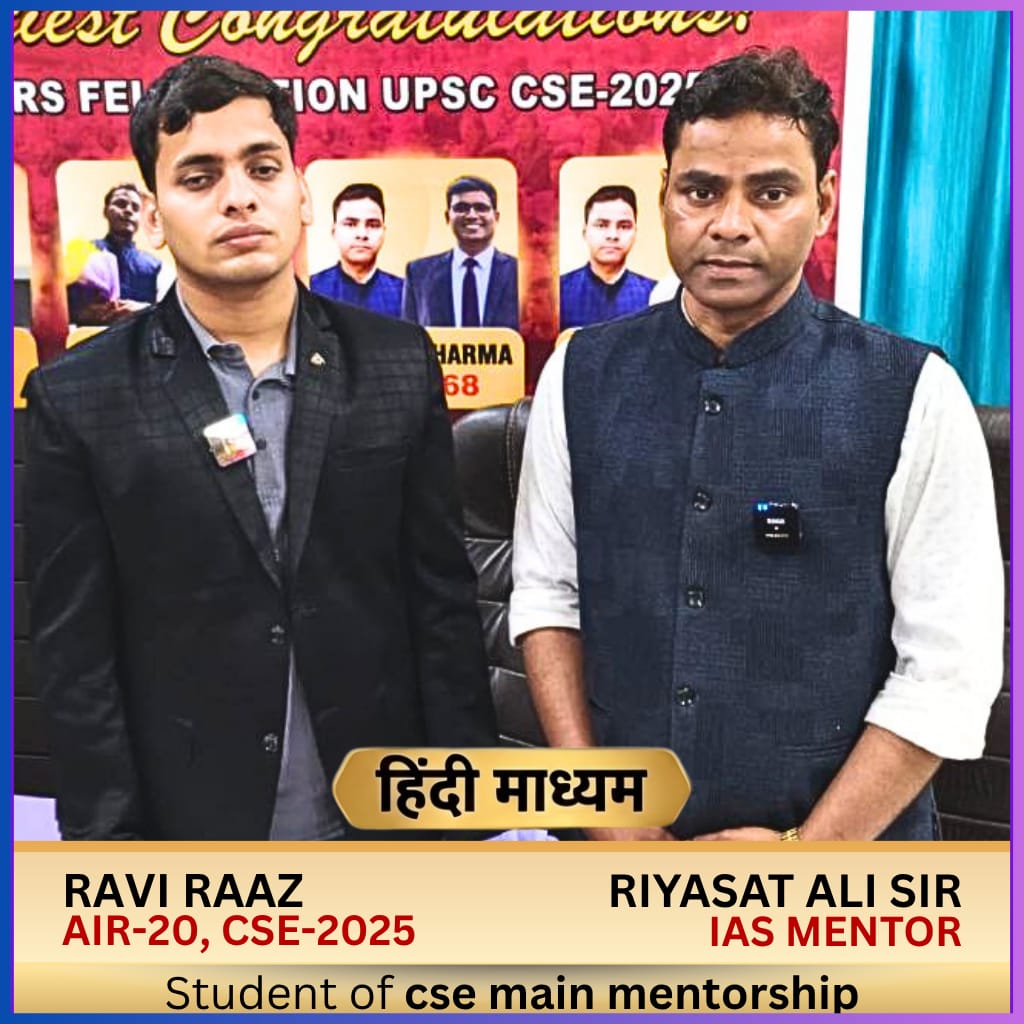 Ravi Raaz
 Hassan Khan
 Shadab Ali