
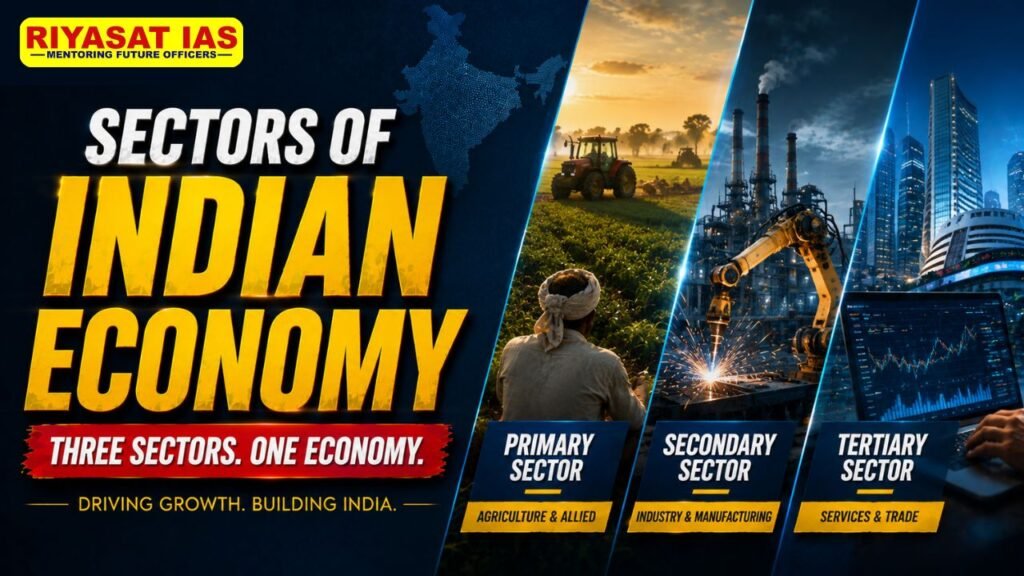
Introduction
The Indian economy consists of a wide range of economic activities involved in the production of goods and services. These activities are classified into different sectors based on the nature of economic activity, ownership, and employment conditions.
Understanding these sectors helps explain India’s economic structure, employment pattern, contribution to national income, and process of structural transformation.
Broadly, economic activities can be classified in three ways:
- Based on nature of activity: Primary, Secondary and Tertiary sectors.
- Based on knowledge intensity: Quaternary and Quinary sectors.
- Based on employment conditions: Organised and Unorganised sectors.
- Based on ownership: Public and Private sectors.
Classification of Economic Sectors
| Basis of Classification | Major Sectors |
| Nature of activity | Primary, Secondary, Tertiary |
| Knowledge intensity | Quaternary, Quinary |
| Employment conditions | Organised, Unorganised |
| Ownership | Public, Private |
Primary Sector
The primary sector includes activities that directly use natural resources for production. It provides essential raw materials and resources required by other sectors of the economy.
Major Activities
- Agriculture
- Dairy
- Fishing
- Forestry
- Mining
Importance of the Primary Sector
- Provides Raw Materials: Agriculture, forestry, fishing and mining supply inputs to industries.
- Supports Rural Employment: A significant proportion of India’s workforce depends on agriculture and allied activities.
- Ensures Food Security: Agriculture is essential for food production and nutritional security.
- Supports Rural Economy: Agricultural income creates demand for goods and services in rural areas.
The primary sector is therefore the foundation of many economic activities, even though its relative contribution to economic output changes as an economy develops.
Secondary Sector
The secondary sector converts raw materials obtained from the primary sector into finished or semi-finished products. It is also known as the industrial sector.
Examples of Secondary Sector
- Textile manufacturing
- Steel production
- Automobile manufacturing
- Chemical industries
- Food processing
- Oil refining
- Construction
- Small-scale manufacturing
Importance of the Secondary Sector
- Value Addition: It converts raw materials into higher-value products.
- Industrialisation: Manufacturing is an important driver of structural transformation.
- Employment Generation: Labour-intensive manufacturing can absorb workers moving out of agriculture.
- Exports: Manufacturing contributes to merchandise exports and foreign exchange earnings.
- Productivity Growth: Technology and economies of scale can increase productivity and competitiveness.
Eight Core Industries in India
The Eight Core Industries are important components of India’s industrial economy:
- Coal
- Crude Oil
- Natural Gas
- Refinery Products
- Fertilizers
- Steel
- Cement
- Electricity
The Index of Eight Core Industries is used as an important indicator of industrial production and economic activity.
Tertiary Sector or Service Sector
The tertiary sector, commonly known as the service sector, provides services rather than physical goods. It supports both primary and secondary activities through transportation, finance, communication, distribution and other services.
Major Activities
- Banking and finance
- Insurance
- Transport
- Trade
- Communication
- Education
- Healthcare
- Information technology
- Tourism
- Professional services
Importance of the Service Sector
- Major Contributor to Economic Output: Services have become the largest component of India’s economic output.
- Supports Other Sectors: Banking, transport, insurance, communication and logistics facilitate agriculture and manufacturing.
- Employment Generation: Services provide employment across both low-skilled and highly skilled occupations.
- Export Potential: IT and IT-enabled services have enabled India to participate significantly in global service markets.
- Knowledge-based Growth: IT, finance, professional services and other knowledge-intensive activities support productivity and innovation.
Why is India’s Economy Service-led?
India’s economic transformation has been somewhat different from the conventional path of agriculture → manufacturing → services.
India experienced rapid growth in services without achieving a comparable level of manufacturing development.
Major Reasons
- Growth of IT and IT-enabled Services: India developed a strong position in software and technology-enabled service exports.
- Skilled Human Resources: Availability of educated workers supported knowledge-intensive services.
- English-language Skills: English proficiency helped Indian service providers access international markets.
- Competitive Labour Costs: Relatively competitive labour costs supported India’s position in global service markets.
- Manufacturing Constraints: Historical challenges related to infrastructure, investment restrictions, labour-market rigidities, land acquisition, environmental clearances and other regulatory issues affected industrial expansion.



Therefore, strengthening manufacturing remains important for employment-intensive growth and balanced structural transformation.
Quaternary Sector
The quaternary sector consists of knowledge-intensive economic activities based on information, research, innovation and specialised expertise.
Examples
- Research and development
- Information technology
- Data analysis
- Higher education
- Advanced financial services
- Professional consultancy
- Knowledge-intensive healthcare
Importance
The quaternary sector contributes to:
- Innovation
- Technological development
- Knowledge creation
- Productivity improvement
- High-skilled employment
It represents the growing importance of knowledge and information in modern economies.
Quinary Sector
The quinary sector includes activities involving high-level decision-making, policy formulation, strategic management and specialised expertise.
Examples
- Senior government officials
- Policy-makers
- Top business executives
- Senior researchers
- Senior consultants
- High-level financial and legal professionals
The quinary sector is associated with activities where the primary contribution comes from decision-making, leadership and strategic knowledge.
Organised Sector
The organised sector consists of formally registered enterprises and institutions operating under established laws and regulations.
Features
- Formal Employment: Workers generally have defined employment conditions.
- Social Security: Eligible employees may receive benefits such as provident fund, insurance and paid leave.
- Regulated Working Conditions: Working hours and employment conditions are governed by applicable regulations.
- Greater Employment Protection: Workers generally have greater legal and institutional protection than those in informal employment.
Examples
- Government institutions
- Registered companies
- Formal factories
- Schools
- Hospitals
- Banks
Unorganised Sector
The unorganised sector consists mainly of informal, small-scale, casual, seasonal, self-employed and home-based economic activities.
Features
- Informal Employment: Employment may be temporary, casual or seasonal.
- Limited Social Security: Workers often have limited access to formal social-security benefits.
- Income Insecurity: Earnings may be irregular and uncertain.
- Limited Worker Protection: Informal workers often have weaker employment protection and bargaining power.
- Labour-intensive Activities: Many activities depend heavily on manual labour.
The unorganised sector remains important for India’s employment and economic activity despite these limitations.
Public Sector
The public sector consists of enterprises and economic activities owned or controlled by the government.
The public sector is not guided only by profit. It also serves objectives such as:
- Public welfare
- Infrastructure development
- Strategic security
- Provision of essential services
- Balanced regional development
Examples
- Railways
- Government-owned enterprises
- Public utilities
- Strategic industries
- Public financial institutions
Classification of Central Public Sector Enterprises
Central Public Sector Enterprises are broadly classified into:
- Maharatna
- Navratna
- Miniratna
These categories provide different levels of operational and financial autonomy to eligible public enterprises.
Private Sector
The private sector consists of businesses owned and operated by private individuals, companies or groups.
Features
- Private Ownership: Productive assets are owned by private entities.
- Profit Motive: Businesses generally operate to earn profits.
- Market Orientation: Production and investment decisions respond to market demand.
- Competition: Competition encourages efficiency and innovation.
- Entrepreneurship: Private enterprise promotes investment, innovation and business creation.
Public-Private Partnership (PPP)
A Public-Private Partnership (PPP) is an arrangement in which the government and a private-sector entity cooperate to provide infrastructure or public services.
Key Features
- Private-sector investment and expertise
- Government oversight
- Sharing of risks and responsibilities
- Competitive selection of private partners
- Performance-linked payments
PPP is particularly useful for infrastructure projects requiring substantial investment, technical expertise and efficient project management.
Sunrise and Sunset Industries
Sunrise Industry
A sunrise industry is an emerging or rapidly growing industry with significant future potential for investment, innovation and employment.
Examples
- Information Technology
- Telecommunications
- Healthcare
- Infrastructure
- Food Processing
- Fisheries
Sunset Industry
A sunset industry is an established industry experiencing long-term decline because of technological change, changing consumer preferences, increased competition or structural transformation.
The distinction between sunrise and sunset industries helps explain how economic activity changes with technology, demand and global market conditions.
Sectoral Structure of the Indian Economy
The relative contribution of different sectors provides an indication of the structural transformation of the economy.
The source material, using 2018–19 data, records the following sectoral shares of GVA:
| Sector | Share of GVA |
| Services | 54.40% |
| Industry | 29.73% |
| Agriculture and Allied Activities | 15.87% |
The same source indicates that agriculture accounted for around 53% of the workforce, compared with approximately 29% in services and 18% in the secondary sector.
Note: These are historical figures from the source material and should not be presented as current estimates without updating the underlying data.
Major Structural Challenges
India’s sectoral structure presents several challenges.
- Agriculture–Employment Imbalance: Agriculture continues to support a large workforce despite its relatively lower contribution to overall economic output.
- Manufacturing Gap: India’s manufacturing sector has not generated employment on the scale required for a large and growing workforce.
- Jobless or Low-employment Growth: Some high-growth sectors, particularly highly automated or skill-intensive activities, may not generate sufficient employment for all sections of the workforce.
- Informality: A large number of workers remain outside formal employment and social-security systems.
- Skill Mismatch: Rapid technological change is increasing demand for specialised skills, while many workers lack adequate training.
- Regional Imbalances: Economic activity and employment opportunities are concentrated unevenly across states and regions.
Importance of Understanding Economic Sectors
Understanding the sectors of the Indian economy is important for analysing:
- Economic Growth: Different sectors contribute differently to GDP and GVA.
- Employment: Sectoral analysis shows where India’s workforce is employed and where new jobs can be generated.
- Structural Transformation: Movement of labour and resources from agriculture towards industry and services indicates economic development.
- Government Policy: Sectoral classification helps governments design policies for agriculture, manufacturing, infrastructure and services.
- Inclusive Growth: Comparing organised and unorganised sectors helps identify gaps in social security, wages and employment protection.
Way Forward
India needs a more balanced and employment-oriented structural transformation.
- Increase Agricultural Productivity: Promote technology, irrigation, diversification, food processing and better market access.
- Strengthen Manufacturing: Encourage labour-intensive industries such as textiles, footwear, food processing and other manufacturing activities capable of generating large-scale employment.
- Expand High-value Services: Promote IT, financial services, professional services, tourism and other knowledge-intensive sectors.
- Formalise Employment: Expand social-security coverage and improve access to formal employment opportunities.
- Strengthen Skills: Align education, vocational training and industry requirements to reduce skill mismatches.
- Promote MSMEs: Improve access to finance, technology, markets and infrastructure for small and medium enterprises.
- Improve Infrastructure: Better transport, logistics, energy and digital infrastructure can strengthen linkages among different sectors.
Conclusion
The sectors of the Indian economy reflect the changing structure of economic activity, employment and production. Agriculture remains important for livelihoods and food security, manufacturing is critical for industrialisation and employment, while services have emerged as the major contributor to economic output.
India’s next stage of development requires a balanced approach that combines higher agricultural productivity, stronger manufacturing, expanding high-value services, skill development and greater formalisation of employment. Such structural transformation will be essential for achieving sustained, inclusive and employment-intensive economic growth.
Frequently Asked Questions (FAQs)
What are the main sectors of the Indian economy?
The main sectors based on economic activity are Primary, Secondary and Tertiary sectors. Quaternary and Quinary sectors represent more specialised knowledge and decision-making activities.
What is the Primary Sector?
The primary sector includes activities that directly use natural resources, such as agriculture, fishing, forestry, dairy and mining.
What is the Secondary Sector?
The secondary sector converts raw materials into finished or semi-finished goods and includes manufacturing, construction and industrial activities.
What is the Tertiary Sector?
The tertiary sector provides services such as banking, insurance, transport, trade, education, healthcare and information technology.
What is the Quaternary Sector?
The quaternary sector includes knowledge-intensive activities such as research, IT, data analysis, higher education and professional consultancy.
What is the Quinary Sector?
The quinary sector involves high-level decision-making and strategic activities, including policy-making, senior management and specialised professional services.
What is the difference between the Organised and Unorganised Sectors?
The organised sector operates under a formal regulatory framework and generally provides greater employment protection, while the unorganised sector consists mainly of informal activities with limited social-security coverage.
What is the difference between the Public and Private Sectors?
The public sector is owned or controlled by the government, while the private sector is owned and operated by private individuals or companies.
What is a Public-Private Partnership?
A PPP is an arrangement in which government and private entities work together to provide infrastructure or public services, with risks and responsibilities shared between them.
Why is India’s economy called service-led?
India is called service-led because services have become the largest contributor to economic output, particularly through IT, finance, trade, communication and other services.
Why is manufacturing important for India?
Manufacturing can generate large-scale employment, increase productivity, support exports and accelerate industrialisation, making it important for India’s structural transformation.
What are sunrise and sunset industries?
A sunrise industry is an emerging sector with strong future growth potential, while a sunset industry is an established sector experiencing structural decline.


 Ravi Raaz
 Hassan Khan
 Shadab Ali