
About
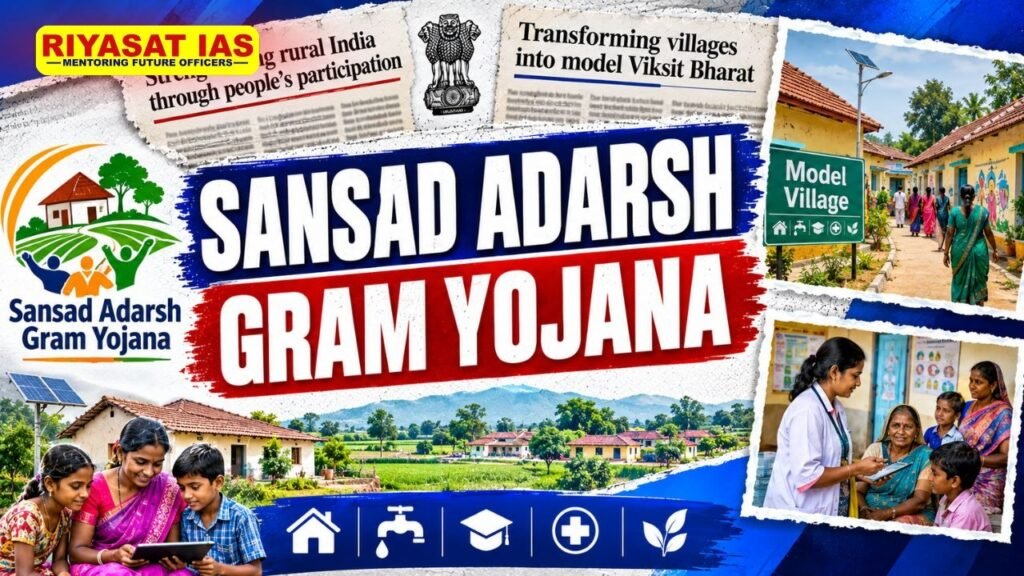
The Sansad Adarsh Gram Yojana (SAGY) was launched in October 2014 with the objective of developing model villages through the leadership of Members of Parliament (MPs). Instead of creating a separate infrastructure programme, SAGY emphasises convergence of existing Central and State Government schemes, community participation and demand-driven development.
Goal of SAGY
The major goal of SAGY is to trigger a holistic development process in selected villages so that they become model villages and serve as examples for neighbouring villages.
Salient Features
· Development Targets: Under SAGY, each Member of Parliament was expected to develop one Adarsh Gram by 2016 and three villages by 2019. The target was subsequently to develop a total of eight villages by 2024, including one village every year after 2019.
· Scale of the Programme: SAGY envisaged the development of nearly 16759 Adarsh Grams (till 17 July 2026) out of approximately 2.65 lakh Gram Panchayats in the country by leveraging the leadership of MPs and convergence of existing government welfare and development programmes.
· Convergence-Based Approach: SAGY does not primarily depend on creating a separate fund for every development requirement. Instead, it seeks to converge resources and benefits available under existing Central and State schemes.
· Antyodaya Approach: The programme was guided by Gandhian principles and the Antyodaya philosophy, focusing on self-reliance, dignity of labour, cleanliness, respect for women, social justice, ecological balance and the welfare of the poorest and most vulnerable sections.
· Community Participation: The scheme emphasises participatory planning, in which villagers identify their needs and participate in the preparation and implementation of the development plan.



· Holistic Development: SAGY focuses not only on roads, electricity and water but also on education, health, sanitation, livelihoods, social development, financial inclusion and environmental sustainability.
· Demand-Driven Development: The Village Development Plan is prepared according to the local needs, priorities and available resources, rather than following a uniform development model for every village.
· Social Development: The scheme promotes social harmony, gender equality, participation of women and vulnerable groups, social justice and community mobilisation.
· Transparency and Monitoring: SAGY provides for web-based monitoring and standardised monitoring mechanisms to track implementation and identify bottlenecks.
· Replication of Best Practices: An important objective is to develop villages whose successful practices can be replicated in neighbouring villages, creating a wider demonstration effect.
Note:
- SAGY: Focuses on MP-led adoption and holistic development of villages.
- PM-AJAY Adarsh Gram: Focuses specifically on the socio-economic development of Scheduled Caste-dominated villages. Since 2021–22, the erstwhile Pradhan Mantri Adarsh Gram Yojana (PMAGY) has been subsumed under PM-AJAY.
FAQs
1. What is the main objective of SAGY?
Ans: SAGY aims to develop model villages (Adarsh Grams) through MP leadership, community participation and convergence of existing government schemes.
2. What were the development targets under SAGY?
Ans: Each MP was expected to develop one village by 2016, three villages by 2019 and a total of eight villages by 2024.
3. What is the Antyodaya approach under SAGY?
Ans: SAGY follows the Antyodaya approach, focusing on the welfare of the poorest sections along with self-reliance, dignity of labour, social justice, cleanliness, gender respect and ecological balance.
4. How is SAGY different from traditional rural-development schemes?
Ans: SAGY follows a participatory and bottom-up approach, involving the Gram Sabha and local communities in planning and implementing village-development activities.
5. How does SAGY achieve village development?
Ans: SAGY relies on convergence of existing Central and State Government schemes, rather than depending solely on a separate programme-specific funding mechanism.


 Ravi Raaz
 Hassan Khan
 Shadab Ali