
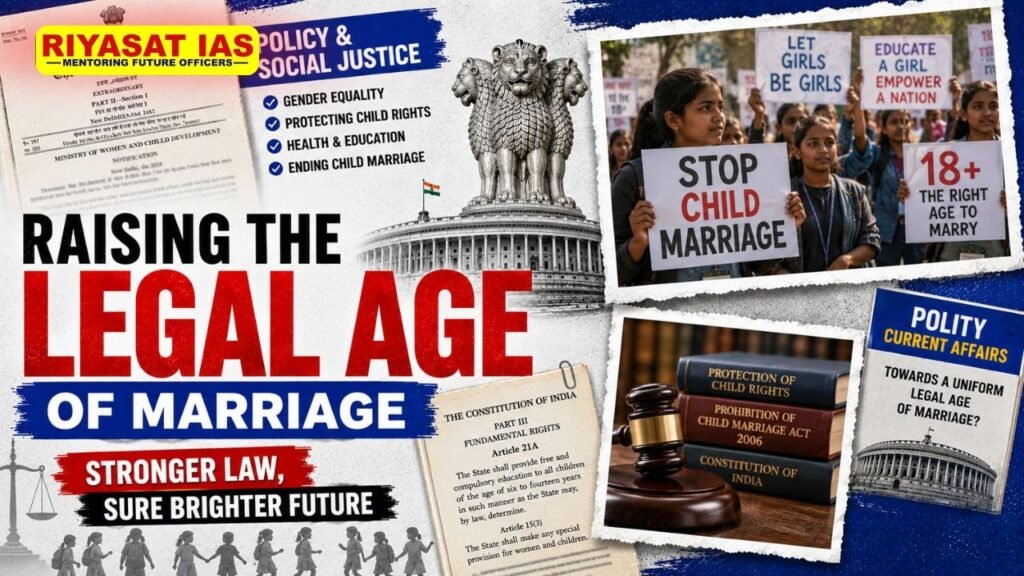
Raising the Legal Age of Marriage
About
The proposal to raise the minimum legal age of marriage for women from 18 to 21 years has generated debate around gender equality, education, health, economic independence and individual choice. The idea is to bring the legal marriageable age of women at par with men and provide young women more time to complete their education and become economically independent.
Minimum Marriageable Age in India
· Under the Prohibition of Child Marriage Act, 2006 and special Marriage Act, 1954, the minimum legal age of marriage is 21 years for men and 18 years for women.
· The Prohibition of Child Marriage (Amendment) Bill, 2021 proposed raising the age for women from 18 to 21 years and sought to bring different personal laws in line with the proposed provision. However, the proposed change has not replaced the existing legal age.
Why is a Minimum Age Prescribed?
· Health: Early marriage can lead to early pregnancy and increase risks for both the mother and child.
· Education: Delaying marriage gives girls greater opportunity to complete school and pursue higher education.
· Economic Independence: More time before marriage can help women acquire skills, employment and financial independence.
· Protection from Child Marriage: A minimum legal age provides a clear legal safeguard against early marriage and exploitation.
· Gender Equality: Having the same legal age for men and women would remove the existing gender-based difference in the law.
Government Efforts to Reduce Gender Gaps
· India became a party to the Convention on the Elimination of All Forms of Discrimination Against Women (CEDAW) in 1993.
· India has enacted dedicated national legislation for the protection and promotion of human rights, drawing upon international human rights principles embodied in instruments such as the Universal Declaration of Human Rights (1948).
· Beti Bachao Beti Padhao: The programme focuses on improving the survival, protection and education of girls and addressing gender-biased social attitudes.
· Mission Shakti: It brings together initiatives for women’s safety, security and empowerment, including One Stop Centres, Women Helplines, BBBP, PMMVY, Sakhi Niwas and Palna.



· Sukanya Samriddhi Yojana: It encourages families to build long-term savings for the education and future needs of the girl child.
Arguments Supporting an Increase in the Legal Marriageable Age
· Protection of Basic Rights: Preventing early and child marriage helps safeguard women’s fundamental rights and dignity and can pave the way for reforms that establish a comprehensive, rights-based framework for the empowerment of women.
· Better Health Outcomes: Delaying marriage can reduce the chances of very early pregnancy and allow women to attain greater physical and reproductive maturity.
· More Time for Education: A higher marriageable age can give girls additional time to complete secondary, higher and professional education.
· Economic Empowerment: Delayed marriage can provide women greater opportunities for skill development, employment and entrepreneurship.
· Gender Equality: Making the legal age 21 for both men and women would establish a uniform legal standard.
· Reduction in Child Marriage: Raising the legal threshold can strengthen the legal framework against early marriage, provided enforcement is effective.
· Demographic Benefits: Later marriage and childbearing may contribute to lower fertility and improved maternal and child health outcomes.
· Intergenerational Benefits: Better educated and economically independent mothers are more likely to contribute to improved health, education and human capital of the next generation.
Arguments Against an Increase in the Legal Marriageable Age
· Individual Autonomy: Adults attain majority at 18 years, so raising the marriage age to 21 may restrict the ability of adults between 18 and 20 to make personal decisions regarding marriage.
· Risk of Criminalisation: Consensual relationships and marriages involving adults aged 18–20 could face greater legal scrutiny if the age is increased.
· Enforcement Problem: Merely changing the legal age may not eliminate child marriage when the underlying causes include poverty, social norms and lack of education.
· Impact on Vulnerable Groups: Strict enforcement without adequate social support may disproportionately affect poor and marginalised families.
· Social Norms Matter: Child marriage is linked to factors such as poverty, patriarchy, insecurity, lack of education and limited livelihood opportunities, which cannot be solved through legislation alone.
· Possibility of Misuse: Laws relating to marriage and young adults may sometimes be used by families or communities to interfere with consensual relationships.
· Need for Broader Reform: Raising the age without improving education, employment, healthcare, safety and social security may have limited impact.
Way Forward
· Improve Girls’ Education: Ensuring access to quality secondary and higher education can be one of the most effective ways of delaying early marriage.
· Create Economic Opportunities: Greater access to skills, employment, entrepreneurship and financial services can reduce the economic pressure for early marriage.
· Strengthen Local Enforcement: Child Marriage Prohibition Officers, local administration, police and community institutions should be equipped to identify and prevent child marriages.
· Work with Communities: Panchayats, schools, self-help groups, civil society and community leaders should be involved in changing social attitudes towards early marriage.
· Improve Adolescent Healthcare: Adolescents should have access to appropriate healthcare, nutrition, counselling and reproductive-health services.
· Ensure Safe Mobility: Safe transport, hostels and secure public spaces can help girls continue education and participate in employment.
· Strengthen Convergence: Education, nutrition, women’s safety, skill development and social-protection programmes should work together instead of functioning in isolation.
Conclusion
Raising the legal age of marriage can support better health, education and economic opportunities for women, but changing the law alone cannot eliminate child marriage. The deeper solution lies in ensuring that girls have education, safety, skills, employment and financial independence, so that marriage is a matter of choice rather than social or economic compulsion.
FAQs
1. What is the present legal age of marriage in India?
Ans: Under the Prohibition of Child Marriage Act, 2006, the minimum legal age is 21 years for men and 18 years for women.
2. Why has the proposal to raise the marriageable age of women to 21 years been discussed?
Ans: The proposal is intended to improve girls’ education, maternal health, economic independence and gender equality, while reducing early marriage and pregnancy.
3. What did the Prohibition of Child Marriage (Amendment) Bill, 2021 propose?
Ans: The Bill proposed raising the minimum marriageable age for women from 18 to 21 years and sought to bring different personal laws in line with the proposed age.
4. What are the main arguments in favour of raising the legal marriage age?
Ans: It can provide women more time for education, skill development and employment, reduce early pregnancy and help establish equal marriageable ages for men and women.
5. What is the major concern regarding raising the legal marriage age?
Ans: The major concern is that it may restrict the autonomy of adults aged 18–20 and could lead to greater legal scrutiny of consensual relationships if the underlying social causes of early marriage are not addressed.


 Ravi Raaz
 Hassan Khan
 Shadab Ali