
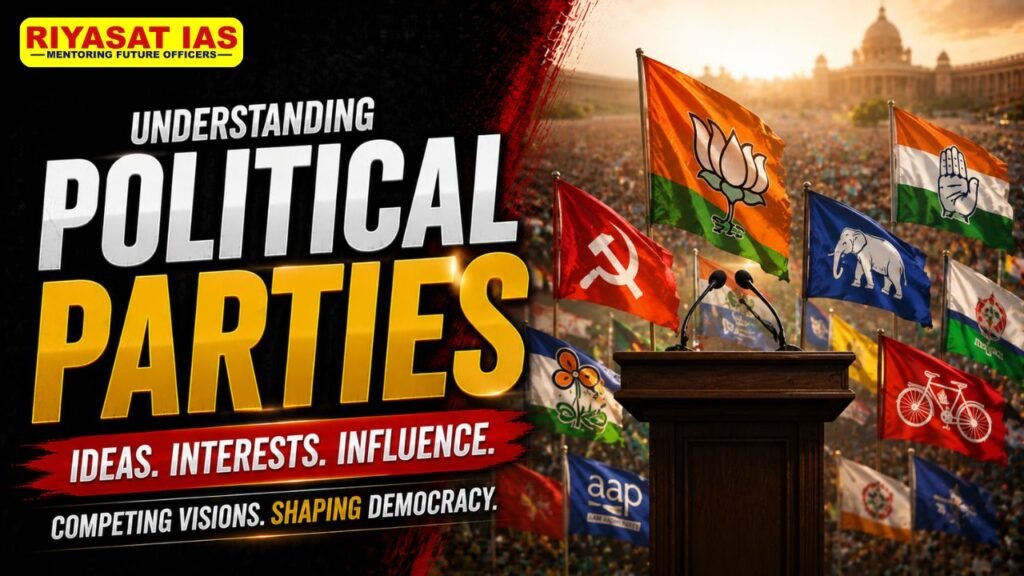
About
A political party is a group of citizens who share broadly similar political ideas and objectives and seek to acquire and exercise political power through constitutional and electoral means. Political parties act as a link between citizens and the government by contesting elections, forming governments, representing interests, and shaping public policies.
Types of Political Parties
Political parties in India can broadly be classified on the basis of their electoral recognition and geographical influence.
1. National Parties
- These are parties with a significant electoral presence across multiple States and are recognized as National Parties by the Election Commission of India (ECI).
- Examples include Bharatiya Janata Party (BJP), Indian National Congress (INC), Bahujan Samaj Party (BSP), Communist Party of India (Marxist) [CPI(M)], Aam Aadmi Party (AAP), and National People’s Party (NPP).
2. State Parties
- These parties have significant electoral influence primarily in one State or a limited number of States and are recognized by the ECI on the basis of prescribed electoral performance.
- Examples include DMK in Tamil Nadu, BJD in Odisha, TMC in West Bengal, and Shiv Sena in Maharashtra.
3. Registered but Unrecognised Parties
- These parties are registered with the ECI under Section 29A of the Representation of the People Act, 1951, but do not fulfil the electoral criteria required for recognition as a National or State Party.
Party System in India
India follows a multi-party system, in which several national and State-level parties compete for political power. The system combines national-level competition with strong regional parties, resulting in both single-party governments and coalition governments at the Union and State levels.
Major Features
- Multi-party Competition: Multiple parties contest elections and represent diverse social, regional, linguistic, and ideological interests.
- Dominant-Party Phase: The Congress system dominated Indian politics during the early decades after Independence.
- Rise of Regional Parties: Regional parties became increasingly influential from the 1980s onwards, particularly in States such as Tamil Nadu, West Bengal, Odisha, Telangana, and Andhra Pradesh.
- Coalition Era: The period from 1989 to 2014 witnessed several coalition governments at the Union level, reflecting the growing importance of regional parties.
- Recent Trend: Since 2014, the BJP has emerged as the dominant party at the Union level, while regional parties continue to play a major role in State politics.



Example: The NDA and UPA illustrate how national and regional parties can come together to form coalition governments at the Union level.
Recognition of Political Parties
· The Election Commission of India classifies political parties as either recognized or unrecognized. A recognized party is further classified as a National Party or State Party under the Election Symbols (Reservation and Allotment) Order, 1968.
· Recognition gives parties important electoral privileges, particularly a reserved election symbol and other facilities provided under election law.
Conditions for Recognition as a State Party
A political party is recognized as a State Party if it fulfils any one of the following conditions in a State:
- 6% Votes + 2 Seats in Assembly: The party secures at least 6% of valid votes in the State Assembly election and wins at least 2 Assembly seats.
- 6% Votes + 1 Lok Sabha Seat: The party secures at least 6% of valid votes in the State in a Lok Sabha election and wins at least 1 Lok Sabha seat from that State.
- 3% Seats or 3 Seats: The party wins at least 3% of the total Assembly seats or 3 seats, whichever is higher.
- 1 Lok Sabha Seat per 25 Seats: The party wins at least one Lok Sabha seat for every 25 seats allotted to the State, or fraction thereof.
- 8% Vote Share: The party secures at least 8% of the total valid votes polled in the State in either a Lok Sabha or Assembly election.
Example: A party securing 8% of the valid votes in a State Assembly election can qualify as a State Party even if it does not win the minimum number of seats under the other criteria.
Conditions for Recognition as a National Party
A political party is recognized as a National Party if it fulfils any one of the following conditions:
- 6% Votes in 4 States + 4 Lok Sabha Seats: The party secures at least 6% of valid votes in each of four or more States in a Lok Sabha or Assembly election and wins at least 4 Lok Sabha seats.
- 2% Lok Sabha Seats + 3 States: The party wins at least 2% of the total Lok Sabha seats and its elected members come from at least 3 different States.
- State Party in 4 States: The party is recognized as a State Party in at least four States.
Prelims Fact: The criteria are alternative, meaning a party needs to satisfy only one of the three conditions to obtain National Party status.
National Parties in India?
As per the Election Commission of India’s current recognized-party list, India has 6 recognized National Parties:
- Bharatiya Janata Party (BJP)
- Indian National Congress (INC)
- Bahujan Samaj Party (BSP)
- Communist Party of India (Marxist) [CPI(M)]
- Aam Aadmi Party (AAP)
- National People’s Party (NPP)
Q1. Which body recognizes National and State Parties in India?
Ans: The Election Commission of India.
Q2. Under which order are political parties recognized?
Ans: The Election Symbols (Reservation and Allotment) Order, 1968.
Q3. How many recognized National Parties are there in India?
Ans: Six.
Q4. What is the minimum vote-share criterion for State Party recognition under one of the alternatives?
Ans: 8% of valid votes in the State in a Lok Sabha or Assembly election.
Q5. What is the minimum number of States in which a party must be recognized as a State Party to qualify as a National Party under one criterion?
Ans: Four States.


 Ravi Raaz
 Hassan Khan
 Shadab Ali