
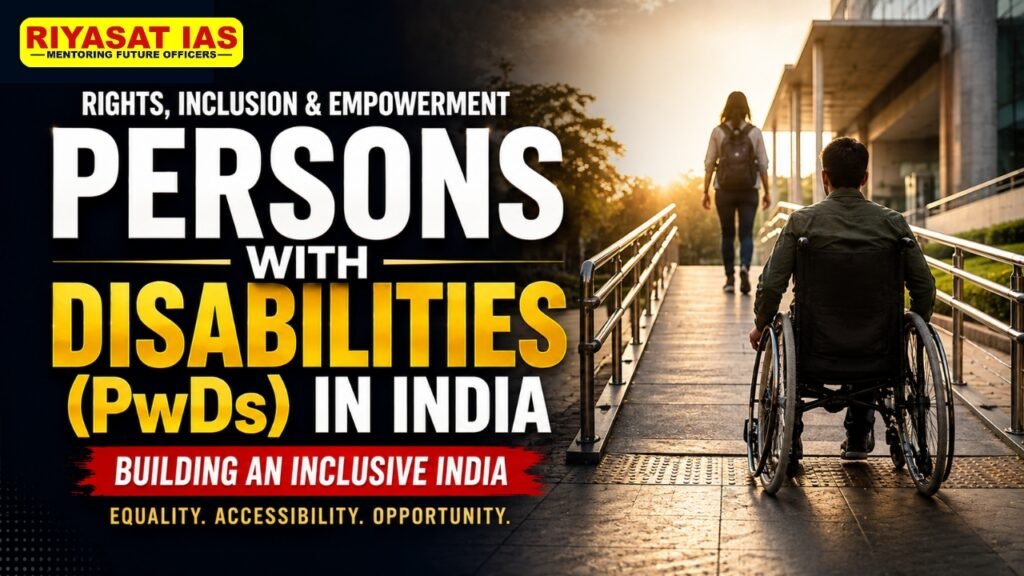
Who are Persons with Disabilities?
UN Definition
The UN Convention on the Rights of Persons with Disabilities (UNCRPD) adopts a rights-based approach and recognises persons with disabilities as people with long-term physical, mental, intellectual or sensory impairments which, in interaction with various barriers, may hinder their full and effective participation in society on an equal basis with others. The Convention was adopted in 2006 and entered into force in 2008.
Definition under Indian Law
Under the Rights of Persons with Disabilities (RPwD) Act, 2016, a person with disability is a person with a long-term physical, mental, intellectual or sensory impairment which, in interaction with barriers, hinders his or her full and effective participation in society equally with others. The Act recognises 21 specified disabilities and adopts a broader rights-based approach than the earlier 1995 law.
Current Situation in India
The Census 2011 remains the latest comprehensive official population enumeration of PwDs. It recorded 2.68 crore persons with disabilities, constituting 2.21% of India’s population, including about 1.50 crore males and 1.18 crore females.
| Indicator | Census 2011 Data |
| Total PwDs | 2.68 crore |
| Share of population | 2.21% |
| Male PwDs | 1.50 crore |
| Female PwDs | 1.18 crore |
| Rural PwDs | 1.86 crore (69.5%) |
| Urban PwDs | 81.8 lakh (30.5%) |
The rural disability population was about 2.24% of the rural population, compared with 2.17% in urban areas, highlighting the importance of accessible services in rural and remote regions.
Major Categories
According to Census 2011, the largest categories included:
- Movement disability: 54.37 lakh.
- Hearing disability: 50.73 lakh.
- Visual disability: 50.33 lakh.
- Speech disability: 19.99 lakh.
- Multiple disabilities: 21.17 lakh.
Data Gap
o The 2011 Census is now more than a decade old, and therefore the current number of PwDs is likely different. Moreover, disability can be under-reported because of stigma, lack of awareness and differences in identification and certification, making updated and disaggregated data essential for evidence-based policymaking.
Constitutional Provisions and Legal Status
A. Constitutional Provisions
| Article | Relevance to PwDs |
| Article 14 | Guarantees equality before law and equal protection of laws. |
| Article 15(1) | Prohibits discrimination by the State on specified grounds; disability-inclusive interpretation supports equality and non-discrimination. |
| Article 16 | Guarantees equality of opportunity in public employment and provides the constitutional basis for affirmative measures. |
| Article 21 | Protects life and personal liberty, which includes the right to live with dignity. |
| Article 21A | Provides free and compulsory education for children aged 6–14 years, supporting inclusive access to education. |
| Article 41 | Directs the State to make effective provision for work, education and public assistance in cases of disability, within its economic capacity. |
| Article 46 | Directs the State to promote the educational and economic interests of weaker sections and protect them from social injustice and exploitation. |
B. Legal Framework
· Rehabilitation Council of India Act, 1992: The Act regulates the training and professional standards of rehabilitation professionals and establishes the Rehabilitation Council of India (RCI).
· National Trust Act, 1999: The National Trust for the Welfare of Persons with Autism, Cerebral Palsy, Mental Retardation and Multiple Disabilities Act, 1999 provides for legal guardianship and welfare measures for specified disabilities.
· UNCRPD and India: India became a party to the UN Convention on the Rights of Persons with Disabilities, reinforcing the shift towards a rights-based and inclusive approach to disability.
· Rights of Persons with Disabilities Act, 2016: The RPwD Act, 2016, which came into force on 19 April 2017, replaced the Persons with Disabilities Act, 1995 and gives statutory effect to India’s obligations under the UNCRPD. It recognises 21 disabilities and provides rights relating to equality, non-discrimination, accessibility, education, employment, social security, healthcare and rehabilitation.



Important Provisions of RPwD Act, 2016
- 4% reservation in government employment for persons with benchmark disabilities.
- 5% reservation in government and government-aided higher educational institutions.
- Benchmark disability generally refers to a specified disability of 40% or more, as certified by the competent authority.
- The Act mandates reasonable accommodation and accessibility.
- It provides for Chief Commissioner and State Commissioners for Persons with Disabilities.
- It provides for special courts for speedy trial of offences.
- It prohibits discrimination on the ground of disability.
Supreme Court Guidelines and Judgements
· Vikash Kumar v. UPSC, 2021: The Supreme Court held that reasonable accommodation is central to substantive equality for persons with disabilities. It clarified that disability rights cannot be reduced to formal equality and that institutions must make appropriate adjustments to enable meaningful participation. The Court also held that benchmark disability cannot be treated as a precondition for obtaining a scribe where the individual requires one.
· Rajive Raturi v. Union of India, 2024: The Supreme Court strengthened the framework for accessibility and universal design and directed the Union Government to formulate mandatory, non-negotiable accessibility standards under the RPwD framework.
Key Directions
- Accessibility must be treated as an ex-ante duty, meaning the State must provide accessibility proactively rather than waiting for a PwD to request accommodation.
- Accessibility rules should follow universal design principles.
- Standards should cover physical, sensory, intellectual and psychosocial disabilities.
- Assistive technologies, including screen readers and accessible digital interfaces, should be integrated into accessibility frameworks.
- Persons with disabilities and their organisations should be involved through continuous stakeholder consultation.
- The Union Government was directed to identify mandatory accessibility requirements rather than treating all standards as merely progressive or recommendatory.
- Non-compliance can attract consequences under relevant provisions of the RPwD Act, including withholding completion certificates and fines.
Challenges Faced by PwDs in India
· Physical Inaccessibility: Many public buildings, schools, hospitals, workplaces, roads and transport systems remain inadequately accessible.
· Digital Divide:Inaccessible websites, applications, documents and digital services can exclude persons with visual, hearing, cognitive or other disabilities from the digital economy and e-governance.
· Educational Exclusion: PwD students face barriers such as inadequate inclusive infrastructure, trained teachers, accessible learning material, assistive technology and sign-language support.
· Employment Barriers: Low skill levels, workplace inaccessibility, discrimination and inadequate reasonable accommodation restrict participation in the labour market.
· Social Stigma: Disability is often viewed through a charity or dependency lens, rather than as an issue of rights, equality and participation.
· Healthcare and Rehabilitation Gaps: Specialised rehabilitation, assistive devices and disability-friendly healthcare services remain unevenly distributed, particularly in rural and remote areas.
· Rural–Urban Inequality: Since around 69.5% of PwDs were living in rural areas according to Census 2011, inadequate rural infrastructure and limited specialised services create significant accessibility challenges.
· Certification and Identification Issues: Difficulty in obtaining disability certificates and UDID cards can prevent eligible persons from accessing reservations, scholarships, pensions and other benefits.
· Intersectional Discrimination: Women, children, elderly persons, persons with multiple disabilities and those belonging to disadvantaged communities can face multiple and overlapping forms of exclusion.
· Implementation Gap: India has a comprehensive legal framework, but the major challenge remains converting rights on paper into accessible institutions, services and opportunities on the ground.
Government Initiatives
Accessible India Campaign – 2015
o The Accessible India Campaign (Sugamya Bharat Abhiyan) was launched by the Department of Empowerment of Persons with Disabilities (DEPwD), Ministry of Social Justice and Empowerment, in 2015 to create a barrier-free environment for PwDs.
o It focuses on built environment, transportation and information and communication accessibility.
o Recent progress: By 2024, accessibility audits had been conducted for 1,671 government buildings, while ₹562 crore had been released for retrofitting 1,314 buildings.
UDID – Unique Disability ID Project
o The UDID project creates a national database and unique identity card for persons with disabilities, helping integrate disability certification and access to government benefits.
o It seeks to reduce duplication, simplify certification and enable PwDs to access schemes through a more portable and transparent system.
ADIP Scheme
o The Assistance to Persons with Disabilities for Purchase/Fitting of Aids and Appliances (ADIP) Scheme, implemented by the Ministry of Social Justice and Empowerment, provides modern assistive devices to eligible PwDs to improve their physical, social and economic rehabilitation.
National Action Plan for Skill Development of PwDs
o The National Action Plan for Skill Development of Persons with Disabilities (NAP-SDP) promotes skill training and employment-oriented capacity building for PwDs. The scheme has been strengthened through the PM-DAKSH-DEPwD digital platform, which connects PwDs, training organisations and employers.
o Recent concern: A Parliamentary Standing Committee reported in August 2026 that the programme had achieved less than 25% of its skill-development targets, highlighting an implementation gap between policy ambition and employment outcomes.
Scholarships for Students with Disabilities
o The Department of Empowerment of Persons with Disabilities implements an umbrella scholarship framework covering multiple scholarship components to support students with disabilities in pursuing education.
PM-DAKSH-DEPwD Portal
o The PM-DAKSH-DEPwD portal provides an integrated digital platform for skill training and employment opportunities for PwDs and includes the Divyangjan Rozgar Setu, which connects PwDs with employers and job opportunities.
National Institutes and Composite Regional Centres
o The government operates National Institutes and Composite Regional Centres (CRCs) to provide specialised services relating to rehabilitation, education, training, research and assistive support.
Way Forward
· From Accessibility to Universal Design: Accessibility should shift from retrofitting infrastructure after exclusion occurs to adopting universal design at the planning stage, as emphasised by the Supreme Court in Rajive Raturi v. Union of India.
· Make Accessibility Standards Mandatory: The accessibility standards under the RPwD framework should have clear timelines, measurable indicators, independent audits and penalties for non-compliance.
· Build Accessible Digital India: All government websites, apps, documents and digital public infrastructure should follow accessibility-by-design principles, including screen-reader compatibility, captions, sign-language support and accessible formats.
· Focus on Employment Outcomes: Skill programmes should be evaluated not merely by persons trained, but by persons placed, retained in employment, earning sustainable incomes and becoming economically independent.
· Strengthen Rural Accessibility: District-level disability services, rehabilitation centres, assistive-device camps and accessible public transport should be expanded in rural and remote areas.
· Promote Assistive Technology: India should encourage domestic production and innovation in prosthetics, wheelchairs, hearing devices, screen readers and other assistive technologies to reduce costs and improve availability.
· Improve Disability Data: Future population and socio-economic surveys should provide regular, disaggregated and interoperable data on disability by gender, age, geography, type of disability, education, employment and income.
· Strengthen Reasonable Accommodation: Educational institutions, employers and public authorities should provide individualised reasonable accommodation, rather than relying only on generic provisions. This follows the Supreme Court’s reasoning in Vikash Kumar.
Conclusion
India has moved from a charity-based approach to a rights-based framework, but the next step is to convert legal entitlements into universal accessibility, meaningful employment and independent living, ensuring that disability never becomes a barrier to equal citizenship. “Nothing about persons with disabilities without persons with disabilities” should guide India’s transition from welfare to empowerment and from accommodation to universal inclusion.
FAQs
Q1. How many persons with disabilities were recorded in Census 2011?
Ans: Census 2011 recorded 2.68 crore PwDs, constituting 2.21% of India’s population.
Q2. How many disabilities are recognised under the RPwD Act, 2016?
Ans: The RPwD Act, 2016 recognises 21 specified disabilities.
Q3. Which constitutional provision specifically mentions disability?
Ans: Article 41 directs the State to make effective provision for work, education and public assistance in cases of disability, subject to its economic capacity.
Q4. Which Supreme Court case is associated with reasonable accommodation?
Ans: Vikash Kumar v. UPSC (2021) strongly established reasonable accommodation as an essential component of substantive equality for PwDs.
Q5. Which recent Supreme Court judgment strengthened accessibility rights?
Ans: Rajive Raturi v. Union of India (2024) directed the government to formulate mandatory accessibility standards based on universal design and inclusion.


 Ravi Raaz
 Hassan Khan
 Shadab Ali