
About
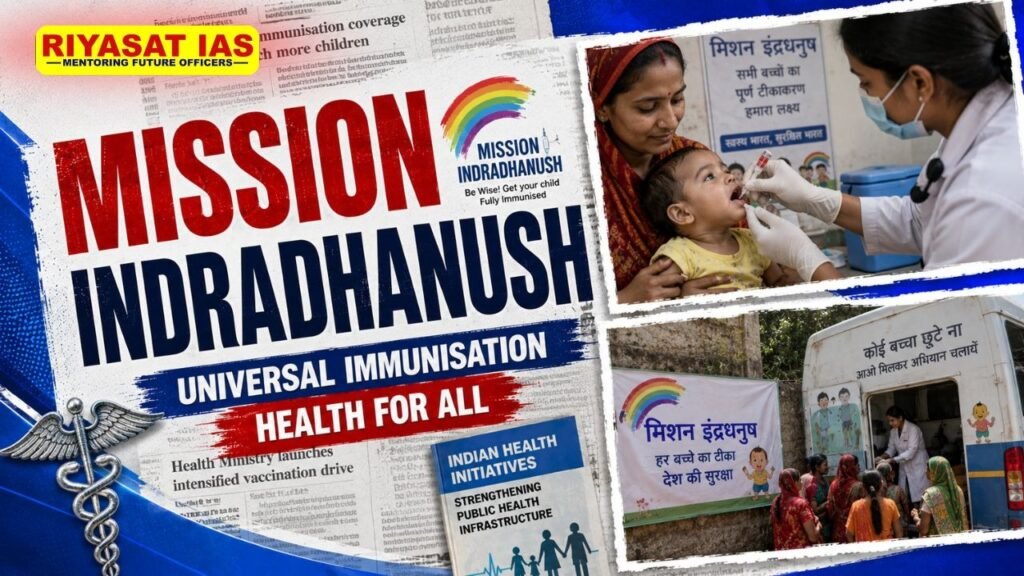
Mission Indradhanush (MI) was launched by the Government of India in December 2014 to improve full immunisation coverage by reaching children who were left out or partially vaccinated under the Universal Immunisation Programme (UIP), especially in areas with low coverage. Its original goal was to achieve more than 90% full immunisation coverage and sustain it through routine immunisation.
The programme follows a targeted catch-up approach rather than replacing routine immunisation. It focuses on hard-to-reach areas, urban slums, underserved communities, areas with vaccine-preventable disease outbreaks and pockets where children are repeatedly missed.
Objectives of Mission Indradhanush
- To increase full immunisation coverage to more than 90%.
- To identify and vaccinate left-out and drop-out children.
- To cover pregnant women who have missed essential vaccination.
- To focus on low-coverage and hard-to-reach areas.
- To strengthen routine immunisation through micro-planning, monitoring and community mobilisation.
- To accelerate progress towards Measles-Rubella elimination and other vaccine-preventable disease-control goals.
What is the Universal Immunisation Programme (UIP)?
The Universal Immunisation Programme (UIP) is one of India’s largest public-health programmes. It began as the Expanded Programme on Immunisation in 1978 and was renamed UIP in 1985, when it was expanded beyond urban areas.
Key Points
- It provides vaccines free of cost through the public-health system.
- It targets around 2.6 crore newborns and 3 crore pregnant women annually.
- Around 1.3 crore routine immunisation sessions are planned every year.
- It operates through approximately 30,000 cold-chain points.
- UIP currently protects against 12 vaccine-preventable diseases:
- 11 diseases nationally
- Japanese Encephalitis (JE) in endemic districts.
- It uses fixed-site and outreach sessions, beneficiary tracking, cold-chain systems and community mobilisation.
Universal Immunisation Programme
The Universal Immunisation Programme (UIP) is a flagship public-health initiative of the Ministry of Health and Family Welfare that provides free vaccination to every eligible children and pregnant women against various vaccine-preventable diseases.
· The programme was initially launched as the Expanded Programme on Immunization (EPI) in 1978 and was subsequently expanded and renamed the Universal Immunisation Programme (UIP) in 1985.
· The UIP aims to expand immunisation coverage, improve the quality of vaccination services, maintain an effective cold-chain system up to health facilities, monitor programme performance and strengthen self-sufficiency in vaccine production.
Diseases Covered under UIP
| Disease | Protection through UIP |
| Diphtheria | ✓ |
| Pertussis | ✓ |
| Tetanus | ✓ |
| Polio | ✓ |
| Tuberculosis – severe childhood forms | ✓ |
| Measles | ✓ |
| Rubella | ✓ |
| Hepatitis B | ✓ |
| Rotavirus diarrhoea | ✓ |
| Hib meningitis & pneumonia | ✓ |
| Pneumococcal pneumonia | ✓ |
| Japanese Encephalitis | Selected endemic districts |
Mission Indradhanush → Intensified Mission Indradhanush
Mission Indradhanush 1.0 – 2014: Launched in December 2014, MI focused on children who were unvaccinated or partially vaccinated, particularly in districts and pockets with low immunisation coverage.
Intensified Mission Indradhanush 1.0 (2017): The programme was intensified in 2017 to accelerate progress towards more than 90% full immunisation coverage.



The strategy placed greater emphasis on:
- High-risk and low-coverage districts
- Urban slums
- Head-count surveys
- Completing beneficiary due-lists
- Greater inter-ministerial convergence
- Stronger monitoring and accountability.
IMI 2.0 – 2019–20: It further expanded the catch-up approach to low-coverage districts and underserved areas, with greater focus on identifying missed beneficiaries and strengthening routine immunisation.
IMI 3.0 – 2021: It focused particularly on children and pregnant women who had missed or dropped out of vaccination, including those affected by disruptions caused by the COVID-19 pandemic.
IMI 4.0 – 2022: It focused on improving immunisation coverage among left-out and drop-out beneficiaries, with greater attention to hard-to-reach and underserved populations.
IMI 5.0 – 2023
This marked an important expansion:
- Conducted across all districts of the country.
- Covered children up to 5 years and pregnant women who had missed routine immunisation.
- Special focus on Measles-Rubella elimination.
- For the first time, children aged 2–5 years were specifically covered for missed MR doses.
Vaccine Strategy: Mission Indradhanush does not replace routine immunisation. It acts as a catch-up mechanism to identify beneficiaries who have been missed under UIP.
Major Approaches
- Head-count surveys to identify unvaccinated and partially vaccinated children.
- Preparation of due-lists for beneficiaries.
- Special immunisation sessions in low-coverage areas.
- Outreach vaccination for hard-to-reach populations.
- Community mobilisation through ASHAs, Anganwadi workers and local institutions.
- Strengthening of cold-chain and vaccine logistics.
- Monitoring of coverage and corrective action after every round.
- Greater convergence with ICDS, Panchayati Raj Institutions and other departments.
Achievements
o Large-scale Vaccination: Across the various phases of MI/IMI, 5.46 crore children and 1.32 crore pregnant women had been vaccinated by the completion of the reported 12 phases.
o Improvement in Full Immunisation: NFHS-4 to NFHS-5 shows that full immunisation among children aged 12–23 months increased from 62% to 76.4%. The Government has linked the accelerated improvement in several States/UTs with the implementation of Mission Indradhanush and intensified immunisation efforts.
Current National Coverage
Government data show that national full immunisation coverage remained above 90% during the last four reported years:
| Year | Full Immunisation Coverage |
| 2022–23 | 94.7% |
| 2023–24 | 93.7% |
| 2024–25 | 98.3% |
| 2025–26 | 97.9% |
· Reduction in Zero-Dose Children: The share of zero-dose children declined from 0.11% in 2023 to 0.06% in 2024, according to recent government data.
· Major Public-Health Milestones: India’s immunisation programme has contributed to major public-health milestones, including the elimination of polio in 2014 and the elimination of maternal and neonatal tetanus in 2015.
· Measles-Rubella Campaign: Under the Measles-Rubella elimination efforts associated with IMI 5.0, more than 34.77 crore children were vaccinated, with reported coverage of 97.98%.
· Digitalisation (U-WIN): U-WIN (Universal Immunisation Web-enabled Network) is the digital platform for tracking vaccination under UIP.
Key Features
o Digital registration of children and pregnant women.
o Tracking of due and missed doses.
o Automated SMS reminders.
o QR-based vaccination certificates.
o Digital vaccination records.
o Integration with Ayushman Bharat Digital Mission, POSHAN Tracker and SAFEVAC.
· Current status
o As of 8 February 2026:
o 11.12 crore children registered.
o 3.78 crore pregnant women registered.
o In 2025 alone, 8.01 crore beneficiaries were registered.
o 29.42 crore SMS messages were sent for reminders and related communication.
Challenges
· Zero-Dose and Drop-Out Children: Although the number has declined, some children continue to remain completely unvaccinated or fail to complete the vaccination schedule.
· Hard-to-Reach Populations: Tribal communities, migrants, remote villages, urban slums and nomadic populations can be difficult to identify and reach consistently.
· Migration: Frequent movement between States can disrupt vaccination schedules and make beneficiary tracking difficult.
· Vaccine Hesitancy: Misinformation, rumours and fear regarding vaccines can contribute to delayed or missed vaccination.
· Cold-Chain and Logistics: Maintaining appropriate temperature, storage, transportation and timely vaccine supply remains essential, particularly in remote areas.
· Human-Resource Constraints: Frontline workers already handle multiple programmes, which can affect micro-planning, mobilisation and follow-up.
· Regional Disparities: National averages can conceal district-level and State-level variations in immunisation coverage.
· Data Quality: Digital systems improve tracking, but accurate beneficiary registration and timely updating remain essential for identifying genuinely missed children.
Way Forward
· Focus on Zero-Dose Children: Use U-WIN and frontline-worker data to create real-time lists of children who have never received a vaccine.
· Strengthen Last-Mile Delivery: Special outreach sessions should continue in tribal, remote, migrant and urban-slum populations.
· Improve Vaccine Confidence: Use local-language communication, community leaders, ASHAs and trusted healthcare professionals to address misinformation.
· Strengthen Routine Immunisation: Mission Indradhanush should remain a catch-up mechanism, while the long-term objective should be to ensure that routine immunisation itself reaches every eligible beneficiary.
· Improve Digital Tracking: Expand U-WIN integration with other public-health databases while maintaining privacy, data accuracy and offline alternatives.
· Strengthen Cold Chain: Invest in solar-powered cold-chain systems, better logistics and real-time temperature monitoring in difficult geographical areas.
· District-Level Targeting: Instead of relying only on national averages, identify low-performing districts and pockets and prepare micro-level action plans.
· Convergence: Strengthen coordination among Health, Women & Child Development, Education, Panchayati Raj Institutions and tribal-development agencies.
Conclusion
Mission Indradhanush has strengthened India’s immunisation system by focusing on children and pregnant women missed by routine services. Its expansion through IMI 5.0 and U-WIN has improved coverage. The next priority is to identify zero-dose children, strengthen routine immunisation, build community trust and ensure every child receives all due vaccines on time.
FAQs
1. What is Mission Indradhanush?
Ans: It is a catch-up immunisation programme launched in December 2014 to vaccinate children and pregnant women who were left out or partially covered under UIP.
2. What is the difference between UIP and Mission Indradhanush?
Ans: UIP provides routine immunisation, while Mission Indradhanush specifically targets left-out and drop-out beneficiaries.
3. What was the main objective of IMI 5.0?
Ans: To vaccinate missed children and pregnant women across all districts, with special emphasis on Measles-Rubella elimination.
4. What has been the improvement in full immunisation coverage?
Ans: Full immunisation among children aged 12–23 months increased from 62% in NFHS-4 to 76.4% in NFHS-5.
5. What is U-WIN?
Ans: U-WIN is a digital platform for registering, tracking and recording vaccinations under UIP, with reminders and digital certificates.


 Ravi Raaz
 Hassan Khan
 Shadab Ali