
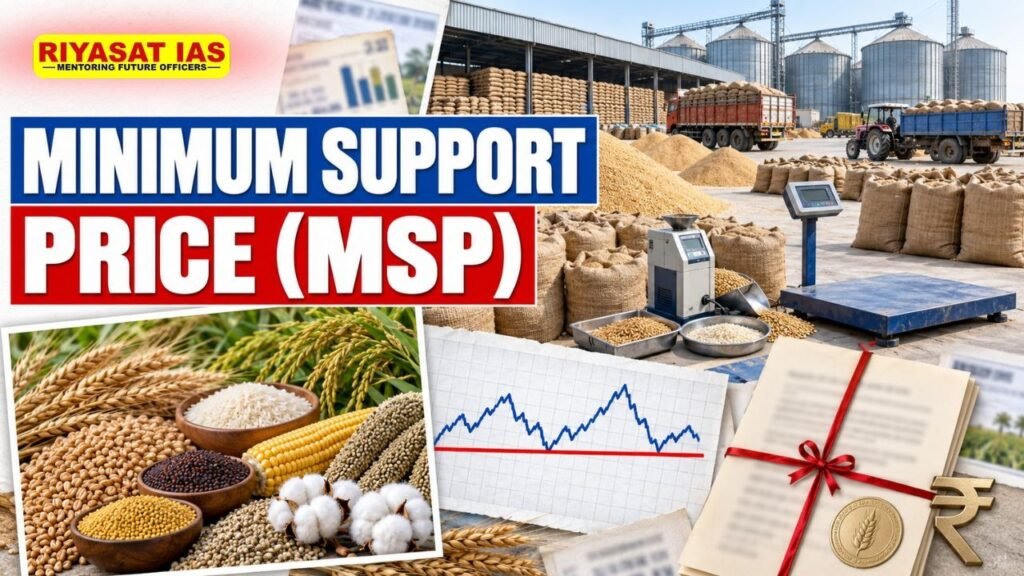
Minimum Support Price (MSP) is a government-announced price that seeks to provide price assurance to farmers in the event of a severe fall in agricultural prices. It acts as a price assurance benchmark and a procurement reference for government agencies for specific crops.
The recommended MSP rates are worked out by the Commission for Agricultural Costs and Prices (CACP) and announced by the Government of India prior to the relevant cropping season.
Background of MSP
The MSP concept evolved as part of the Green Revolution initiatives to provide some price security to farmers and increase foodgrain production. Over time, MSP recommendations were extended to encompass a variety of agricultural commodities.
The broad goal is to limit the price risks that farmers face due to extreme price volatility.
Why is MSP important for farmers?
- Price Assurance: MSP offers some price security to farmers when market prices fall significantly.
- Helps decision-making for crop cultivation: As MSP rates are announced in advance, farmers can take into account the likely profitability of specific crops before making decisions on cultivation based on factors such as soil type, farm size and irrigation potential.
- Encourages production: Higher support prices can entice farmers to plant crops that are crucial for food security and meeting demand for specific agricultural goods.
- Market benchmark: MSP rates act as a vital pricing benchmark, with actual market prices for many crops potentially hovering around the announced support price.
- Farm income and purchasing power security: By limiting the risk of extremely low prices, MSP protects farmers from severe income losses and helps maintain their purchasing power, especially in the context of weak demand.
Committees and MSP Reforms
Agricultural Prices Commission
The Agricultural Prices Commission (APC) was set up in 1965 to advise the government on agricultural prices. The commission was re-christened as the Commission for Agricultural Costs and Prices (CACP).
National Commission on Farmers
The National Commission on Farmers (NCF) was established in 2004 under the chairmanship of renowned agricultural scientist M.S. Swaminathan. It recommended that MSP should incorporate a minimum 50% margin over the comprehensive cost of production.



Shanta Kumar Committee
The Shanta Kumar Committee was constituted in 2014 to review the functioning of the Food Corporation of India (FCI). It recommended that greater focus should be placed on providing income support rather than a predominant reliance on price support.
Major Issues Associated with MSP
- Lack of uniformity: Not all farmers and crops benefit from MSP, as overall procurement levels are concentrated in specific crops.
- Surpluses: Large-scale procurement of certain foodgrains can lead to considerable food grain stocks and associated carrying costs.
- Market distortion: The concentration of procurement activity can have a bearing on farmers’ production choices with regard to crops and potentially lead to market distortions.
- Fiscal implications: Procurement, storage and distribution costs can be considerable, particularly when the level of procurement exceeds demand, resulting in budgetary implications.
- Export competitiveness: The impact of MSP on the competitiveness of certain agricultural products in export markets can be negative.
- Environmental concerns: The focus on water-intensive foodgrains can have implications for groundwater levels, over-irrigation and soil health in vulnerable areas.
- Lack of diversification: The heavy emphasis on certain crops can lead to continued cultivation practices, with farmers being reluctant to cultivate other crops varieties that might be more suitable for local conditions, including millets, pulses and oilseeds.
Alternatives and Reforms to MSP
- Diversification of farm-income sources: Farmers should supplement MSP-linked procurement by exploring horticulture crops, animal husbandry, fisheries and other avenues.
- Enhance market intervention: The Market Intervention Scheme (MIS) is a viable option for farmers cultivating specific perishable commodities, where prices tend to fall considerably.
- Price deficiency payment: Introduce a mechanism such as the Price Deficiency Payment (PDP) that would see farmers compensated for the deficiency in prices for certain crops, with conditions subject to the design of the program.
- Leverage income support: Income support measures (e.g. PM-KISAN) can supplement price support measures to ensure additional income to farmers.
- Diversify public procurement: The government can look to procure more than staples such as rice and wheat in line with the government’s goal of diversification of the cropping pattern, supporting nutritional security and water conservation.
Way Ahead
A lasting agricultural support system should be mindful of the need to balance farm incomes, promote consumer interests, fiscal responsibility, market imperatives and environmental sustainability.
The focus should be on:
- Enhancing farmers’ access to remunerative markets
- Diversifying procurement in line with food-security, diversification and nutritional imperatives
- Encouraging the cultivation of non-staple cereals in addition to pulses, oilseeds and coarse cereals, wherever appropriate
- Complementing price support with direct support to farm incomes
- Enhancing storage, processing and marketing infrastructure
- Promoting crops on the basis of water availability and agro-climatic suitability
- Limiting the over-reliance on procurement of specific crops
Conclusion
MSP continues to play an important role in providing price assurance and helping protect farmers from dramatic price drops. While announced MSP rates are important, the practical impact depends to a large extent on the actual level of procurement as well as farmers’ access to viable markets.
A combination of price and income support, market reforms, diversification in procurement and crop production, and efficient resource use can offer enhanced farm income security while reducing economic and environmental implications of large-scale procurement of specific crops.
FAQs on Minimum Support Price
What is Minimum Support Price (MSP)?
Minimum Support Price (MSP) is a government-announced price that seeks to provide price insurance to farmers in the case of a significant drop in agricultural prices.
Who recommends MSP in India?
The recommended MSP rates are worked out by the Commission for Agricultural Costs and Prices (CACP) and announced by the Government of India prior to the relevant cropping season.
When was MSP introduced?
The MSP concept evolved as part of the Green Revolution initiatives to provide price security to farmers and boost foodgrain production. The Agricultural Prices Commission was set up in 1965.
What is the main purpose of MSP?
The main purpose of MSP is to provide price assurance and reduce price risk to farmers.
What are the major problems associated with MSP?
Major problems associated with MSP include uneven procurement, surpluses, fiscal implications, market distortions, lack of crop diversification, and environmental concerns.
What did the National Commission on Farmers recommend regarding MSP?
The National Commission on Farmers recommended that a minimum 50% margin over the comprehensive cost of production be incorporated in the design of MSP.
What did the Shanta Kumar Committee recommend?
It recommended greater emphasis on providing income support as well as reforms in regard to food procurement and distribution.
What is Price Deficiency Payment?
Under a Price Deficiency Payment scheme, farmers would be able to receive compensation in the event of market prices falling below a predetermined benchmark price, subject to the conditions of the scheme.
How does MSP affect crop diversification?
The focus on specific crops with regard to price support and procurement encourages farmers to continue cultivating them, thereby limiting diversification into other crops.
What is the way forward for MSP?
The way ahead for MSP would involve a combination of price support and income support, stronger markets, crop diversification, and judicious use of resources to enhance farm income security.



 Ravi Raaz
 Hassan Khan
 Shadab Ali