
About
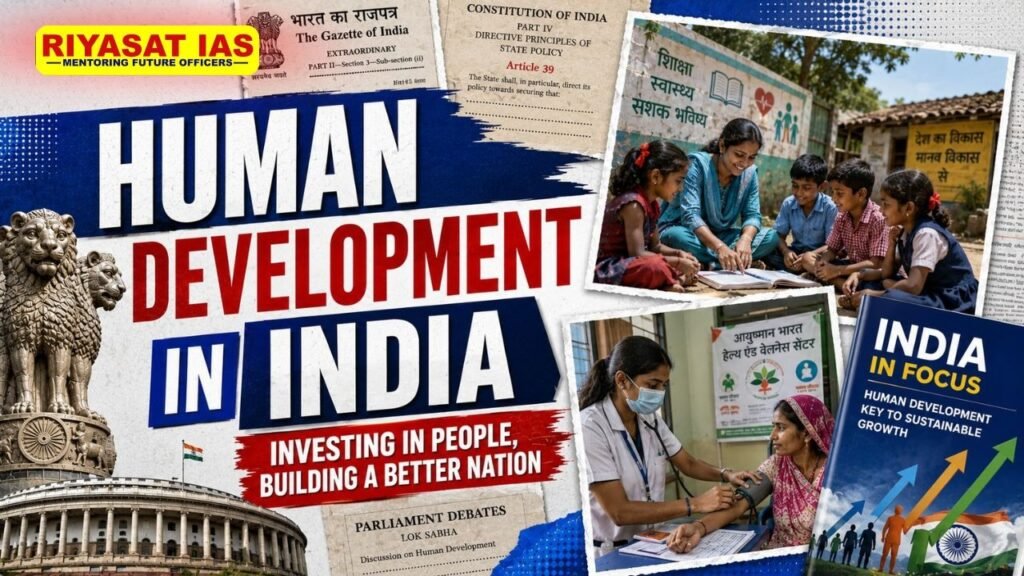
Human development is a broader measure of progress that looks beyond economic growth and focuses on whether people are able to live long and healthy lives, acquire knowledge and enjoy a decent standard of living. The concept, associated with the work of Amartya Sen and Mahbub ul Haq, places people and their capabilities at the centre of development.
The Human Development Index (HDI) developed by UNDP measures these dimensions through health, education and income. For India, the recent trend shows improvement, but regional, gender and socio-economic inequalities continue to affect the quality of human development.
Current Status of Human Development in India
India’s HDI has improved over time, although the country remains in the medium human development category. According to the UNDP Human Development Report 2025, India’s HDI value increased from 0.676 in 2022 to 0.685 in 2023, placing India at 130th position among 193 countries.
· Life Expectancy: India’s life expectancy at birth reached 72.0 years in 2023, showing a significant recovery from the pandemic period.
· Education: India’s expected years of schooling stood at 13.0 years, while mean years of schooling were 6.9 years in 2023.
· Income: India’s GNI per capita was about US$9,047 in 2023, reflecting the income dimension used in HDI.
· Long-Term Progress: India’s HDI increased from 0.446 in 1990 to 0.685 in 2023, indicating considerable improvement in health, education and income over the long term.
Major Dimensions of Human Development
Health
Health is a basic component of human capability because poor health directly affects education, productivity and quality of life. India has made progress in life expectancy and maternal and child health, but malnutrition, anaemia, unequal healthcare access and the growing burden of non-communicable diseases remain major concerns.
· India’s life expectancy reached 72 years in 2023, according to the latest UNDP HDI data.
· NFHS-5 reported that 35.5% of children below five years were stunted, 19.3% were wasted and 32.1% were underweight, showing that nutritional deprivation remains an important human-development challenge.
· Anaemia also remains widespread, particularly among women and children, affecting learning, productivity and overall well-being.
Education
Education expands people’s capabilities by improving their knowledge, skills and employment opportunities. India has improved access to schooling, but learning outcomes, school dropouts, regional disparities and unequal access to quality higher education remain concerns.
· The expected years of schooling were 13.0 years in 2023, while the average person aged 25 years and above had 6.9 years of schooling.
· The gap between expected and mean years of schooling indicates that access to education has expanded faster than the accumulation of educational attainment.
· The challenge is therefore shifting from merely bringing children into schools towards ensuring foundational learning, retention and quality education.
Standard of Living
Income is an important component of HDI because it determines people’s ability to access food, housing, healthcare, education and other necessities. However, income alone does not capture the full extent of deprivation.



· India’s GNI per capita reached around US$9,047 in 2023 in the HDI framework.
· NITI Aayog estimates that India’s multidimensional poverty declined from 29.17% in 2013–14 to 11.28% in 2022–23, with around 24.82 crore people moving out of multidimensional poverty during this period.
· NFHS-5 also indicates improvement in basic living conditions, with 95.4% of households living in pucca or semi-pucca houses and 41% having at least one member covered by a health insurance or health scheme.
Major Challenges to Human Development in India
· Regional Inequality: Human-development outcomes differ significantly between States and also between rural and urban areas. Better-performing regions generally have stronger healthcare, education and employment opportunities.
· Social Inequality: Caste, gender, tribal status and economic position continue to influence access to quality education, healthcare, employment and assets.
· Gender Inequality: Women continue to face disadvantages in labour-force participation, wages, property ownership, education and access to decision-making.
· Malnutrition and Anaemia: Despite improvement in several indicators, high levels of child malnutrition and anaemia continue to affect India’s human-capital formation.
· Quality of Education: Increasing enrolment does not automatically result in better learning. Foundational literacy, numeracy, teacher quality and learning outcomes remain important concerns.
· Healthcare Inequality: Rural and tribal populations often have weaker access to specialists, diagnostics, medicines and quality hospitals.
· Unemployment and Informal Employment: A large informal workforce faces low wages, limited social security and uncertain employment, which restricts improvements in living standards.
· Digital Divide: Digitalisation can improve access to education, healthcare and government services, but unequal access to devices, internet connectivity and digital skills can create a new form of exclusion.
Government Efforts to Improve Human Development
National Education Policy, 2020
o NEP 2020 seeks to improve the quality, accessibility, affordability and equity of education.
o It introduces the 5+3+3+4 structure, emphasises foundational literacy and numeracy, promotes multidisciplinary education and gives greater importance to vocational and skill-based learning.
Ayushman Bharat
o It seeks to improve access to healthcare while reducing the financial burden of medical treatment.
o It combines Ayushman Arogya Mandirs for comprehensive primary healthcare with PM-JAY for hospitalisation cover.
POSHAN 2.0
o The programme addresses malnutrition and nutritional deficiencies among children, pregnant women, lactating mothers and other vulnerable groups.
o It combines supplementary nutrition with growth monitoring, early childhood care, nutrition awareness and convergence with health services.
Skill India Mission
o The mission aims to improve employability, vocational skills and entrepreneurship among India’s youth.
o It supports skill training, upskilling and reskilling through different programmes and institutions.
MGNREGA
o MGNREGA provides livelihood security to rural households while creating productive community assets.
o It provides a legal guarantee of up to 100 days of wage employment to rural households willing to undertake unskilled manual work.
National Multidimensional Poverty Reduction
Government interventions in housing, sanitation, electricity, drinking water, financial inclusion, cooking fuel and healthcare have contributed to the reduction of multidimensional deprivation. NITI Aayog’s analysis estimates that 24.82 crore people moved out of multidimensional poverty between 2013–14 and 2022–23.
Way Forward
· Move from Access to Outcomes: Development programmes should focus not only on the number of schools, hospitals or beneficiaries but on actual outcomes such as learning levels, health outcomes, nutrition and income security.
· Strengthen Human Capital: Greater investment is needed in early childhood development, nutrition, quality education, healthcare and skill development, since these areas determine long-term productivity.
· Reduce Regional Gaps: Aspirational districts, tribal areas and other backward regions require targeted investment and decentralised planning rather than a uniform approach.
· Promote Women’s Capabilities: Greater focus on girls’ education, women’s employment, financial inclusion, reproductive healthcare and political participation can improve human development across generations.
· Improve Public Services: Quality public education, healthcare, sanitation and social protection should be strengthened so that economic status does not determine access to basic capabilities.
· Create Productive Employment: Human development gains become sustainable when people can convert education and skills into decent and productive employment.
· Use Technology Carefully: Digital platforms can improve service delivery, but the government must address the digital divide and privacy concerns so that technology does not create new inequalities.
· Strengthen Local Participation: Panchayats, municipalities, self-help groups and communities should have a greater role in identifying local needs and monitoring welfare programmes.
Conclusion
India’s human-development journey has moved forward considerably, as reflected in improvements in HDI, life expectancy, education and multidimensional poverty. However, the next stage of development will depend less on aggregate economic growth and more on how equally the benefits of growth reach different sections and regions.
The focus should therefore be on building healthy, educated, skilled and economically secure citizens, because human development ultimately determines the quality and sustainability of economic development.
FAQs
1. What is human development?
Ans: Human development is a people-centred approach that focuses on expanding people’s capabilities, choices and opportunities, particularly in health, education and standard of living.
2. What is India’s current position in the Human Development Index (HDI)?
Ans: According to the UNDP Human Development Report 2025, India ranked 130th among 193 countries, with an HDI value of 0.685 in 2023.
3. What are the major challenges to human development in India?
Ans: Major challenges include regional and social inequalities, malnutrition, anaemia, gaps in learning outcomes, healthcare disparities, informal employment and the digital divide.
4. Which government initiatives contribute to human development in India?
Ans: Major initiatives include NEP 2020, Ayushman Bharat, POSHAN 2.0, Skill India, MGNREGA and programmes aimed at reducing multidimensional poverty.
5. What should be the focus of India’s future human-development strategy?
Ans: India should focus on quality education, accessible healthcare, nutrition, productive employment, women’s empowerment and reduction of regional inequalities, with greater emphasis on measurable outcomes rather than merely increasing expenditure or coverage.


 Ravi Raaz
 Hassan Khan
 Shadab Ali