
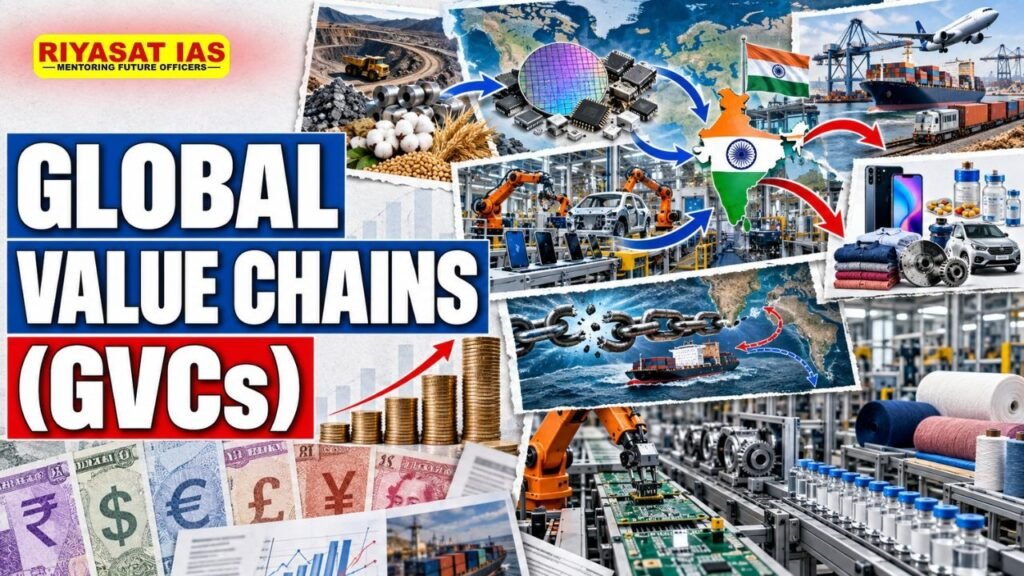
Global Value Chains (GVCs) are production networks where various stages in the production of a good or service such as designing, manufacturing, processing, marketing, transporting and distributing are located in different nations. At least two stages of production must be situated in different countries.
For instance, smartphones are designed in one country, have software designed in another country, have hardware produced in another location, and assembled in yet another country. Therefore, GVCs enable countries to specialise in the production stages in which they have an advantage.
According to the source, approximately 70 percent of world trade is performed through GVCs.
Participation of Countries in GVCs
A country participates in GVCs through backward and forward linkages.
1. Backward Linkages
Backward linkages are situations in which a nation imports a certain material from another nation and then uses it to produce a different item. For instance, India imports fabric from Italy and uses it to produce garments before exporting them.
2. Forward Linkages
Forward linkages are occurrences where a nation exports a material to another country for the purpose of manufacturing. For instance, India exports auto components to Germany which uses them to produce automobiles.
Importance of GVCs
1. Increase in Productivity
With access to higher quality, technology, knowledge, and specialization, productivity is likely to rise.
2. Rise in Income
According to the source, India’s World Bank estimates that a one percentage point rise in participation in GVCs is likely to increase per capita income by over one percent, compared to traditional trade. Additionally, India’s income from GVCs is projected to be twice as high as that of traditional trade.
3. Creation of Employment
Through industrialisation, structural transformation, and business linkages, GVCs open up employment opportunities. For instance, India’s export-led garment industry is a significant employer of labor.
4. Higher Female Labour Participation
Since GVCs open up employment opportunities in labor-intensive industries such as garments, electronics, and footwear, there is likely to be a rise in female labour participation.
5. Specialization
Since GVCs enable countries to specialise in specific stages of production, countries are able to participate in global production without having to produce entire products. For instance, Vietnam’s participation in GVCs enables it to specialise in textile production.
India’s Participation in GVCs
India’s participation in GVCs is low in comparison to many other trade-oriented countries. According to the source, GVC-related trade accounts for 40.3 percent of India’s gross trade.



The reorganisation of supply chains that is taking place worldwide after COVID-19 presents India with an opportunity to attract investment and strengthen its position in international production networks.
India’s GVC Export Profile
1. Few Networked Products
Despite electronics, computers, telecommunication equipment and vehicles being critical GVC products, they only account for roughly 10 percent of India’s total merchandise exports, according to the source.
2. Key Sectors
India’s GVC participation takes place in coal and petroleum, business services, chemicals, and transport equipment.
3. Strong Export of Raw Materials and Intermediate Goods
India has strong forward linkages as a result of its exports of raw materials and intermediate inputs, giving it an opportunity to participate in downstream and high value-added activities.
Reasons for India’s Low Participation in GVCs
1. Inadequate Infrastructure
GVCs require extensive infrastructure to ensure smooth and timely delivery of products. Inadequate infrastructure raises production and transportation costs while also presenting challenges to meeting delivery deadlines.
2. Taxation and Policy-related Problems
GVCs require stable policies to ensure sustainability and attract investment. Fluctuating tariffs and policies present challenges to participation. According to the source, India’s tariffs, for instance, rose from 13 percent in 2014 to 18.1 percent in 2022, making it challenging to compete with other countries such as Vietnam, Thailand, and Mexico.
3. Lack of Appropriate Standards
International buyers set stringent standards and specifications for products. Therefore, failure to adhere to these requirements impacts trade negatively.
4. Few Labor-intensive Manufacturing Activities
Although India has a large labor force with low skills, it has invested less in labor-intensive manufacturing activities. Instead, it has focused on capital- and skill-intensive activities. This limits the extent to which India can benefit from GVCs since the utilization of its vast labor force is limited.
5. Limited Information on International Buyers, Partners, and Trade Finance
Many small and medium-sized enterprises (SMEs) lack the information and skills required to navigate the complex international business market, including details on documentation, trade finance, and international buyers and partners.
6. Domestic Policy-related Issues
Regulations such as those related to taxes, labor and trade, among others, increase the operating costs of many businesses and consequently hinder their ability to fully participate in GVCs.
Steps Taken by India to Promote Participation in GVCs
1. Foreign Trade Policy 2023
This policy promotes process re-engineering, automation, and trade facilitation to promote exports.
2. Production-Linked Incentive (PLI) Scheme
Through this scheme, the government promotes local manufacturing, particularly of electronics. The scheme encourages multinational corporations to locate manufacturing activities in India.
3. One District One Product – Districts as Export Hubs
This initiative focuses on identifying products with high export potential at the district level and positioning them as potential products in the global market.
4. Make in India
This campaign focuses on positioning India as a global manufacturing and design hub. According to the source, India’s manufacturing gross domestic product (GDP) rose by 57 percent between 2014 and 2022, with foreign direct investment (FDI) equity inflows rising by 57 percent.
Future of GVCs in India
1. Improvement of the Overall Business Environment
A stable and attractive investment climate is critical to enhancing domestic and foreign direct investment, which is needed to boost participation in GVCs.
2. Trade Facilitation
Trade-friendly policies such as stable tariffs and fast border and customs inspections facilitate trade and reduce trade costs.
3. Enhancement of Standards
There is a need for India to invest in meeting international standards so that its products can meet international quality and technical specifications.
4. Policy-related Changes
For businesses to fully participate in GVCs, there is a need for stable tax policies and other regulations.
5. Moving Up the Value Addition Ladder
India needs to participate in higher value-added activities such as design, research, prototyping, and maintenance to increase its competitiveness.
6. Emphasis on Labor-intensive Activities
There is a need for India to focus on labor-intensive activities so that it can utilize its vast labor force and generate employment.
Conclusion
GVCs enable countries to specialise in specific stages of production, thereby increasing productivity, employment, technology, investment, and exports. For India, increased participation in GVCs will enable it to enhance manufacturing and diversify exports. However, for India to fully benefit from GVCs, it will be important to enhance infrastructure, skills, adherence to global quality standards, ease of doing business, trade finance, and stable policies. In this way, Indian firms will be able to move from simply supplying inputs to participating in higher-level value addition activities.
FAQs on Global Value Chains
What are Global Value Chains?
GVCs are production networks where various stages in the production of a good or service such as designing, manufacturing, processing, marketing, transporting and distributing are located in different nations.
What are backward linkages?
Backward linkages are situations in which a nation imports a certain material from another nation and then uses it to produce a different item.
What are forward linkages?
Forward linkages are occurrences where a nation exports a material to another country for the purpose of manufacturing.
Why are GVCs important?
GVCs can increase productivity, employment, investment, technology, specialization, and exports.
What is India’s GVC participation?
According to the source, GVC-related trade accounts for 40.3 percent of India’s gross trade.
What are India’s major GVC sectors?
The source identifies coal and petroleum, business services, chemicals, and transport equipment as major areas of India’s GVC participation.




 Ravi Raaz
 Hassan Khan
 Shadab Ali