
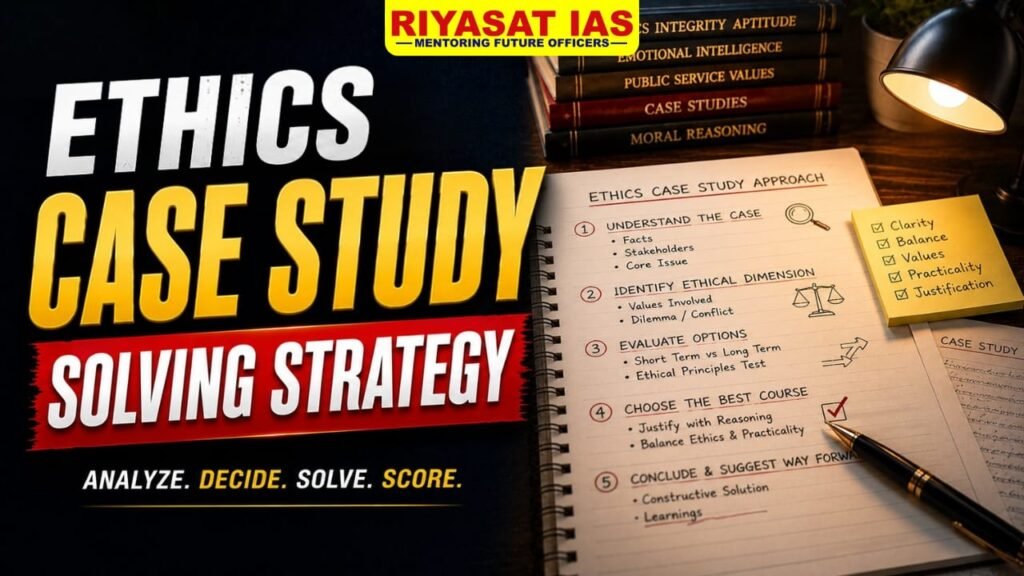
Ethics case studies in UPSC GS Paper 4 are not tests of moral character — they are tests of structured ethical reasoning. An aspirant who responds to a case study with a correct moral conclusion but no reasoning process will score 5–7 marks. An aspirant who demonstrates the same conclusion through an explicit, multi-framework, stakeholder-aware reasoning process will score 9–12 marks. The content of the conclusion barely differs; the process of reaching it determines nearly the entire mark difference.
Follow this five-step strategy to solve UPSC Ethics case studies within 10 minutes. It helps you present clear, structured reasoning that GS Paper 4 consistently rewards.
Step 1: Read the Case Twice — Once for Situation, Once for Tension (60 seconds)
Most aspirants read the case once, identify an obvious ‘wrong’ and an obvious ‘right’, and begin writing. This produces answers that address the surface dilemma but miss the deeper ethical structure the case is designed to test.
First read: understand the situation. Who is the officer? What is the factual context? What action is being requested or has occurred?
Read the case study a second time to identify the ethical tension. Don’t ask, “What is wrong here?” Instead, ask, “Which two legitimate values or obligations are in conflict?” Most UPSC Ethics case studies revolve around a genuine clash between two morally valid principles.
| Common Tension Type | Example from Case Structure | The Ethical Challenge |
| Duty vs Loyalty | An officer discovers a colleague’s financial irregularity | Institutional duty to report conflicts with personal loyalty to a colleague |
| Rule vs Compassion | An official must deny a legitimate but exceptional benefit | Procedural correctness conflicts with empathetic response to genuine hardship |
| Short-term harm vs Long-term good | A policy will displace communities but serves national interest | Immediate suffering of identifiable people conflicts with diffuse long-term benefit |
| Transparency vs Confidentiality | Disclosure of government information serves public interest but violates official secrecy | Two legitimate principles — public right to know vs institutional confidentiality — in direct conflict |
| Individual rights vs Collective welfare | An officer must enforce a regulation that harms a minority for majority benefit | Constitutional rights of individuals conflict with aggregate social good |
Naming the tension precisely in the case study’s first sentence signals to the evaluator that the answer will be reasoning, not assertion.
Step 2: Map Stakeholders in Three Layers (60 seconds)
Stakeholder analysis is the most frequently incomplete step in case study answers. Aspirants identify the immediate parties — officer and petitioner — and miss the systemic stakeholders that give the analysis its ethical depth.
- Layer 1 — Immediate stakeholders: The officer in the dilemma; the primary affected person(s); immediate supervisors or institutional authorities
- Consider the institution’s reputation and integrity, protect the public interest the institution serves, and evaluate how your decision will influence future officers who face similar ethical dilemmas by setting a strong precedent.
- Layer 3 — Constitutional and societal stakeholders: The constitutional values at stake (Article 14, 21, DPSPs); the social trust that makes public administration legitimate; vulnerable communities disproportionately affected by the decision



A case study answer that identifies all three layers of stakeholders consistently scores higher than one that identifies only Layer 1 — because it demonstrates an administrative mindset, not merely a personal moral response.
| Want weekly feedback on whether your case study stakeholder analysis is complete? → Explore Ethics Mentorship at Riyasat IAS |
Step 3: Apply Two Frameworks to the Tension (2 minutes)
Apply two ethical frameworks to the specific tension identified in Step 1 — not to the case in general, but to the specific competing obligations. Show what each framework recommends and note whether they converge on the same action or point in different directions.
| Tension Type | Framework 1 (and what it recommends) | Framework 2 (and what it recommends) | When They Converge / Diverge |
| Duty vs Loyalty | Kantian Deontology: The duty to report corruption is universalisable — if all officers concealed colleagues’ misconduct, institutional integrity would collapse. Kant mandates reporting. | Virtue Ethics (Aristotle): The virtues of justice and courage of conviction require acting on what is right despite personal cost. Both virtues support reporting. | Convergence — both frameworks support reporting; the answer’s conclusion is strengthened by multi-framework support |
| Rule vs Compassion | Utilitarianism (Mill): Calculate aggregate impact — denying one exception sets a procedural precedent that protects the many; granting it creates perverse incentives. | Care Ethics (Gilligan): Relationships and context matter — the particular circumstances of this person’s hardship demand an empathetic response beyond rule application. | Divergence — requires the aspirant to weigh the frameworks and choose the more applicable one, explaining why |
When frameworks diverge, the answer does not need to ‘solve’ the philosophical disagreement — it needs to explain which framework is more applicable to this specific administrative context and why.
Step 4: State the Course of Action with Principled Justification (3 minutes)
The course of action section is where most case study answers fail to distinguish themselves. The common approach: ‘I would do X.’ The competitive approach: ‘I would do X because the principle of Y, applied to this specific situation, produces Z as the justified action — and this is preferable to the alternative because W.’
Three elements are mandatory in this step:
- The action named clearly and specifically — not ‘take appropriate action’ but ‘report the irregularity to the Vigilance Department under Rule 14 of the Central Civil Services Conduct Rules’
- The primary principle invoked — which ethical framework or constitutional value provides the strongest justification
- The acknowledgment and rejection of the strongest counterargument — ‘While loyalty to a colleague has moral weight, it cannot take precedence over the institutional duty that makes public trust possible’
Step 5: The Systemic Recommendation (60 seconds)
Every case study answer should close with a specific systemic recommendation — the institutional or policy change that would prevent this type of dilemma from recurring. Include this step in every answer—it offers the highest mark gain per word but is the most commonly overlooked.
The systemic recommendation must be specific, not generic. ‘Strengthen accountability mechanisms’ — generic and earns no marks. ‘A mandatory anonymous reporting channel within each department, with protection for whistleblowers under the Whistle Blowers Protection Act 2014, would reduce the personal cost that makes this dilemma recurring’ — specific and earns marks.
Frequently Asked Questions
How do I identify the ethical tension when the case seems to have an obvious right answer?
If the case seems to have an obvious right answer, look for the legitimate moral weight on the ‘wrong’ side of the decision. A bribery case is obviously ‘wrong’ on one side — but the legitimate tension might be between whistleblowing (right thing) and the risk to the officer’s career and family that this imposes (real moral weight). The tension is not always between two equally valid options; sometimes it is between a clear duty and the genuine personal cost of fulfilling it. Name both sides explicitly even when the conclusion is clear.
Is it better to resolve the dilemma decisively or acknowledge ambiguity?
Resolve decisively — but acknowledge the genuine weight of the counterargument before doing so. UPSC case studies reward principled decision-making, not philosophical indecision. An answer that ends without a clear course of action scores poorly regardless of the sophistication of its analysis. The formula: acknowledge the genuine difficulty → weigh the competing considerations → choose decisively → justify the choice with a named principle → acknowledge what the chosen action costs.
How do I practise this strategy to make it automatic in 10 minutes?
Write one timed case study per day using this five-step structure, strictly enforcing the time allocation (60 sec + 60 sec + 2 min + 3 min + 60 sec = 8 minutes of planning and writing). After writing, self-evaluate: which step was rushed? Which was omitted? The omitted step is the preparation gap. After 30–40 timed case studies, the structure becomes automatic and speed increases naturally. Do not try to perfect each step before moving to timed practice — imperfect execution under time pressure is better preparation than perfect execution with unlimited time.
Conclusion
Read the case study twice to identify the situation and ethical tension. Map stakeholders across three layers. Apply two ethical frameworks to the specific conflict. Recommend a clear course of action, justify it with ethical principles, acknowledge the main counterargument, and conclude with a practical systemic recommendation. This structure, practised under timed conditions across 30–40 case studies, becomes automatic before the examination and produces the structured ethical reasoning that distinguishes 10–12 mark case study answers from 5–7 mark ones.
| Riyasat IAS Mentorship — Personal Guidance for UPSC CSE Direct mentorship from Riyasat Ali Sir │ Hindi & English Medium │ 100% Online — Apply Now |


 Ravi Raaz
 Hassan Khan
 Shadab Ali