
6. (a) On the request of his Personal Assistant (PA), the District Magistrate (DM) stops the transfer of a schoolteacher who takes private tuition for his daughter diagnosed with learning disability. In this context, discuss the aspects of empathy versus compliance with rules. (Answer in 150 words)
Introduction
The case presents a conflict between compassion for a child with special needs and the need for impartial administration. The DM should recognise the genuine difficulty faced by the family, but personal empathy should not result in preferential use of official authority.
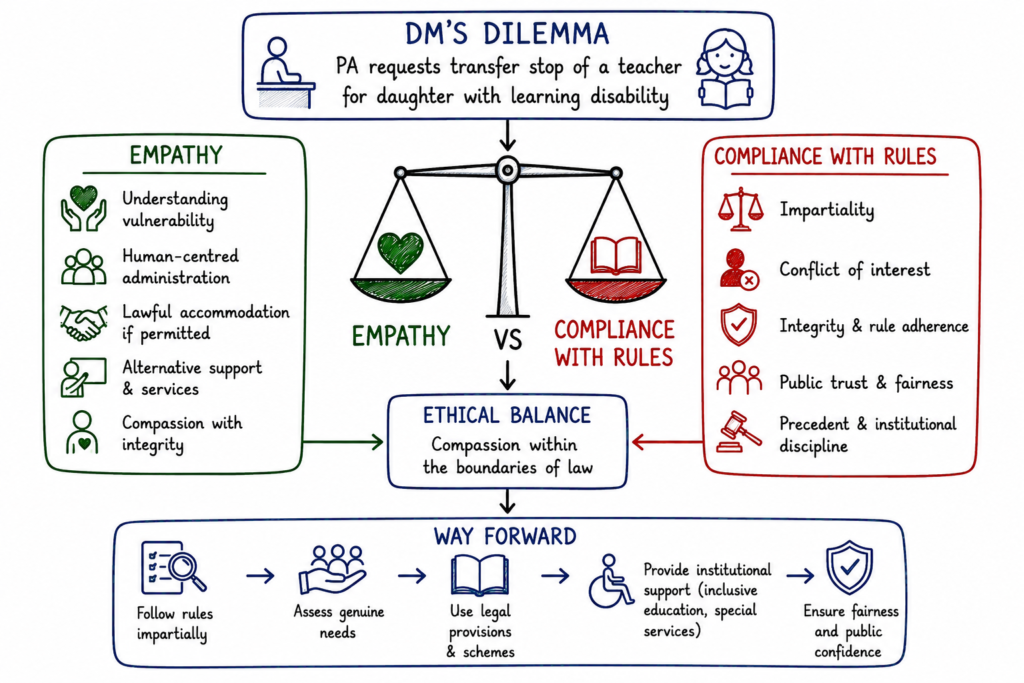
Compliance with Rules
- Impartiality: Stopping a teacher’s transfer merely because of a personal request may create an impression of favouritism.
- Conflict of interest: Using official discretion to solve a private concern of a subordinate can compromise administrative propriety.
- Integrity: If applicable service rules prohibit private tuition, overlooking the violation selectively would weaken rule-based governance.
- Public trust: Other employees may feel that those with personal access to senior officers receive preferential treatment.
- Precedent: One personal exception can encourage similar requests and gradually weaken institutional discipline.



Empathy
- Understanding vulnerability: A child with a learning disability may genuinely require continuity and specialised educational support.
- Human-centred administration: Rules should be enforced without becoming insensitive to genuine human difficulties.
- Lawful accommodation: If rules permit, reasonable flexibility may be considered through proper channels.
- Alternative support: The DM can facilitate access to special educators, inclusive education programmes or counselling services.
- Compassion with integrity: Empathy should lead to a lawful solution rather than an arbitrary exception.
Example: Under inclusive education approaches such as Samagra Shiksha, children with special needs can receive additional educational support. Such institutional mechanisms are preferable to using the DM’s personal authority to retain a particular teacher.
Conclusion
The DM should not bend rules for personal convenience, but neither should he ignore the child’s genuine needs. The ethical approach is “compassion within the boundaries of law”—firmness in principle combined with sensitivity in dealing with people.





 Ravi Raaz
 Hassan Khan
 Shadab Ali