
Introduction
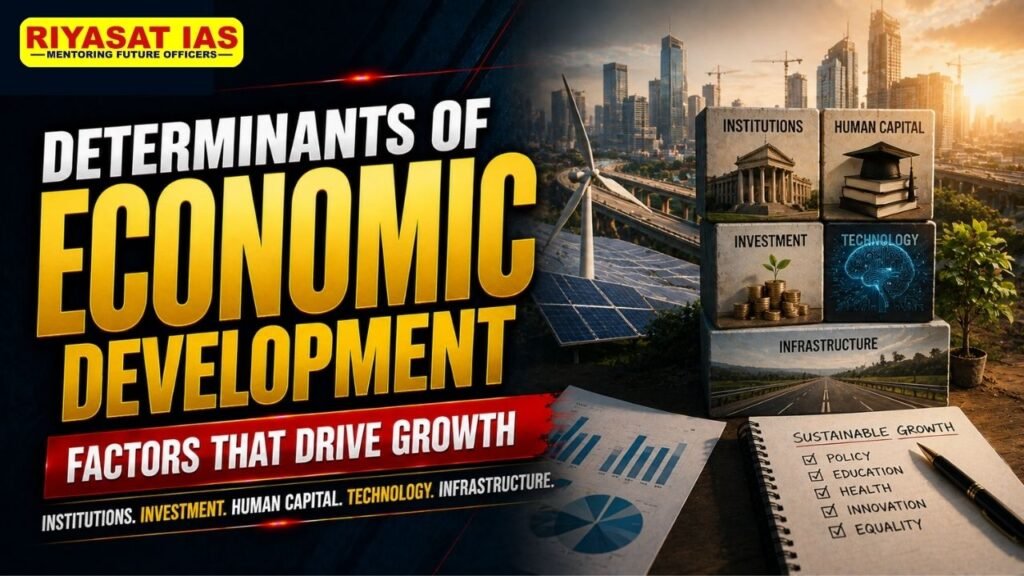
Economic development refers to the long-term improvement in an economy’s productive capacity, income, employment, living standards and overall well-being. It is not determined by economic growth alone but depends on a combination of capital, human resources, technology, infrastructure, natural resources, trade and institutional quality.
For developing economies, understanding these determinants is essential for transforming economic growth into higher productivity, employment generation and inclusive development.
What are the Major Determinants of Economic Development?
The determinants of economic development can broadly be grouped into economic, human, technological and institutional factors.
1. Capital Formation and Investment
Capital Formation: Capital formation involves the accumulation of productive assets such as machinery, equipment, infrastructure and other physical capital.
- Raises Productive Capacity: Investment in productive assets enables an economy to produce more goods and services.
- Improves Productivity: Modern machinery and equipment allow workers to produce more efficiently.
- Creates Employment: Investment in industries, infrastructure and enterprises generates direct and indirect employment.
- Mobilises Savings: Higher domestic savings can provide resources for investment and reduce excessive dependence on external capital.
Thus, sustained investment is essential for expanding an economy’s productive capacity.
2. Human Capital, Education and Health
Human Capital: Human capital refers to the knowledge, skills, health and capabilities embodied in people.
- Improves Productivity: Educated, skilled and healthy workers contribute more effectively to economic production.
- Supports Innovation: Higher levels of education and skills strengthen research, creativity and technological adoption.
- Improves Employability: Quality education and vocational training help workers adapt to changing labour-market requirements.
- Creates Demographic Dividend: A large working-age population becomes an economic advantage only when supported by adequate education, healthcare, skills and employment opportunities.
Therefore, investment in education, healthcare and skill development is a fundamental determinant of development.
3. Technology and Innovation
Technological Progress: Technology enables economies to produce more output using available resources more efficiently.
- Raises Productivity: Better production techniques increase output and reduce resource wastage.
- Reduces Costs: Technological improvements can lower production and transaction costs.
- Promotes Structural Transformation: Technology enables economies to move towards higher-productivity manufacturing and modern services.
- Encourages Innovation: Investment in research and development strengthens domestic technological capabilities.
However, technology produces broad development benefits only when supported by skilled workers, investment and appropriate institutions.
4. Infrastructure and Connectivity
Economic Infrastructure: Transport, electricity, telecommunications, digital networks, ports and logistics provide the foundation for economic activity.
- Reduces Transaction Costs: Efficient infrastructure lowers the cost and time involved in moving goods, people and information.
- Improves Market Access: Connectivity links producers with consumers and integrates regional markets.
- Attracts Investment: Reliable infrastructure improves the business environment and encourages private investment.
- Supports Regional Development: Better connectivity can integrate less-developed regions with major economic centres.



Infrastructure is therefore a critical link between investment, productivity and economic development.
5. Natural Resources and Agricultural Surplus
Natural Resources: Land, water, forests, minerals and energy resources provide essential inputs for agriculture, industry and other economic activities.
- Supports Production: Efficient resource utilisation expands the productive base of an economy.
- Generates Income: Natural resources can create employment, government revenue and export opportunities.
- Requires Sustainable Management: Resource abundance alone does not guarantee development; effective utilisation requires capital, technology and sound institutions.
Agricultural Surplus: A sufficient agricultural surplus is equally important, particularly during industrialisation.
- Supports Urbanisation: Surplus food production is necessary to meet the requirements of a growing non-agricultural population.
- Facilitates Labour Mobility: Higher agricultural productivity can release labour for industry and services.
- Supports Industrialisation: Agricultural income can create demand for manufactured goods and provide raw materials for agro-based industries.
6. Foreign Trade and Market Integration
Foreign Trade: International trade enables countries to access larger markets, technology, capital goods and international investment.
- Expands Markets: Firms can sell beyond the limits of domestic demand.
- Promotes Specialisation: Countries can specialise according to their comparative advantages.
- Provides Technology and Capital Goods: Imports can provide machinery, equipment and technological inputs required for development.
- Generates Foreign Exchange: Exports provide foreign exchange needed to finance essential imports.
However, excessive dependence on a narrow range of commodities can increase vulnerability to global price fluctuations. Export diversification and greater value addition are therefore important.
7. Financial Development and Entrepreneurship
Financial Development: Efficient financial institutions mobilise savings and channel them towards productive investment.
- Provides Credit: Access to affordable finance enables businesses, farmers and entrepreneurs to invest and expand.
- Supports Entrepreneurship: Financial access allows new enterprises to enter markets and generate employment.
- Mobilises Savings: Banks and other financial institutions convert savings into productive investment.
A strong financial system therefore helps connect savings, investment and economic growth.
8. Institutions, Governance and Political Stability
Institutional Quality: Effective institutions provide the rules and systems necessary for economic activity.
- Political Stability: Stable political conditions reduce uncertainty and encourage long-term investment.
- Good Governance: Efficient administration improves the implementation of development policies and delivery of public services.
- Rule of Law: Protection of property rights and enforcement of contracts provide greater certainty to businesses and investors.
- Transparency: Reducing corruption and improving accountability can ensure more efficient use of public resources.
Strong institutions therefore create an environment in which investment, entrepreneurship and innovation can flourish.
9. Women’s Economic Participation and Inclusion
Women’s Economic Participation: Inclusive development requires equal opportunities for women in education, employment and entrepreneurship.
- Expands the Workforce: Greater female labour force participation increases the economy’s productive potential.
- Improves Household Welfare: Women’s economic empowerment can improve household spending on health, nutrition and education.
- Strengthens Human Capital: Greater opportunities for women improve the productive capabilities of future generations.
- Promotes Inclusive Growth: Wider participation ensures that the benefits of development reach a larger section of society.
How do These Determinants Work Together?
Economic development does not depend on any single factor. Different determinants reinforce one another.
For example, natural resources may remain underutilised without capital and technology. Technology may have limited impact without skilled workers. Infrastructure may fail to generate sustained growth without effective institutions and political stability.
Similarly, a large working-age population becomes a demographic dividend only when adequate education, healthcare, skills and employment opportunities are available.
Thus, sustainable economic development requires a combination of physical capital, human capital, technology, infrastructure, markets and strong institutions.
Key Challenges to Economic Development
- Low Investment: Insufficient capital formation can constrain productive capacity and employment generation.
- Human Capital Gaps: Unequal access to quality education, healthcare and skills can reduce labour productivity.
- Technology Divide: Limited access to advanced technology can widen productivity gaps between firms and regions.
- Infrastructure Deficits: Poor connectivity and inadequate energy and logistics infrastructure increase the cost of economic activity.
- Institutional Weaknesses: Corruption, policy uncertainty and weak enforcement can discourage investment.
- Regional Inequality: Uneven distribution of infrastructure, investment and human capital can produce unequal development outcomes.
Way Forward
- Increase Productive Investment: Prioritise infrastructure, manufacturing, logistics and other productivity-enhancing investments.
- Strengthen Human Capital: Improve the quality of education, healthcare and skill development.
- Promote Innovation: Increase investment in research, technology adoption and industry-academia collaboration.
- Improve Infrastructure: Strengthen physical and digital connectivity to reduce transaction costs.
- Deepen Financial Inclusion: Expand affordable credit for MSMEs, farmers and entrepreneurs.
- Strengthen Institutions: Improve transparency, accountability, rule of law and administrative efficiency.
- Promote Women’s Participation: Remove barriers to women’s education, employment and entrepreneurship.
- Diversify Trade: Promote value-added exports and integrate domestic firms into global value chains.
Conclusion
Economic development is a multidimensional process shaped by capital formation, human capital, technology, infrastructure, natural resources, trade, financial development and institutional quality. No single factor can ensure sustained development.
For developing economies, the priority should therefore be to create a virtuous cycle of investment, productivity, innovation and human development. Strong institutions, quality infrastructure, skilled human resources and inclusive economic opportunities can help transform economic growth into sustained improvements in employment, income and living standards.
Frequently Asked Questions (FAQs)
What are the main determinants of economic development?
The major determinants include capital formation, human capital, technology, infrastructure, natural resources, agricultural productivity, foreign trade, financial development and institutional quality.
Why is human capital important for economic development?
Human capital improves labour productivity, employability, innovation and adaptability, making education, healthcare and skills essential for long-term development.
Does natural resource abundance guarantee economic development?
No. Natural resources contribute to development only when supported by capital, technology, skilled labour and effective institutions.
How does technology promote economic development?
Technology increases productivity, reduces production costs, supports innovation and enables economies to move towards higher-productivity activities.
Why are institutions important for development?
Strong institutions provide policy stability, property-right protection, contract enforcement, transparency and accountability, creating a favourable environment for investment and entrepreneurship.
What is the role of foreign trade in economic development?
Foreign trade expands markets, promotes specialisation, provides access to technology and capital goods, and generates foreign exchange through exports.


 Ravi Raaz
 Hassan Khan
 Shadab Ali