
About
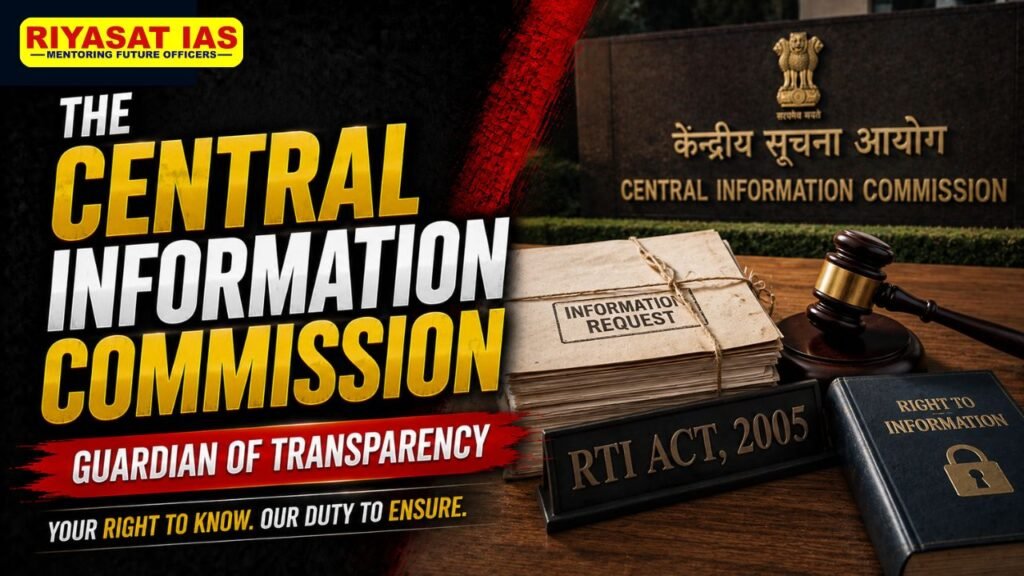
The Central Information Commission (CIC) is a statutory and independent body established to ensure the effective implementation of the Right to Information (RTI) Act, 2005. It hears appeals and complaints relating to access to information held by public authorities under the Central Government and promotes transparency and accountability in public administration.
Background
- The demand for the Right to Information emerged from civil society movements, particularly the Mazdoor Kisan Shakti Sangathan (MKSS) in Rajasthan.
- The Freedom of Information Act, 2002 was enacted but never became operational.
- Parliament enacted the Right to Information Act, 2005, which came into force on 12 October 2005.
- The Central Information Commission was constituted on 12 October 2005.
- The Right to Information (Amendment) Act, 2019 empowered the Central Government to prescribe the tenure, salaries, and service conditions of the Chief Information Commissioner and Information Commissioners.
- It’s Functions as a quasi-judicial body to hear and decide complaints and appeals relating to access to information under the RTI Act.
Statutory Provisions
The Central Information Commission is established under the Right to Information Act, 2005.
| Section | Provision |
| Section 12 | Constitution of the Central Information Commission |
| Section 13 | Term of office and conditions of service |
| Section 18 | Powers and functions regarding complaints |
| Section 19 | Appeals |
| Section 20 | Penalties |
| Section 25 | Annual Report |
Composition of the CIC
- The Central Information Commission consists of the Chief Information Commissioner (CIC) and not more than ten Information Commissioners (ICs).
- The Chief Information Commissioner and Information Commissioners are appointed by the President of India.
- They should be persons of eminence in public life with wide knowledge and experience in law, science and technology, social service, management, journalism, mass media, administration, or governance.
- They shall not be Members of Parliament, Members of a State Legislature, hold any office of profit, be connected with any political party, or engage in any business or profession.
- The Commission functions independently while discharging its statutory responsibilities.



Appointment Committee
The Chief Information Commissioner and Information Commissioners are appointed by the President of India on the recommendation of a committee consisting of:
- Prime Minister – Chairperson
- Leader of the Opposition in the Lok Sabha
- A Union Cabinet Minister nominated by the Prime Minister
Tenure
- The Chief Information Commissioner and Information Commissioners hold office for such term as may be prescribed by the Central Government or until age 65 years, whichever is earlier.
- They are not eligible for reappointment in accordance with the provisions of the Act.
- They may resign by addressing their resignation to the President of India.
Note: Prior to the RTI (Amendment) Act, 2019, the tenure was five years or until attaining the age of 65 years, whichever was earlier.
Conditions for Removal
- The President of India may remove the Chief Information Commissioner or an Information Commissioner on the ground of proved misbehavior or incapacity, after an inquiry conducted by the Supreme Court.
- The President may suspend the concerned Commissioner during the pendency of the Supreme Court inquiry.
- The President may also remove a Commissioner if he is adjudged insolvent.
- A Commissioner may be removed if he engages in paid employment outside the duties of the office.
- Removal is also permitted if the Commissioner is declared to be of unsound mind by a competent court.
- A Commissioner may also be removed if convicted of an offence involving moral turpitude or acquires financial or other interests likely to prejudicially affect official functions.
Functions of the CIC
- Receives and inquires into complaints relating to denial of access to information.
- Examines complaints regarding refusal to accept RTI applications or unreasonable delays in providing information.
- Hears second appeals against the decisions of Central Public Information Officers (CPIOs) and First Appellate Authorities.
- Monitors the implementation of the RTI Act by Central Public Authorities.
- Recommends measures for promoting transparency and improving record management.
- Advises public authorities on effective implementation of the RTI Act.
- Prepares and submits an Annual Report on the implementation of the RTI Act to the Central Government.
- The Central Government lays the report before both Houses of Parliament.
Powers of the CIC
- While conducting an inquiry, the Commission enjoys the powers of a Civil Court.
- It may summon and enforce the attendance of witnesses and examine them on oath.
- It may require the discovery and inspection of documents.
- It may receive evidence on affidavits and requisition public records.
- It may order the disclosure of information where permissible under the RTI Act.
- It may impose penalties on Public Information Officers for violations of the Act.
Penalty Provisions
- The Commission may impose a penalty of ₹250 per day, subject to a maximum of ₹25,000, on the Public Information Officer for unjustified delay or refusal to provide information.
- It may also recommend disciplinary action against the concerned Public Information Officer under the applicable service rules.
Limitations
- It cannot direct the Government to frame or amend policies.
- It cannot compel the creation of information that does not exist.
- It cannot adjudicate contractual disputes or service matters unless related to access to information.
- It cannot inquire into matters outside the scope of the RTI Act.
- Delay in disposal of appeals due to vacancies and backlog affects effectiveness.
FAQs
Q1. Under which Act was the Central Information Commission established?
Ans: The Right to Information Act, 2005.
Q2. Who appoints the Chief Information Commissioner and Information Commissioners?
Ans: The President of India.
Q3. What is the maximum number of Information Commissioners in the CIC?
Ans: Not more than 10.
Q4. Under which Section is the Central Information Commission constituted?
Ans: Section 12 of the RTI Act, 2005.
Q5. What is the maximum penalty that the CIC can impose on a Public Information Officer?
Ans: ₹25,000.


 Ravi Raaz
 Hassan Khan
 Shadab Ali