
Introduction
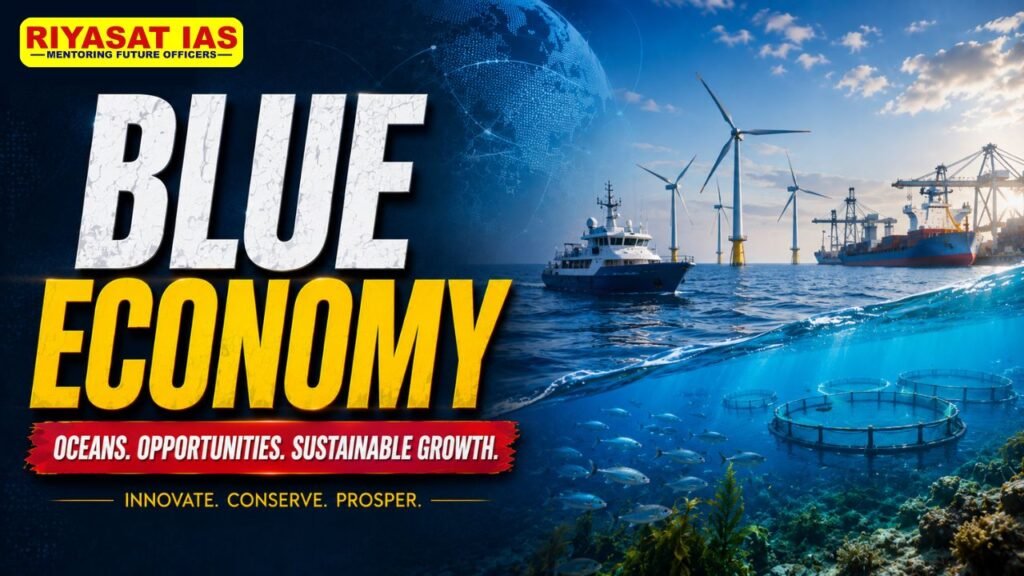
The Blue Economy refers to the sustainable use of ocean and marine resources for economic growth, employment, improved livelihoods, and environmental protection. It covers a wide range of activities, including fisheries, aquaculture, shipping, ports, marine biotechnology, shipbuilding, and other ocean-based industries.
For India, the Blue Economy has strategic importance because of its extensive coastline, large Exclusive Economic Zone (EEZ), maritime infrastructure, and millions of people dependent on coastal and marine resources. It seeks to combine economic development with conservation of ocean ecosystems, making it an important component of sustainable development.
What is the Blue Economy?
The Blue Economy focuses on generating economic value from oceans and coastal areas while ensuring that marine resources remain productive and ecosystems remain healthy.
Unlike an approach based solely on resource extraction, the Blue Economy promotes sustainable fisheries, responsible aquaculture, efficient maritime transport, coastal tourism, marine biotechnology, renewable energy, and ecosystem conservation.
Its broader objective is to ensure that economic activities do not undermine the ecological systems on which future economic opportunities depend.
Why is the Blue Economy Important for India?
India has significant maritime resources and infrastructure that provide a strong foundation for developing a sustainable Blue Economy.
• Extensive Coastline: India has a coastline of around 7,500 km, providing significant opportunities for fisheries, shipping, ports, tourism, and coastal industries.
• Large EEZ: India’s Exclusive Economic Zone extends over 2.2 million sq. km, providing access to substantial marine resources.
• Maritime Infrastructure: India has 12 major ports, more than 200 other ports, and around 30 shipyards, supported by a wide range of maritime service providers.
• Employment and Livelihoods: Fisheries, aquaculture, shipping, ports, tourism, and related activities support millions of livelihoods, particularly in coastal communities.
• Resource Security: Sustainable use of marine resources can contribute to food, energy, mineral, and economic security.
• Environmental Sustainability: The Blue Economy promotes the conservation of marine ecosystems while enabling economic development.
• Global Economic Potential: The global ocean economy is estimated to be worth around USD 1.5 trillion annually, with projections indicating significant expansion in the coming years.
Major Sectors of the Blue Economy
The Blue Economy covers diverse sectors that connect marine resources with economic activity.
• Fisheries: Sustainable fisheries can provide food, employment, and livelihoods while protecting fish stocks.
• Aquaculture and Mariculture: Sustainable farming of fish, shellfish, and seaweed can increase food production and reduce pressure on wild marine resources.
• Shipping and Maritime Transport: Efficient shipping networks support international trade and strengthen India’s position in global supply chains.
• Ports and Logistics: Modern ports and coastal infrastructure can reduce logistics costs and improve trade competitiveness.
• Marine Biotechnology: Marine organisms and resources offer opportunities for pharmaceuticals, biotechnology, food products, and other industries.
• Shipbuilding and Ship Recycling: Modern and environmentally sound shipbuilding and recycling can create employment while improving resource recovery.
• Coastal and Marine Tourism: Sustainable tourism can generate income for coastal communities while promoting conservation.
Blue Economy 2.0
Blue Economy 2.0 focuses on making India’s coastal development more climate-resilient, sustainable, and integrated. It recognises that climate change, pollution, overexploitation, and ecosystem degradation pose increasing risks to marine resources and coastal communities.
Key Components of Blue Economy 2.0
• Coastal Ecosystem Restoration: Restore degraded mangroves, coral reefs, and other coastal ecosystems to strengthen biodiversity and ecosystem resilience.



• Climate Adaptation: Develop measures to address sea-level rise, extreme weather events, coastal erosion, and other climate-related risks.
• Sustainable Aquaculture: Expand coastal aquaculture and mariculture while ensuring that marine ecosystems and wild fish stocks are protected.
• Seaweed Cultivation: Promote sustainable seaweed farming as a source of livelihood, food, industrial inputs, and environmental benefits.
• Integrated Development: Coordinate activities across fisheries, tourism, renewable energy, shipping, conservation, and coastal infrastructure rather than treating them as isolated sectors.
• Stakeholder Participation: Strengthen cooperation among governments, industries, coastal communities, research institutions, and civil society.
Examples of Blue Economy in India
Community-led Seaweed Cultivation in Odisha
Seaweed cultivation can diversify coastal livelihoods and provide supplementary income to coastal households. It can also contribute to ecosystem services by absorbing dissolved carbon dioxide and improving water quality.
Smart Port Transformation in Kochi
The use of digital twin technology can improve port efficiency by enabling better resource management, reducing vessel waiting times, and supporting environmental monitoring.
Green Ship Recycling in Alang
Upgrading ship-recycling facilities to international standards, including the Hong Kong Convention framework, can improve recovery of steel and other materials while ensuring safer handling of hazardous waste.
These examples demonstrate how technology, livelihood generation, resource efficiency, and environmental protection can be integrated within the Blue Economy.
Major Government Initiatives for the Blue Economy
India has introduced several initiatives to develop its maritime sector while promoting sustainable use of marine resources.
• Deep Ocean Mission: Focuses on exploring deep-sea resources, developing technologies for deep-sea exploration, studying marine biodiversity, and developing human submersibles.
• Sagarmala Programme: Aims to modernise ports, improve port connectivity, reduce logistics costs, and promote port-led development and coastal economic activity.
• Blue Economy 2.0: Emphasises coastal ecosystem restoration, climate-resilient coastal development, sustainable aquaculture, mariculture, and seaweed cultivation.
• Pradhan Mantri Matsya Sampada Yojana (PMMSY): Supports fisheries infrastructure, modernisation, productivity, sustainable practices, and the livelihoods of fishers and fishing communities.
Benefits of the Blue Economy
• Economic Growth: Ocean-based industries can contribute to GDP, trade, investment, and economic diversification.
• Employment Generation: Fisheries, aquaculture, shipping, tourism, ports, and marine industries create direct and indirect employment.
• Coastal Livelihoods: Sustainable marine activities provide income opportunities for fishing and other coastal communities.
• Food Security: Sustainable fisheries and aquaculture can strengthen the availability of nutritious food.
• Trade Competitiveness: Efficient ports and maritime logistics can reduce transportation costs and strengthen India’s participation in global trade.
• Environmental Protection: Ecosystem-based approaches can protect biodiversity, improve coastal resilience, and reduce marine pollution.
• Climate Resilience: Healthy mangroves, coral reefs, and other marine ecosystems provide natural protection against coastal hazards.
Challenges to India’s Blue Economy
Despite its potential, India’s Blue Economy faces several economic, environmental, technological, and governance challenges.
• Marine Pollution: Plastic waste, untreated wastewater, oil spills, and other pollutants threaten marine ecosystems and coastal livelihoods.
• Overfishing: Unsustainable fishing practices can reduce fish stocks and undermine the long-term viability of fisheries.
• Climate Change: Rising sea levels, ocean warming, coastal erosion, and extreme weather events pose increasing risks to coastal communities and infrastructure.
• Ecosystem Degradation: Loss of mangroves, coral reefs, wetlands, and other coastal ecosystems reduces biodiversity and natural resilience.
• Infrastructure Gaps: Inadequate cold-chain facilities, fishing harbours, processing infrastructure, and coastal connectivity limit the potential of marine industries.
• Weak Governance: Overlapping institutional responsibilities and gaps in monitoring and enforcement can hinder sustainable resource management.
• Limited Technology and Skills: Advanced marine research, deep-sea exploration, biotechnology, and sustainable resource management require greater technological capacity and specialised skills.
• Livelihood Vulnerability: Small-scale fishers and coastal communities can be disproportionately affected by environmental degradation, climate change, and restrictions on resource use.
Blue Economy and Sustainable Development
The Blue Economy provides a framework for balancing marine economic activities with ecological conservation.
• Sustainable Fisheries: Ensures marine resources remain available for future generations.
• Ecosystem Conservation: Protects biodiversity and maintains essential ecosystem services.
• Climate Action: Healthy marine and coastal ecosystems contribute to climate resilience and carbon management.
• Inclusive Development: Ensures coastal communities participate in and benefit from ocean-based economic opportunities.
• Responsible Resource Use: Promotes efficient and sustainable utilisation of marine resources rather than short-term extraction.
Way Forward
India needs an integrated approach that combines economic development, marine conservation, technology, climate resilience, and community participation.
• Promote Sustainable Fisheries: Strengthen ecosystem-based fisheries management, scientific stock assessment, responsible fishing practices, and sustainable aquaculture.
• Strengthen Marine Spatial Planning: Allocate marine resources efficiently while reducing conflicts among fisheries, shipping, tourism, conservation, and energy activities.
• Invest in Climate-resilient Infrastructure: Develop ports, coastal settlements, fisheries infrastructure, and other assets capable of withstanding climate-related risks.
• Strengthen Coastal Ecosystems: Restore mangroves, coral reefs, wetlands, and other natural ecosystems that support biodiversity and protect coastal communities.
• Develop Blue Finance: Promote instruments such as blue bonds, public-private partnerships, and sustainable finance to mobilise investment in ocean-based activities.
• Improve Ocean Governance: Strengthen coordination among government agencies, coastal states, industries, research institutions, and local communities.
• Promote Technology and Innovation: Invest in marine biotechnology, deep-sea exploration, digital ports, sustainable aquaculture, and ocean monitoring.
• Strengthen International Cooperation: Collaborate with other countries and regional institutions on marine pollution, fisheries management, maritime security, climate change, and ocean governance.
Conclusion
The Blue Economy offers India an opportunity to combine maritime economic growth with environmental sustainability and coastal development. Its potential extends from fisheries and aquaculture to ports, shipping, marine biotechnology, tourism, and deep-sea resources.
However, this potential can be realised only through sustainable resource management, climate-resilient infrastructure, technological innovation, stronger governance, and greater participation of coastal communities. A resilient, inclusive, and environmentally responsible Blue Economy can become an important pillar of India’s long-term economic growth and ecological security.
Frequently Asked Questions (FAQs)
What is the Blue Economy?
The Blue Economy refers to the sustainable use of ocean and marine resources for economic growth, employment, livelihoods, and environmental conservation.
Why is the Blue Economy important for India?
India’s extensive coastline, large EEZ, maritime infrastructure, fisheries sector, and coastal communities provide significant opportunities for economic growth through sustainable ocean-based activities.
What are the major sectors of the Blue Economy?
Major sectors include fisheries, aquaculture, shipping, ports, marine biotechnology, shipbuilding, ship recycling, coastal tourism, and marine renewable energy.
What is Blue Economy 2.0?
Blue Economy 2.0 focuses on climate-resilient coastal development, ecosystem restoration, sustainable aquaculture and mariculture, and integrated management of coastal resources.
What are the major Blue Economy initiatives in India?
Key initiatives include the Deep Ocean Mission, Sagarmala Programme, Blue Economy 2.0, and Pradhan Mantri Matsya Sampada Yojana (PMMSY).
What are the major challenges to India’s Blue Economy?
Major challenges include marine pollution, overfishing, climate change, ecosystem degradation, infrastructure gaps, weak governance, and limited technological capacity.
How can India promote a sustainable Blue Economy?
India can promote it through sustainable fisheries, marine spatial planning, climate-resilient infrastructure, ecosystem restoration, blue finance, technological innovation, stronger governance, and international cooperation.


 Ravi Raaz
 Hassan Khan
 Shadab Ali