
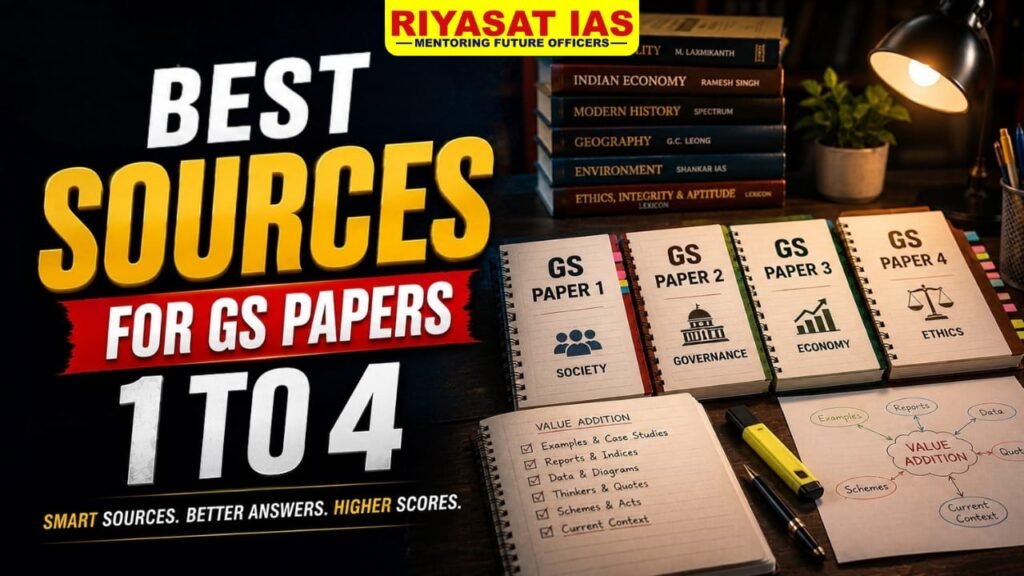
Source selection is one of the most consequential and most debated preparation decisions in UPSC GS preparation.Online forums often create endless debates over booklists. As a result, many aspirants keep collecting references instead of completing them. They also confuse popular resources with those that match UPSC’s actual depth requirements, and this mistake repeats across every preparation cycle.
This guide gives you a specific, calibrated source list for each of the four GS papers — not the longest list, but the right list. The principle behind every recommendation: one well-chosen primary source per subject, read completely and revised multiple times, produces better Mains performance than three sources read once. We recommend every source below because it aligns with UPSC’s actual question patterns and prepares you at the required depth.
The Three-Layer Reading Architecture
Every GS subject should be read in three layers:
- Layer 1 — NCERT Foundation: builds conceptual vocabulary, institutional framework, and basic factual accuracy. Read first, complete, with notes.
- Layer 2 — Primary Reference: one comprehensive source that covers the subject at UPSC’s required depth. Read chapter by chapter, with PYQ practice after each chapter.
- Layer 3 — Current Affairs: daily newspaper reading with GS-tagged notes connecting current developments to Layer 1 and Layer 2 content. Runs in parallel from Day 1.
GS Paper I: History, Art and Culture, Society, Geography
| Sub-area | NCERT Foundation | Primary Reference | What to Read / Skip |
| Ancient History | Class 6 — Our Pasts I; Class 7 — Our Pasts II | Spectrum (brief history section on Ancient India) or Old NCERT Class 11 Ancient India for high-frequency UPSC topics | Read NCERT completely; use Spectrum selectively for Art, Culture, and dynasty-specific PYQ topics — not cover to cover |
| Medieval History | Class 7 — Our Pasts II; Class 8 — Our Pasts III | Satish Chandra (Medieval India) for depth on Mughal administration and Bhakti-Sufi movements | Read selectively — focus on administration, society, and art-culture topics that PYQs emphasise; not narrative political history in depth |
| Modern History | Class 10 — Nationalism in India; Class 12 — Themes in Indian History (Part III) | Spectrum (A Brief History of Modern India) — complete; Bipin Chandra for analytical depth on nationalism and economic critique of colonialism | Read Spectrum completely; use Bipin Chandra selectively for topics where UPSC asks for analytical depth (colonial economy, nature of nationalism, communalism) |
| World History | Class 9 — The Story of Cricket (skip); Class 10 — Chapter-wise World History sections | NCERT is sufficient for World History at Prelims level; for Mains depth on specific themes, selected chapters from Norman Lowe (Mastering Modern World History) | Read NCERT chapters; supplement Norman Lowe only for Mains-relevant analytical topics (World Wars’ causes, Cold War, decolonisation) |
| Indian Society | Class 12 — Indian Society; Class 12 — Social Change and Development in India | Ram Ahuja (Indian Society) for in-depth sociology analysis; OR comprehensive notes from a reliable current affairs source that connects NFHS and census data | Read both Class 12 sociology NCERTs completely; use Ram Ahuja selectively for Mains depth on caste, tribal issues, gender, urbanisation |
| Geography | Class 6–10 — Our Environment series; Class 11 — Fundamentals of Physical Geography (complete) | Majid Husain (Geography of India) for economic and human geography; GC Leong for physical geography concept revision | Class 11 is the most important NCERT — read it completely with revision; Majid Husain for India-specific economic geography; GC Leong selectively for concept revision |



GS Paper II: Polity, Governance, International Relations
| Sub-area | NCERT Foundation | Primary Reference | What to Read / Skip |
| Indian Polity and Constitution | Class 6–12 Political Science — complete, especially Class 11 (Indian Constitution at Work) | Laxmikanth (Indian Polity) — complete, with article-linked notes on every chapter | Read Laxmikanth completely cover to cover; re-read specifically the chapters on constitutional bodies, amendments, Centre-State relations, and emergency provisions which generate the highest PYQ frequency |
| Governance and Social Justice | Class 12 — Political Science Part 2 (Politics in India since Independence) | 2nd Administrative Reforms Commission reports (select chapters); DD Basu for constitutional interpretation depth on specific articles | 2nd ARC selectively — chapters on ethics, RTI, e-governance, and citizen-centric administration are most UPSC-relevant; DD Basu only for specific constitutional interpretation questions |
| International Relations | Class 12 — Contemporary World Politics | Pushpesh Pant (International Relations) for analytical depth; current affairs as primary source for IR at Mains level | Read Class 12 completely; Pushpesh Pant selectively for India’s foreign policy chapters; current affairs is the most important IR source — bilateral relationships, multilateral positions, and India’s stances on global issues |
| Want a personalised reading list calibrated to your background and timeline? → Apply for Foundation Mentorship Courses |
Paper III: Economy, Environment, Security
| Sub-area | NCERT Foundation | Primary Reference | What to Read / Skip |
| Indian Economy | Class 9 — Economics; Class 10 — Understanding Economic Development; Class 11 — Indian Economic Development; Class 12 — Macroeconomics (complete) | Ramesh Singh (Indian Economy) — complete; Economic Survey (current year) — selected chapters | Read Ramesh Singh completely but prioritise Agriculture, Banking, Fiscal Policy, and Infrastructure chapters for PYQ frequency; Economic Survey for current data and the theme essay in Volume I |
| Environment and Ecology | Class 6–10 Science (environment chapters); Class 11 Geography Chapter 16 (Biodiversity) | Shankar IAS (Environment) — complete; India State of Forest Report for forest cover data | Read Shankar completely — it is well-calibrated to UPSC’s actual environment questions; supplement with species in news from current affairs; ISFR for specific forest cover statistics |
| Science and Technology | Class 6–10 Science NCERTs — complete | No dedicated primary reference; current affairs is the primary S&T source | Science Technology chapter of Ramesh Singh or Vision IAS notes for basic S&T concepts; current affairs (space, defence, health technology, agriculture technology) is the main S&T preparation source |
| Internal Security | No specific NCERT | Ashok Kumar and Vipul Anekant (Internal Security) selectively; current affairs on LWE, border management, cyber security | Read selected chapters — LWE, border management, cyber security, and money laundering are highest PYQ-frequency; read the rest selectively |
GS Paper IV: Ethics, Integrity and Aptitude
| Sub-area | Foundation Reading | Preparation Approach | What to Skip |
| Ethical Theories and Thinkers | Lexicon (Ethics, Integrity and Aptitude by Chronicle) for structured overview; selected original thinker writings for the 3–4 most versatile frameworks | Build thinker application cards (framework + 3 governance applications + 1 contrast) rather than reading comprehensively; prioritise Kant, Mill, Aristotle, Rawls, Gandhi, Ambedkar | Comprehensive philosophy texts — UPSC Paper 4 does not test academic philosophy depth; application skill matters more than theoretical comprehensiveness |
| Case Studies and Public Administration Ethics | 2nd ARC reports (Ethics chapter); Nolan Committee Principles on public life (UK) | Weekly timed case study practice with five-step structure; build a contemporary governance examples bank | Memorising model case study answers — writing your own against the structure produces better skill development than reproducing someone else’s approach |
| Aptitude and Foundational Values | NCERT-level psychological concepts for emotional intelligence; definitions from the syllabus itself | Conceptual notes with governance application; connect each value to a specific constitutional provision or governance context | Lengthy aptitude exam books designed for general competitive exams — the UPSC Paper 4 aptitude component is governance-focused, not psychometric testing |
Frequently Asked Questions
Should I complete all sources before starting answer writing?
No — and this is one of the most expensive source-selection mistakes. Begin answer writing from Month 3 of preparation, on topics already covered in primary source reading. PYQ practice should follow every chapter, not be deferred to after the source is complete. Answer writing and source reading run in parallel — the output discipline keeps the input honest. An aspirant who finishes all sources before any output practice has coverage without exam-level knowledge.
Can I skip NCERTs if I have a strong academic background in GS subjects?
Skip selectively, not entirely. An Economics graduate can skim Class 9 and 10 Economics NCERTs quickly and move to Class 11 and 12. Although History graduates can skim Class 6–8 NCERTs, they should read Class 10 and 12 carefully for Modern History. After all, even students with a strong background often have gaps in the specific coverage and vocabulary that UPSC expects. The NCERT reading investment for a strong-background aspirant is 2–3 weeks, not 2–3 months — it is never zero.
Is current affairs more important than static sources for GS Paper II and III?
Both are necessary and mutually reinforcing. However, the balance is different for Papers II and III than for Paper I. For example, Paper II (Polity, Governance, IR) requires strong static foundations (constitutional provisions, landmark judgments, institutional frameworks), which current affairs then update and apply. Without the static foundation, current affairs produces isolated awareness without conceptual grounding. The static sources build the framework; current affairs fills it with contemporary content. Neither alone is sufficient.
Conclusion
Choose sources that match UPSC’s actual question patterns instead of the most comprehensive or popular books. Read each source completely and revise it multiple times. Most importantly, follow a one-source-per-subject approach to build depth and consistency. The three-layer architecture (NCERT foundation, one primary reference, current affairs in parallel) consistently produces stronger Mains performance than the accumulation of multiple partial sources. Complete one; revise it; practice PYQs from it. Then decide whether a second source adds anything the first did not.
| Riyasat IAS Mentorship — Personal Guidance for UPSC CSE Direct mentorship from Riyasat Ali Sir │ Hindi & English Medium │ 100% Online — Apply Now |


 Ravi Raaz
 Hassan Khan
 Shadab Ali