
16. What is agentic Artificial Intelligence (AI)? Explain its working. Describe its applications with suitable examples. Discuss the advantages, risks and challenges associated with agentic AI systems. (Answer in 250 words)
Introduction
Agentic Artificial Intelligence (AI) refers to AI systems that can pursue a given goal with a high degree of autonomy. Unlike conventional generative AI, which primarily produces responses to prompts, agentic AI can plan tasks, use digital tools, take actions, observe outcomes and modify its approach with limited human intervention.
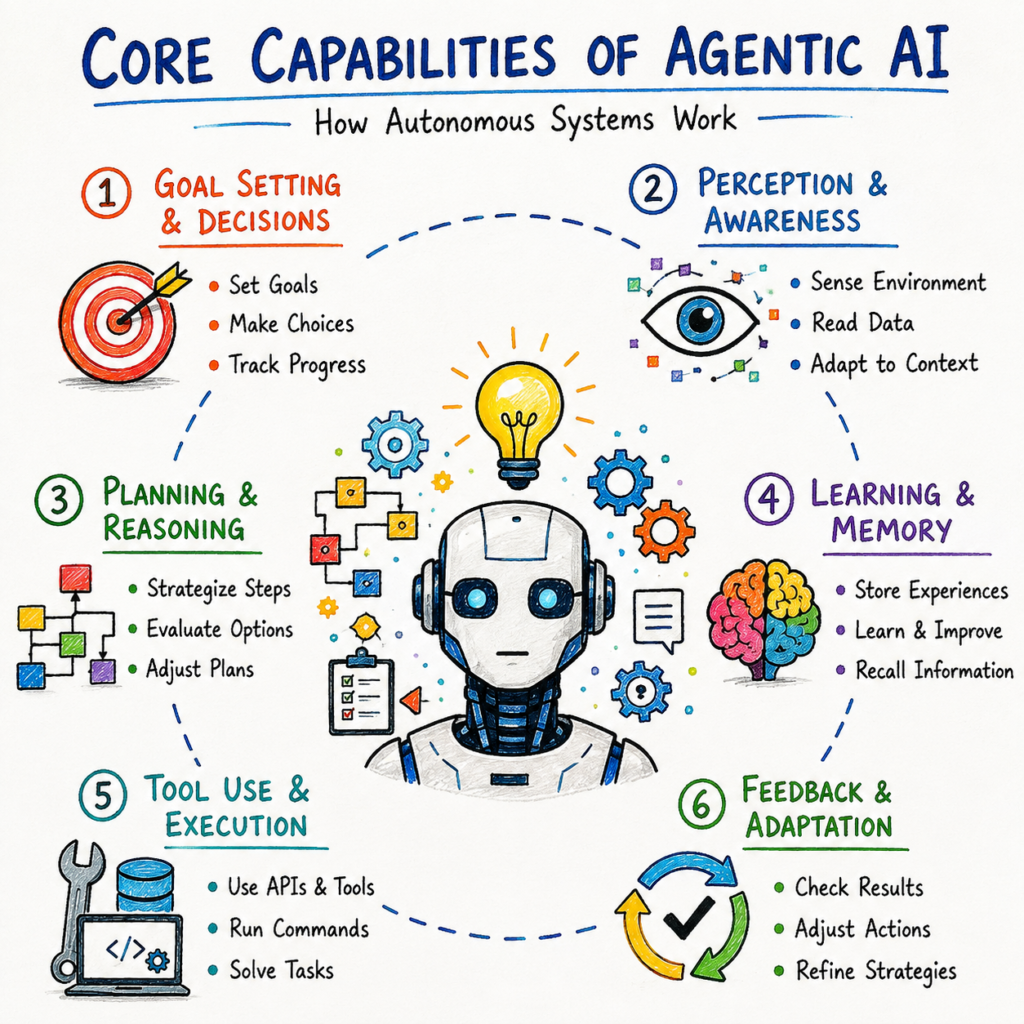
1. How Agentic AI Works
Agentic AI generally follows an iterative decision-making loop:
- Goal & Perception: Understands the user’s objective and gathers relevant information from its environment.
- Planning & Reasoning: Breaks a complex objective into smaller, achievable tasks and determines the sequence of actions.
- Tool Use & Execution: Interacts with APIs, databases, software applications, browsers or other digital tools to perform tasks.
- Observation & Feedback: Evaluates the outcome of each action and changes its strategy when required.
- Memory & Learning: Uses relevant past interactions and outcomes to improve subsequent decisions.



2. Applications
- Healthcare: Assists in analysing patient data, scheduling care and supporting clinical decision-making.
- Software & IT: Can generate code, identify bugs, run tests and manage routine development workflows.
- Scientific Research: Helps analyse large datasets, generate research hypotheses and coordinate experimental workflows.
- Finance & Business: Supports fraud detection, customer service, supply-chain management and financial analysis.
- Cybersecurity: Continuously monitors networks, detects threats and assists in responding to vulnerabilities.
3. Advantages
- Higher productivity: Automates complex, multi-step workflows.
- Adaptive problem-solving: Responds to changing conditions rather than following fixed instructions.
- 24×7 operation: Can perform repetitive tasks continuously.
- Personalisation: Tailors actions according to individual or organisational needs.
4. Risks and Challenges
- Loss of human control: Autonomous actions may produce unintended consequences.
- Hallucination and errors: Incorrect decisions can propagate through multiple steps.
- Privacy and cybersecurity risks: Access to sensitive data and digital systems can create new vulnerabilities.
- Accountability gap: Responsibility becomes unclear when an autonomous system causes harm.
- Bias and manipulation: Biased data or objectives can produce discriminatory outcomes.
Conclusion
Agentic AI can transform AI from a response-generating tool into an action-oriented digital collaborator. Its responsible deployment requires human oversight, clear permissions, audit trails, cybersecurity safeguards and accountable AI governance so that autonomy remains aligned with human interests.




 Ravi Raaz
 Hassan Khan
 Shadab Ali