
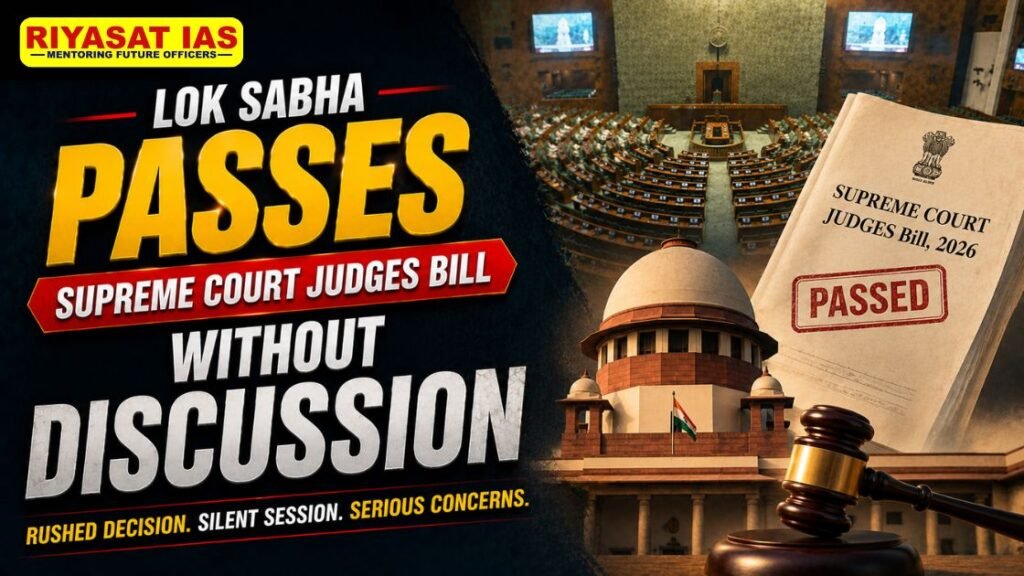
- The Lok Sabha passed the Supreme Court Judges (Salaries and Conditions of Service) Amendment Bill, 2026 without discussion amid disruptions in the House.
Key Provisions of the Bill
- Salary revision: Revises the salaries of the Chief Justice of India (CJI) and Supreme Court Judges.
- Pension revision: Enhances pension and family pension benefits for retired judges and their dependents.
- Retrospective effect: The revised salary and pension provisions will take effect from the date specified in the Act.
- Objective: To align judicial salaries and post-retirement benefits with changing economic conditions and maintain judicial independence.
Constitutional Provisions
- Article 124: Provides for the establishment, appointment and service conditions of Supreme Court Judges.
- Article 125: Salaries, allowances, leave and pensions of Supreme Court Judges are determined by Parliament by law.
- Protection of salary: The salaries and allowances of judges cannot be varied to their disadvantage after appointment, except during a Financial Emergency (Article 360).
Significance
- Strengthens judicial independence by ensuring adequate remuneration.
- Updates judges’ salaries and pensions in line with inflation and economic conditions.
- Improves post-retirement financial security for judges.
- Reinforces the constitutional principle of an independent judiciary.



Concerns
- The Bill was passed without parliamentary discussion, limiting legislative scrutiny.
- Lack of debate reduces transparency and accountability in law-making.
- Parliamentary deliberation is important even for non-controversial constitutional amendments affecting the judiciary.
UPSC Prelims Practice Question (English)
Q. With reference to the salaries and conditions of service of Supreme Court Judges, consider the following statements:
- Parliament determines the salaries and allowances of Supreme Court Judges by law.
- The salaries of Supreme Court Judges can be reduced after appointment by an ordinary law at any time.
- Article 125 of the Constitution deals with the salaries and allowances of Supreme Court Judges.
Which of the statements given above is/are correct?
A. 1 and 3 only
B. 2 and 3 only
C. 1 and 2 only
D. 1, 2 and 3
Answer: A
Explanation
- Statement 1: Correct. Article 125 provides that Parliament determines the salaries and allowances of Supreme Court Judges by law.
- Statement 2: Incorrect. Their salaries cannot be varied to their disadvantage after appointment, except during a Financial Emergency (Article 360).
Statement 3: Correct. Article 125 specifically deals with salaries, allowances, leave and pensions of Supreme Court Judges.


 Ravi Raaz
 Hassan Khan
 Shadab Ali