
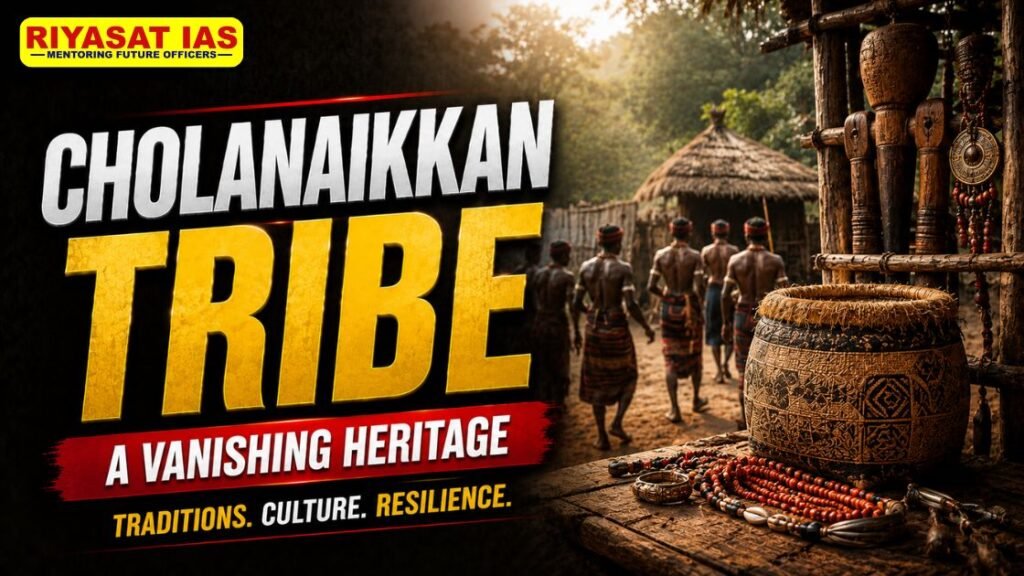
- Meaning of the name: Cholanaikkan means “King of the Forest” (Chola = forest, Naikkan = leader/king).
- PVTG Status: Recognised as a Particularly Vulnerable Tribal Group (PVTG).
- Location: Primarily inhabits the Nilambur forests of Malappuram District, Kerala.
- Habitat: Lives deep inside the Western Ghats, mainly in caves, rock shelters and temporary huts.
- Population: One of the smallest tribal communities in India.
Lifestyle
- Traditionally hunter-gatherers with limited dependence on settled agriculture.
- Collect honey, medicinal plants, tubers, fruits and forest produce.
- Fishing and small-scale food gathering supplement their livelihood.
- Traditionally practised barter with neighbouring communities.
Language
- Speak the Cholanaikkan language, considered distinct and influenced by Malayalam.
- The language has no widely used written script.
Social Features
- Live in small family-based groups.
- Possess rich indigenous knowledge of forests, wildlife and medicinal plants.
- Follow traditional customs and animistic religious beliefs, while some also follow Hindu practices.



Government Initiatives
- Included among India’s 75 Particularly Vulnerable Tribal Groups (PVTGs).
- Covered under the Pradhan Mantri Janjati Adivasi Nyaya Maha Abhiyan (PM-JANMAN) for improving housing, healthcare, education and basic infrastructure.
- Welfare measures are implemented through the Government of Kerala and the Ministry of Tribal Affairs.
UPSC Prelims Practice Question (English)
Q. With reference to the Cholanaikkan Tribe, consider the following statements:
- They are recognised as a Particularly Vulnerable Tribal Group (PVTG).
- They are primarily found in the Nilambur forests of Kerala.
- Their traditional livelihood is based mainly on hunting, gathering and collection of forest produce.
Which of the statements given above is/are correct?
A. 1 and 2 only
B. 2 and 3 only
C. 1 and 3 only
D. 1, 2 and 3
Answer: D
Explanation
- Statement 1: Correct. The Cholanaikkan are recognised as a PVTG.
- Statement 2: Correct. They inhabit the Nilambur forests of Malappuram district, Kerala.
- Statement 3: Correct. Traditionally, they follow a hunter-gatherer lifestyle and depend on forest resources.



 Ravi Raaz
 Hassan Khan
 Shadab Ali