
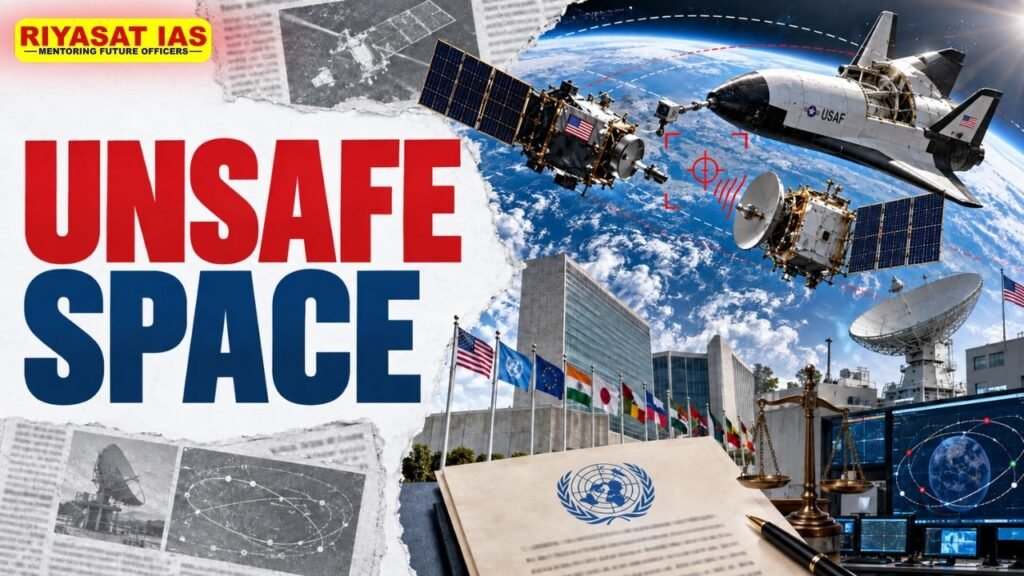
GS-II – International Relations | GS-III Science and Technology | GS-III Security | International Law
- Data: The increase reliance of our communications, energy and financial networks on satellite systems, together with the proliferation of commercial satellite systems designed for dual civilian and military usage.
- Development of Counter-space Capabilities: The US, Russia, China and India are also developing counter-space capabilities while contributing to the technology or strategic environment that makes battle no different than surface warfare i.e earth orbit becoming a battlefield.
- The Militarisation of Commercial Satellites: The greater military usage which is being made of commercial satellites will pose risks to the protections such satellite-based systems receive under international humanitarian law because this area of law is ill-prepared for a situation where broadly interconnected systems are designed often with dual-use capability.
- Orbital Defence Systems: The characteristics that necessitate orbital defence systems also render imprecisely defined weapons a potential source of instability.
- U.S. Military Doctrine: Mr. Meink characterized the weapon as defensive, but U.S. military doctrine that describes “space control” actions as may include offensive action plus defense of space assets or formations and supporting operations in another domain.
- Confusion and Escalation: Added to the confusion that will be experienced when two steerable satellites approach each other without knowing what the other’s intentions — including due to future autonomous satellites running artificial intelligence models onboard — is the lack of policy details.
- Unclear definitions: What is “hostile action” and that weapon is able to do.
Legal Framework
- Outer Space Treaty:
- The Outer Space Treaty, for its part, does not technically prohibit weapons in orbit (though Article IV explicitly prohibits nuclear weapons or other weapons of mass destruction therein — a notoriously moveable line in an era where satellite-based networks are integral to modern society and conventional munitions can wreak mass damage).
- Its Article III further mandates that space activities be in conformity with international law.
- Accountablity: Existing rules (such as the Liability Convention) are ill-suited for quickly determining accountability in the event a commercial dual-use earth orbiting asset with autonomy initiates an unwanted defensive strike.
- Rules- Based Order: The rules have become sufficiently coarse to be inappropriate for the current state of the technologies (and fall in global prestige of a rules-based world order).



Way Forward
- U.N. Open-Ended Working Group: The U.N. Open-Ended Working Group on the ‘Prevention of an Arms Race in Outer Space’ should provide governments a chance to discuss the disclosure.
- Disclosure: The U.S. needs to disclose the details of the weapons used.
- Multilateral Governance: Involve a multilateral governance structure that specifies exact thresholds for action and escalation.
Conclusion
- Security versus Stability A natural solution: The particulars which sustain the requirement for orbital defence systems also present poorly defined armaments as a driver of instability, potential instability.
- International Cooperation: How to cope with the pace of risk generated by evolving technologies and fewer care for a rules-based world order can be addressed through disclosure and multi-lateral governance apparatus precisely defining thresholds of action or escalation.
UPSC Mains Practice Question
Q. How does the growing militarization of outer space, especially advances in “on-orbit space control weapons” clash with the imperatives of international law, accountability and strategic stability? Talk about challenges and measures.





 Ravi Raaz
 Hassan Khan
 Shadab Ali