
GS-III – Science & Technology
U.S. Science Policy
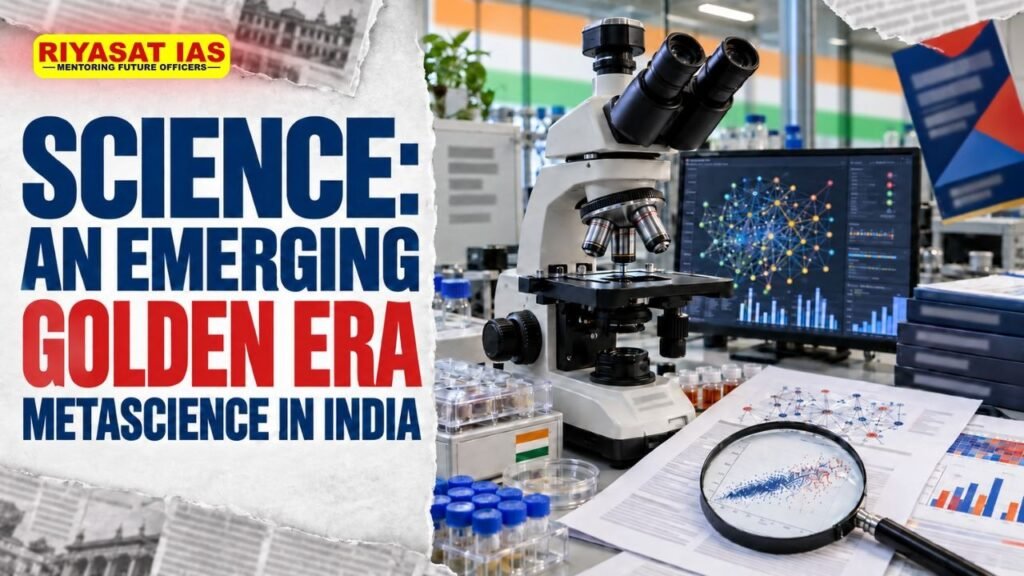
- OSTP Report: The U.S. Office of Science and Technology Policy published a 125-page briefing document, ‘Science: A New Golden Age’, laying out an ambitious new vision for American science.
- Vannevar Bush: Positioned as the follow-up report to Vannevar Bush’s pivotal 1945 ‘Science: The Endless Frontier’, which constructed the post-war U.S. research system.
- Relevance for India: The report shows that India also needs to develop a capacity to examine its own science system based on evidence.
Why a System Works
- Metascience: Despite increased investment in R&D, scientific productivity and returns on innovation have lagged.
- Self-Evaluation: A science system should use its own data to determine what works and what does not.
- Research Funding: The report calls for more support for individual researchers with daring, high-risk ideas and experiments with alternative funding mechanisms.
- Accountability: Funding agencies need to assess the efficacy of their funding mechanisms.
- Illustrative Global Trend: Metascience is a paradigmatic example of Europe, the U.K., China and Japan exploring what to fund, peer review, researcher assessment and scientific incentives.
Building Institutional Memory in India
- Context: When we talk about the development of the science system in India and its performance, there have been immense overlaps between experience and leadership by eminent scientists.
- Call for Systematic Analysis: The growing complexity of today’s research ecosystem requires systematic analysis drawing on economics, sociology, political science, public policy, organisational studies, scientometrics, and even history and philosophy.
- Research Gaps: Metascience and allied questions received low attention in India from 1950 to 2024; except scientometrics, they were only around 1–2% of global output.
- Loss of Institutional Memory: New leadership can lose corrective memory of what worked, what failed and why.
- Science Governance: The act of documenting how institutions adapt and learn is foundational to good science governance.



Reason of State
- National Scientific Goals: The OSTP report urges clearly defined national scientific goals to improve how research is organised and managed, facilitate Congress’ ability to prioritise research investments, and speed up the translation of discoveries into technologies.
- Curiosity-Driven Research: Transformative science can also come about through curiosity-driven research without a specified mission.
- Examples: Quantum mechanics made semiconductors and lasers/computing possible; research in molecular biology set the stage for CRISPR and mRNA vaccines; exploratory research helped lay the groundwork for AI.
- Entrepreneurial State: Mariana Mazzucato points to state-funded blue-sky research behind the internet, GPS, touchscreen and voice-recognition technology.
- Mission-Oriented Research: The Apollo programme, decoding of the Human Genome and India’s Green Revolution underline the disruptive potential of mission-oriented research.
- Evidence-Based Assessment: The environmental, regional and sustainability issues of the Green Revolution point to an additional need for evidence-based assessment of missions.
Striking the Balance
- Two-Pronged Strategy: This might mean mission-directed research on immediate challenges, but also curiosity-driven work that creates new frontiers.
- Evidence, Not Whim: The balance should be settled by debate and evidence rather than shifting policy fashions.
- Indian Context: India requires institutes, experts and people to study the functioning of its science system.
- Documentation: An institutionally worthwhile process of documenting what worked and what failed can help preserve learning even if leadership changes.
UPSC Mains Practice Question
Q. What is metascience? What is the evidence-based need for India to have more capacity to study its own science ecosystem?



 Ravi Raaz
 Hassan Khan
 Shadab Ali