GS-III: Environment | Pollution | Environmental Governance | Public Health | Article 21
Context
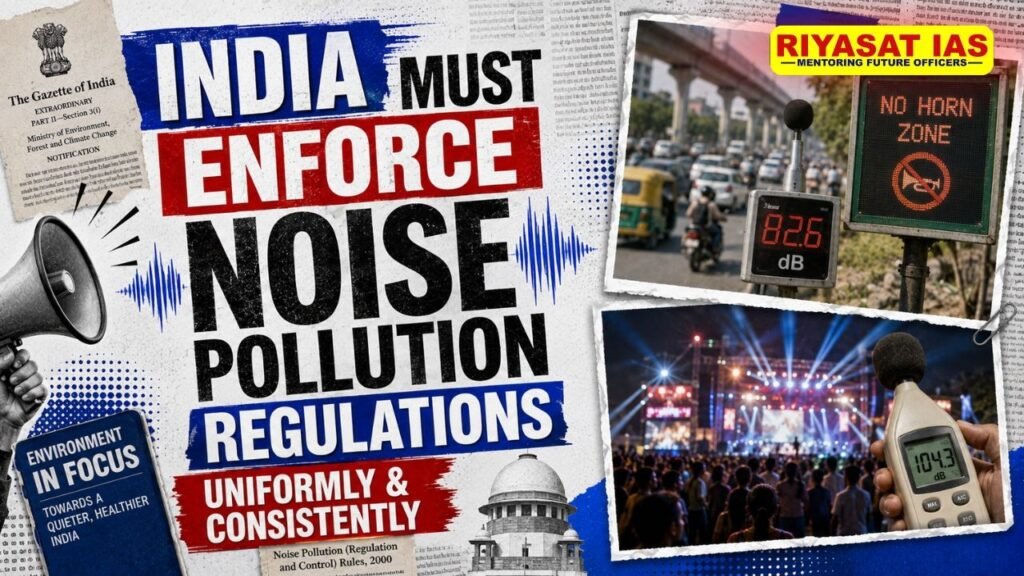
- Patna High Court Intervention: In a February 2025 hearing in Surendra Prasad vs State of Bihar, the Patna High Court identified DJ trolleys and loudspeakers as major sources of noise pollution in Patna.
- Enforcement Failure: The Court criticised the Bihar State Pollution Control Board (BSPCB) for failing to effectively control the problem.
- Police Action: Police reported seizures of equipment and imposition of fines in Patna, Barh and Fatuha, but no action was reported in Masaurhi.
- Court’s Response: Justice Rajiv Roy described the absence of action in Masaurhi as “unbelievable”, indicating serious enforcement gaps.
- Statewide Directions: The Court’s August 14 order expanded the directions towards Statewide regulation of high-decibel noise.
- Core Concern: The case highlights how weak enforcement can undermine comprehensive environmental laws.
Noise Pollution and Article 21
- Right to Life: Courts have repeatedly held that protection from unlawful noise is part of the Right to Life under Article 21.
- Public Health: Excessive noise affects the quality of life and can cause significant physical and psychological stress.
- Enforcement Gap: Despite the existence of comprehensive laws, enforcement often remains episodic and complaint-based.
- Judicial Intervention: The Patna High Court’s intervention demonstrates the judiciary stepping in when regulatory enforcement becomes ineffective.
From Complaint-Based to Routine Enforcement
- Existing Problem: It is unrealistic to expect citizens to lodge complaints against every DJ, loudspeaker or vehicle horn before authorities take action.
- Proactive Enforcement: Authorities should undertake routine monitoring and enforcement instead of waiting for individual complaints.
- Registration: The Court directed DJs, sound-system operators and event halls to register themselves with subdivisional authorities.
- Regulatory Advantage: Registration can enable authorities to identify and regulate operators systematically and uniformly.
- Selective Enforcement: A registration-based system can reduce the possibility of sporadic or selective interventions.


Why Enforcement Is Difficult
- Social Events: Loud noise is frequently associated with festivals, weddings, political campaigns and religious events.
- Cultural Sensitivity: Enforcement may create friction with people who perceive unrestricted noise as part of their cultural or religious practices.
- Political Incentives: Governments may be reluctant to antagonise constituents by strictly enforcing regulations.
- Balancing Rights: Authorities must balance freedom of cultural and religious expression with the rights of others to a peaceful and healthy environment.
Governance Concerns
- Regulatory Failure: The case illustrates the gap between laws on paper and enforcement on the ground.
- Institutional Accountability: Pollution control authorities and police need to demonstrate consistent compliance and monitoring.
- Boilerplate Affidavits: The Court’s criticism of routine and inadequate affidavits reflects concerns about superficial administrative compliance.
- Judicial Oversight: Summoning officials and seeking detailed reports can improve accountability, but courts becoming quasi-regulators also indicates institutional enforcement failure.
- Long-Term Concern: Judicial intervention should ideally act as a corrective or stopgap mechanism, not replace regular executive regulation.
Way Forward
- Routine Monitoring: Shift from complaint-based action to regular and proactive monitoring of noise sources.
- Mandatory Registration: Create a comprehensive registry of DJs, sound-system operators and event venues.
- Uniform Enforcement: Apply regulations consistently across locations to prevent selective enforcement.
- Technology-Based Monitoring: Use noise monitoring systems and digital decibel measurement for objective enforcement.
- Clear Accountability: Establish clear responsibility among police, pollution control authorities and local administration.
- Public Awareness: Promote awareness regarding permissible noise levels, timings and the health impacts of excessive noise.
- Community Coordination: Engage event organisers and local communities to ensure compliance without unnecessarily creating social conflict.
- Institutional Strengthening: Ensure that environmental regulators have adequate staff, equipment and enforcement capacity.
Conclusion
The Patna High Court’s intervention highlights a fundamental problem in environmental governance: the existence of laws does not guarantee their enforcement. Noise pollution requires proactive regulation because expecting citizens to individually report every violation is neither practical nor sustainable.
UPSC Mains Practice Question
Q. “The challenge of noise pollution in India lies less in the absence of laws and more in their inconsistent enforcement.” Discuss in the context of recent judicial intervention by the Patna High Court.




 Ravi Raaz
 Hassan Khan
 Shadab Ali