
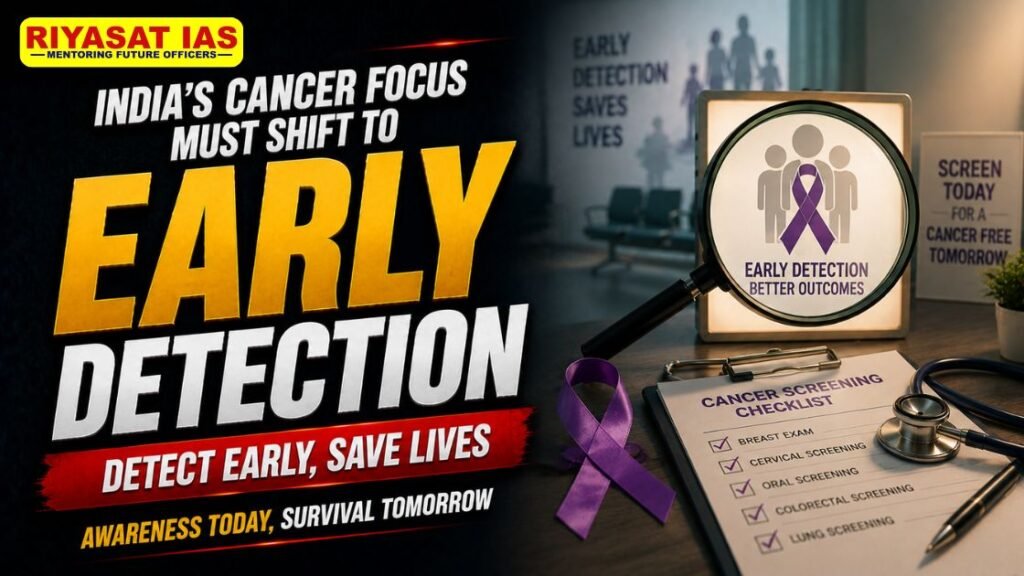
GS-II: Health | Public Health | Cancer Care | Healthcare Policy
Context
- Most cancer patients in India are diagnosed at an advanced stage: More than 70% of patients reach oncology centres only after the disease has progressed, reducing the chances of successful treatment.
- Editorial argues that India’s cancer strategy must shift towards prevention and early detection: Strengthening public health interventions, screening and research can reduce mortality, financial burden and improve treatment outcomes.
Late diagnosis remains the biggest challenge in cancer care
- More than 70% of patients present with advanced-stage cancer: Treatment becomes more complex, expensive and less likely to achieve a cure.
- Expansion of tertiary cancer care alone cannot improve outcomes: Despite investments in surgery, radiation therapy and systemic treatments, patients continue to arrive too late for effective intervention.
- Cancer is largely diagnosed only after severe symptoms develop: Delayed diagnosis reduces opportunities for curative treatment.
Late diagnosis creates both health and economic burdens
- More than three-fourths of cancer-affected households face catastrophic healthcare expenditure: Cancer pushes many families into financial distress.
- Delayed diagnosis contributes to poverty: The burden extends beyond healthcare to household economic security.
- India’s survival outcomes remain significantly lower than developed countries: Five-year survival for lung cancer is about 4% in India compared with nearly 33% in Japan.
- Differences in survival largely reflect differences in the stage of diagnosis: Early detection remains a critical determinant of outcomes.
India’s cancer burden continues to increase
- India recorded an estimated 1.56 million new cancer cases in 2024: The disease burden continues to rise.
- More than 8.74 lakh cancer deaths occurred in 2024: Cancer remains a major public health challenge.
- Lifetime risk of developing cancer has reached around 11% nationally: The risk exceeds 20% in some northeastern States.
- Population ageing and lifestyle changes will further increase the burden: Without major policy changes, cancer incidence is expected to rise.



Cancer prevention should become a lifelong public health priority
- Prevention should move beyond occasional awareness campaigns: The editorial advocates a sustained public health approach.
- Nearly half of all cancers are preventable: Preventive interventions can substantially reduce disease burden.
- Lifestyle habits are formed early in life: Awareness campaigns targeting adults often have limited effectiveness.
- Health education should begin in schools: Life skills should receive importance comparable to subjects such as mathematics and social sciences.
- Life skills education should promote holistic health: It should cover physical, mental and social health, addictions, diet, vaccinations, financial literacy and civic responsibilities.
Early diagnosis must become the second pillar of cancer control
- Public awareness about persistent symptoms should be strengthened: Symptoms lasting more than three weeks should prompt medical evaluation.
- Screening remains the most effective tool for detecting cancer early: Early identification improves treatment outcomes before symptoms appear.
- Organised screening has traditionally focused on selected cancers: Cervical, breast and prostate cancers have received greater attention.
Emerging technologies are expanding cancer screening possibilities
- Blood-based Multi-Cancer Early Detection (MCED) tests represent a promising innovation: A single blood sample can potentially detect biological signals from multiple cancers.
- MCED tests may identify several major cancers simultaneously: These include colorectal, lung, liver, pancreatic, ovarian, gastric, oesophageal, breast, prostate and bladder cancers.
- Population-wide implementation requires further scientific validation: The technology requires careful evaluation before large-scale adoption in India.
India needs a decentralised and technology-driven screening model
- A single centralised screening programme cannot effectively serve India’s diversity: Regional and socioeconomic differences require flexible approaches.
- A layered healthcare model should be adopted: Community health workers, digital risk assessment, AI, mobile diagnostic services and referral systems should work together.
Technology and research can strengthen early cancer detection
- NITI Aayog is supporting development of a large imaging biobank: It will include more than 20,000 cancer patient profiles.
- Artificial Intelligence can assist frontline healthcare workers: AI tools can identify suspicious lesions and prioritise patients requiring specialist care.
Draft National Health Research Policy 2026 can accelerate cancer research
- The policy prioritises diseases contributing most to India’s disease burden: Research is expected to focus on measurable public health impact.
- The policy promotes implementation science over publication-driven research: Greater emphasis is placed on practical healthcare solutions.
- Research should support affordable screening technologies: Innovation is needed in risk prediction models, digital health platforms and cancer detection systems.
Conclusion
- India’s success in cancer care should be measured not by the sophistication of treatment for advanced disease but by the number of cancers detected before reaching advanced stages. A prevention- and early detection-oriented strategy can significantly improve survival, reduce healthcare costs and strengthen public health outcomes.
UPSC Mains Practice Question
Q. Late diagnosis remains the biggest challenge in India’s cancer control strategy. Discuss the need for shifting from treatment-centred care to prevention and early detection, highlighting the role of technology, research and public health interventions.




 Ravi Raaz
 Hassan Khan
 Shadab Ali