
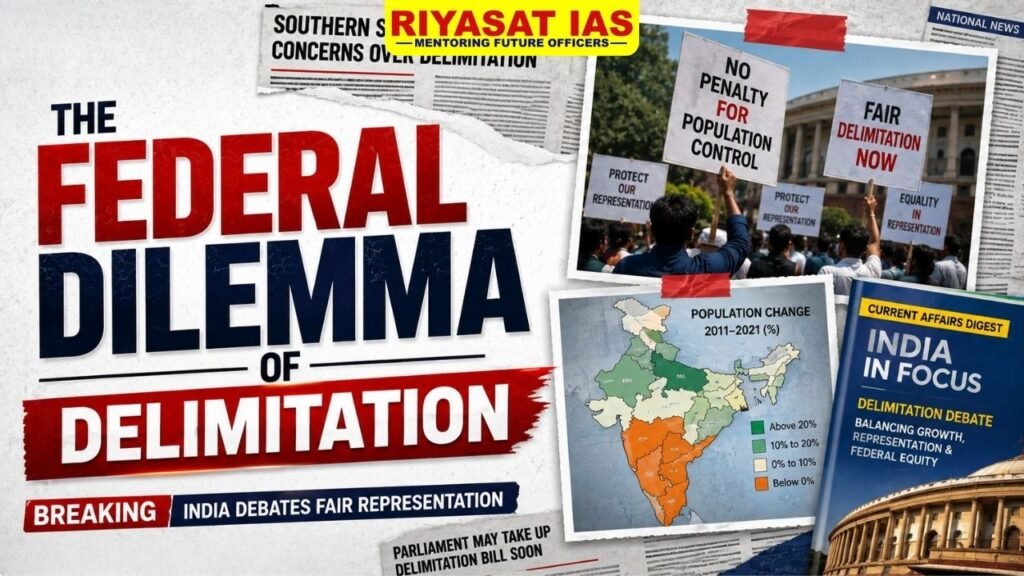
GS-II: Polity | Federalism | Delimitation | Parliamentary Representation | Women’s Reservation
Context
- Tamil Nadu resolution: The State Assembly has urged the Centre to freeze Lok Sabha seats at 543 and retain the present State-wise distribution.
- Rajya Sabha ratio: It also seeks to preserve the present 2.2:1 Lok Sabha–Rajya Sabha ratio.
- Women’s reservation: It wants one-third reservation for women from 2029, without linking it to a future Census or delimitation.
- Core debate: The issue involves balancing “one person-one vote-one value” with federal representation.
Defining Delimitation
- Meaning: Delimitation fixes the number of seats and boundaries of territorial constituencies for Lok Sabha and State Assemblies.
- Commission: It is conducted by a Delimitation Commission constituted under an Act of Parliament.
- Current basis: Lok Sabha seats were last determined using the 1971 Census.
- Article 81(2): Seeks, as far as practicable, equality in the ratio between population and seats across States.
- Freeze: The 42nd Amendment froze seats and the 84th Amendment extended the freeze until 2026.
The Core Democratic–Federal Tension
- Uneven population growth: States such as UP, Bihar, MP and Rajasthan have experienced higher population growth than States such as Kerala, Tamil Nadu, Karnataka and Andhra Pradesh.
- Representation imbalance: The present seat distribution does not correspond to current population levels.
- Possible redistribution: Population-based delimitation could significantly increase seats of highly populous States.
- Federal concern: Southern, smaller northern and North-Eastern States could lose relative political influence despite better population-control performance.
- Policy dilemma: Rewarding population growth through greater representation may undermine the incentive for population stabilisation.



Centre’s Proposal
- 131st Constitutional Amendment Bill, 2026: Proposed increasing the maximum Lok Sabha strength from 550 to 850.
- 50% pro-rata increase: An assurance was given that every State/UT would receive a 50% increase in seats.
- Bill defeated: The Bill was defeated in the Lok Sabha, with expectations of possible reintroduction.
Concerns with Increasing Seats
- Rajya Sabha imbalance: A 50% rise in Lok Sabha seats without increasing Rajya Sabha strength could change the ratio from 2.2:1 to 3.3:1.
- Weakening Rajya Sabha: This could reduce its role as a check on the Lok Sabha.
- Joint sittings: A larger Lok Sabha could increase the possibility of resolving disagreements through Joint Sittings.
- Limited parliamentary time: With the Lok Sabha sitting for around 60 days annually, a larger House may reduce meaningful opportunities for MPs to participate.
- Fiscal burden: More MPs would increase expenditure, including costs related to MPLADS.
Way to Harmonise Democratic and Federal Principles
- Freeze Lok Sabha seats: Retain the existing 543 seats to protect the current federal balance.
- Women’s reservation: Provide one-third reservation for women within the existing Lok Sabha strength.
- Increase State Assembly seats: Adjust the number of MLAs according to current population to address representational concerns.
- Preserve federalism: Avoid penalising States that successfully controlled population growth.
Conclusion
Delimitation requires balancing democratic equality with federal stability. A sudden population-based redistribution could strengthen populous States while weakening the political voice of States that achieved better population control. Retaining 543 Lok Sabha seats, providing women’s reservation within the existing strength, and increasing State Assembly representation can offer a balanced approach.
UPSC Mains Practice Question
Q. “The delimitation exercise must balance the principle of ‘one person-one vote-one value’ with India’s federal character.” Discuss.




 Ravi Raaz
 Hassan Khan
 Shadab Ali