
In News
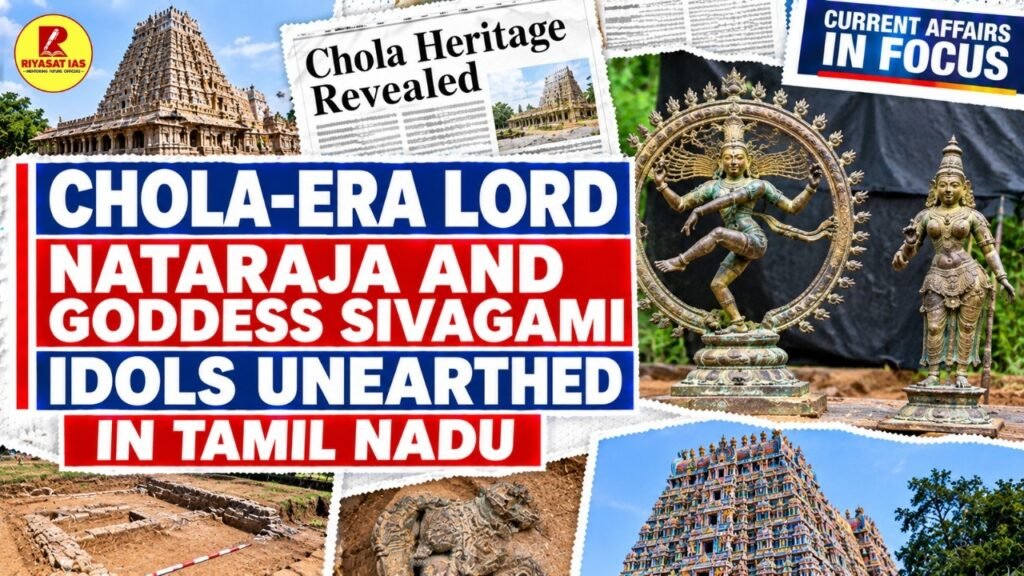
- Discovery: Tamil Nadu State Department of Archaeology unearthed bronze alloy idols of Lord Nataraja and Goddess Sivagami during ongoing excavations in Nagapattinam, Tamil Nadu.
- Period: The idols are estimated to date back to the 12th century CE, belonging to the Chola period.
- Location: Nagapattinam, Tamil Nadu.
- Depth: Both idols were discovered at a depth of approximately one metre, along with their respective pedestals.
- Significance: The discovery provides evidence of Chola-period religious practices, bronze sculpture traditions and artistic excellence.
Important Features of the Unearthed Idols
1. Lord Nataraja Idol
- Depiction: Lord Shiva is depicted in the Ananda Tandava posture, representing the cosmic dance of bliss.
- Arms: Four arms.
- Dimensions: 110 cm in height and 100 cm in width.
- Iconography:
- Upper right hand holds a drum (Damaru).
- Upper left hand holds a flame.
- One foot rests on Muyalaka, the demon representing ignorance.
- The other foot is raised.
2. Goddess Sivagami Idol
- Depiction: Goddess Sivagami is depicted in the traditional Tribhanga posture.
- Arms: Two arms.
- Dimensions: 82 cm in height and 23 cm in width.
- Association: Sivagami is the consort of Lord Nataraja.
Chola Bronze Sculpture
- Lost-Wax Technique: Chola bronze sculptures were produced using the lost-wax technique, also known as Cire Perdue.
- Process: A wax model is prepared, covered with clay and heated to remove the wax. Molten metal is then poured into the mould.
- Uniqueness: The technique generally produces one individual sculpture because the mould is broken to retrieve the finished idol.
- Artistic Features: Chola bronzes are known for their fine workmanship, graceful postures, detailed ornamentation and realistic proportions.
- Nataraja: Represents Shiva’s cosmic dance, symbolising the processes of creation, preservation and destruction.
- Tribhanga: A graceful three-bend posture involving the neck, torso and legs.



Chola Dynasty
Period: The Cholas were a major ruling dynasty of South India, particularly prominent between the 9th and 13th centuries CE.
- Important Rulers:
- Rajaraja Chola I
- Rajendra Chola I
- Rajadhiraja Chola I
- Capital: Thanjavur was an important Chola capital; Gangaikonda Cholapuram later became another major capital.
- Economic Base: The fertile Kaveri delta supported agriculture, trade and urban growth.
- Temples: Temples played an important role in religious, economic, social and cultural life.
- Trade: Merchant guilds and commercial towns known as Nagaram supported regional and overseas trade.
- Architecture: The Cholas made major contributions to Dravidian temple architecture and bronze sculpture.
Important Chola Temples
Brihadeeswara Temple
- Thanjavur, Tamil Nadu.
- Built by Rajaraja Chola I.
- Dedicated to Lord Shiva.
Brihadeeswara Temple, Gangaikonda Cholapuram
- Built by Rajendra Chola I.
- Dedicated to Lord Shiva.
Airavatesvara Temple
- Darasuram, Tamil Nadu.
- Built by Rajaraja Chola II.
- Dedicated to Lord Shiva.
These three temples are collectively known as the Great Living Chola Temples and are UNESCO World Heritage Sites.
Prelims Practice Questions
Q1. With reference to the recently discovered Chola-era idols in Tamil Nadu, consider the following statements:
- The idols of Nataraja and Sivagami were discovered in Nagapattinam.
- The Nataraja idol depicts the Ananda Tandava posture.
- The Sivagami idol depicts the Tribhanga posture.
- Both idols belong to the 10th century CE.
Which of the statements given above are correct?
(a) 1, 2 and 3 only
(b) 1 and 4 only
(c) 2, 3 and 4 only
(d) 1, 2, 3 and 4
Answer: (a) 1, 2 and 3 only
Explanation:
- Statements 1, 2 and 3 are correct.
- Statement 4 is incorrect because the idols are estimated to belong to the 12th century CE.
Build conceptual clarity in History, Polity, Geography, Economy and other GS subjects with our comprehensive GS Foundation Course in English
Prepare smartly for UPSC 2027 with comprehensive GS coverage, regular assessments and answer-writing practice.



 Ravi Raaz
 Hassan Khan
 Shadab Ali