
GS-II: International Relations
Context
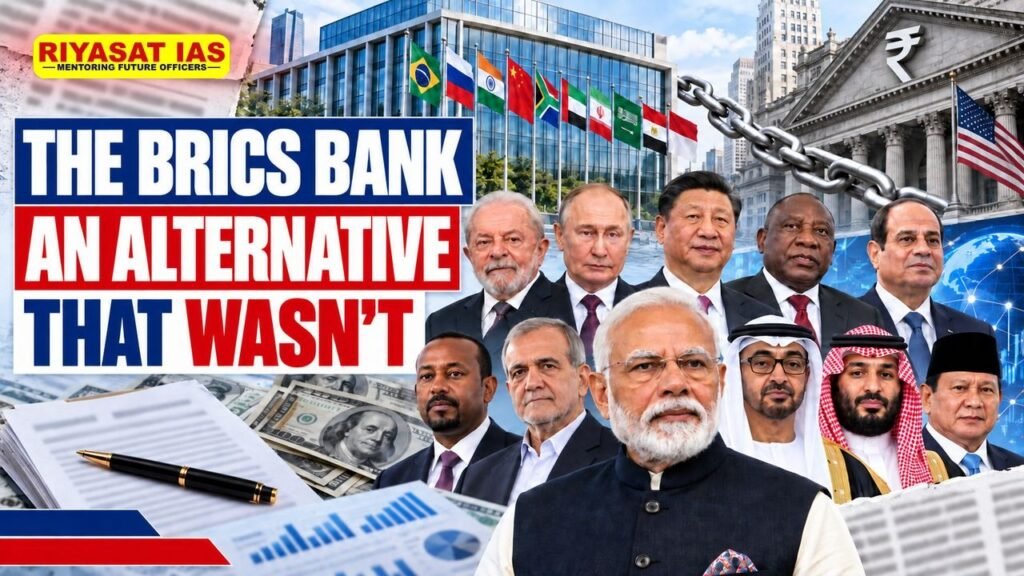
- Annual Meeting of the BRICS Leaders: India will host the 18th BRICS Summit in New Delhi, September 12–13, 2026, under the theme — “Humanity First”. This summit coincides with the ongoing portrayal of BRICS as a potential rival to the western-led world financial order.
- What BRICS Said it Would Do — Originally: The bloc has promoted three big ideas — a new bank to rival the World Bank, a reserve fund that could lessen dependence on the IMF and an evolution away from the dominance of the U.S. dollar.
- Structural Contradiction: The BRICS countries want to change the world financial order, but are completely stuck in it. Consequently, the institutions established by BRICS embody this dependency as well.
The Same Bank, Different Nameplate
New Development Bank (NDB)
- Flagship Development: Established in 2015 as the flagship BRICS financial institution, the New Development Bank (NDB) was designed to provide developing countries with an alternative to the World Bank.
- Original Purpose: It was supposed to provide loans without political strings, governance that does not rely on western powers such as the U.S. and financing in local currencies rather than dollars. The aim was to give more financial independence to developing nations.
Continued Dependence on the Dollar
- Dollar-Dominated Funding: A decade later, nearly half of the NDB bonds are U.S. dollar-denominated, with much of the remainder denominated in Chinese yuan. The remainder, 1%, is related to the South African rand.
- Local-Currency Lending Stigma: Local-currency lending was about 22% as at mid-2025, despite the NDB leadership targeting 30% of its portfolio by year-end. It reflects the slow pace of moving away from dollar-denominated funding.
- Rupee-Denominated Bond: Despite having been operational for 10 years, the NDB had its first rupee-denominated bond merely planned as of September 2025.
Dependence on Western Credit-Rating Agencies
- Credit Ratings: The New Development Bank continues to depend on western credit-rating agencies, such as S&P, Fitch and Moody’s, despite the fact that BRICS governments have openly denounced these agencies as biased against non-developed countries.
- Russia Case from March 2022: Because of the Russian war on Ukraine, NDB froze Russia operations to protect its credit ratings at New York, ending up having big financial troubles as a founding member and 20% shareholder from Oct-23.
- Implication — Episode: The episode shows that when western financial norms clashed with bloc solidarity, the needs of the existing financial system triumphed.



Limited Scale of the NDB
- Project Approvals: By end of 2024, total NDB project approvals amount to US $39 billion; World Bank Group approximately US $100 billion per year.
- More Complementary Than Competitive: The NDB also co-finances projects with the World Bank and IMF. Thus, its relationship with the present institutions is more of complementary than competitive one.
- Bridging Rhetoric and Reality: The establishment of the NDB was made to appear as an alternative to the western financial world, but in reality its functioning still largely mirrors that of western financial discipline.
The Safety Net Nobody Uses
Contingent Reserve Arrangement (CRA)
- 2nd Establishment: Apart from NDB, BRICS countries also established a Contingent Reserve Arrangement (CRA) in 2015.
- What is it: The CRA, or the Contingent Reserve Arrangement, is a $100 billion pool of foreign exchange reserves designed to assist member countries in managing financial crises without going to the IMF.
- Potential Importance: In principle, the CRA could have offered BRICS countries an alternative to the IMF as a major provider of asymmetric EM financing for all Global South economies.
Canadian Revenue Agency with Little Power
- Never Activated: While the CRA has been around for ten years, it has never actually been used in practice.
- IMF — Exit from IMF Link: A member country needs to enter into a programme with the IMF before drawing more than 30% of its quota. So the mechanism eventually returns to a monetary institution that it was meant to save countries from.
- Ongoing Limitations of a CRA: The CRA lacks permanent personnel, independent monitoring infrastructure and a research arm. As a result, it does not have the capacity to exist without the IMF.
- Core Contradiction: The CRA was conceived of as an alternative to relying on the IMF, but its own rules condition access by having generous access dependent on an IMF programme.
De-dollarisation:
- Meaning: De-dollarisation refers to the potential for BRICS to be a vehicle to lessen global dependence on the U.S. dollar, with greater monetary use of local currencies in global trade.
Lack of a Common Position
- Rio Declaration 2025: The declaration from the Rio Summit issued in July 2025 contained no mention whatsoever of de-dollarisation — and included 126 other points.
- Russia’s Position: Russian President Vladimir Putin said BRICS had “never tried to get rid of the dollar” in a November 2024 speech.
- India’s Stance: India is against a common BRICS currency due to the possibility of American trade retaliation.
- South Africa: South Africa thinks the notion of a common currency is too big a risk.
- The Chinese Position: China is in favour of a slow internationalisation of the yuan on its own terms, not an all-BRICS currency.
- Answering U.S. Pressure: When the U.S. President Donald Trump threatened a 10% imposition of tariffs on countries that adhere to the BRICS policies based on “anti-Americanism”, no common response was given from this bloc.
- Impression: The episode showed how BRICS isn’t willing, much less able, to put up any pretence of challenging the current dollarised system in the face of external pressure.
BRICS and the IMF
- IMF Reform: The statements released at the Kazan and Rio Summits called for a “quota-based and adequately resourced” IMF.
- No Replacement of IMF: Therefore, the statement is not requesting that BRICS optimise IMF or dismantle it. Instead, it seeks a more significant role within the existing institution.
Structural Problem
- U.S. Voting Power: The U.S. has 16.49% of IMF voting power.
- 85% Supermajority: An 85% supermajority is required on all major IMF decisions. Hence, the U.S. holds veto power over major Fund decisions.
- BRICS’ Dilemma: The BRICS countries know about this structural imbalance but only seem to want a bigger share of the pie in the existing system.
What Does This Tell Us About BRICS?
Arguments in Favour of BRICS
- Financing Real Infrastructure: The defenders of BRICS can point out that the NDB financed real infrastructure projects.
- BRICS Expansion: The recent expansion of the grouping to incorporate Egypt, Ethiopia, Iran and the United Arab Emirates reveals a genuine interest among Global South countries for alternatives to western-led institutions.
- Underlying Dissatisfaction: Dissatisfaction with IMF conditionality, dollar hegemony and a financial system designed in 1944 for the industrialised West by the industrialised West are what drive the BRICS agenda.
Gap Between Rhetoric and Record
- No Alternate Financial Architecture: BRICS remains keen on establishing an alternate financial architecture.
- Existing System Continues to Dominate: Institutions directly operate within the existing system through dollar lending, reliance on western rating agencies, safety nets that mandate IMF approval and participation in existing governance structures.
- Central Question: As India gets ready to host the group, one key question the report seeks to answer is whether BRICS governments really want a new global financial order or merely aim for “a better seat at the existing table.”
Conclusion
BRICS does express a real discontent with the western-led international economic order, but there is an enormous gulf between its rhetoric and its institutional history. NDB, CRA and the de-dollarisation discussion indicate that BRICS has performed primarily as a financial actor within the existing architecture rather than constructing an alternative system from scratch.
The crux — the question begging to be answered, especially when India prepares to chair the bloc — is whether BRICS has an interest in materially altering the global financial order or whether its endgame is simply securing a more prominent role within the status quo.
UPSC Mains Practice Question
Q. “The BRICS countries did not build an alternative financial architecture, they built institutions which function within the traditional one.” Elaborate, pointing out the New Development Bank, Contingent Reserve Arrangement and de-dollarisation. (250 words, 15 marks)




 Ravi Raaz
 Hassan Khan
 Shadab Ali