
GS-III | Environment | Biodiversity | Sustainable Development | Climate Change
Introduction
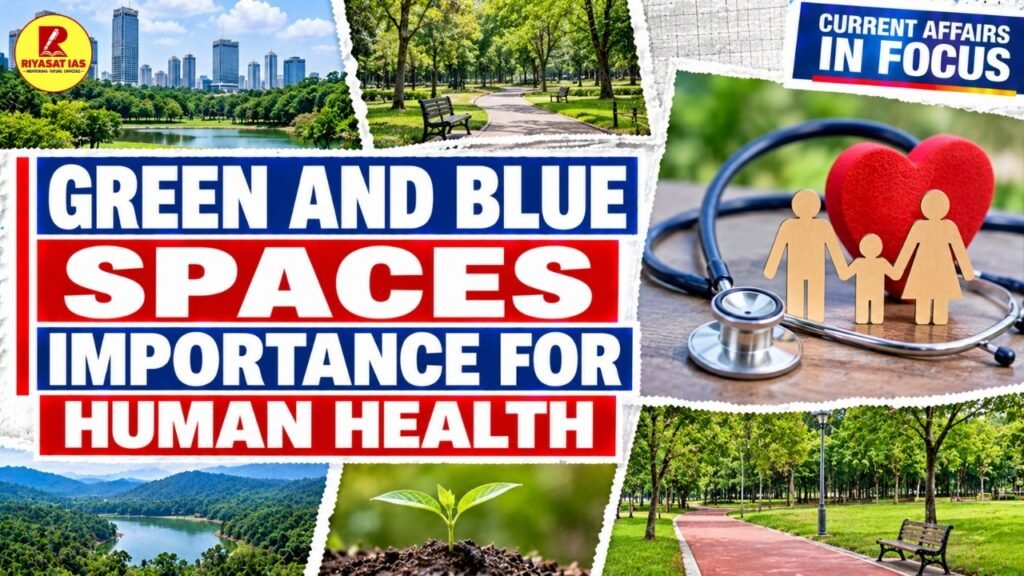
- Importance of Green Spaces: Green trees and plants are vital for human health.
- Tree Canopy: In villages and farmlands, the top of the tree provides a “tree canopy” that creates a cool and healthy environment for people.
- Blue Spaces: And the people who use the rivers, canals, ponds and pools will have a bluer space around them.
- Such rural areas then provide the people who live in them with healthier environments.
Impact of Urbanisation on Green and Blue Spaces
- Canopy Loss: Private companies and commercial agencies that remove thousands of acres of land from cities, suburbs, and rural areas to construct large multi-story buildings and residential developments lead to more canopy loss.
- Telangana: The State of Telangana has about 48% of the people who reside in cities (urban areas) and have had many more trees destroyed to make room for city development, while those residing in rural areas (villages) and farms have fewer trees and less water available for irrigation.
- Other Southern States: This is also true of several other southern States.
- Urban Population: The urban population across India is now 36%.
Impact on Children’s Health
- UNICEF: UNICEF has stated that children’s health is impacted when green and blue areas are disturbed.
- Infant Mortality and Green Spaces: Infant mortality rates have been shown by the National Family Health Survey to correlate with the amount of green space in a region. Areas with less green space generally have higher infant mortality rates than areas with more green space.
- State-wise Comparison: The infant mortality rate in the green States of Kerala, Goa and Puducherry is very low (around 8 per 1,000 births) compared with Uttar Pradesh and Rajasthan where the rates are much higher (closer to 30 per 1,000 births).



Research Findings on Green and Blue Spaces
- The Lancet Study (2023): In 2023, an international group of researchers published a report in the medical journal The Lancet (vol. 8, no. 9, Sept. 2023), stating that as more than half of the world’s population currently resides in cities, then there is a need for those who reside in cities to have increased opportunities for contact with green and blue spaces located within cities, and if they do so, then it may help improve public health.
- Benefits of Green and Blue Spaces: The benefits of green and blue spaces are to increase environmental diversity and community spirit by providing residents with access to parks, sports facilities, increased physical activity, and opportunities for social interaction.
- Indian Researchers Study (2025): A more recent paper from three Indian researchers in the Indian Journal of Science and Research (Pande et al; Ind. J. Sci. Res., 5 (2), 2025) continued on the same theme as previous studies and provided a framework to help develop green infrastructure and promote sustainable urban development.
- Green Infrastructure: These are areas within an urban area that have been made greener. Examples include additional trees, parks, pedestrian walkways, sports facilities (e.g., arenas), and swimming pools.
- Government Initiative: AMRUT has now included these within its scope under the Indian government.
Findings of the PNAS Study (2026)
- Study Coverage: An international team of epidemiologists analyzed data from 57 different countries in relation to the study.
- Research Results: These results, published in Proceedings of the National Academy of Sciences (PNAS), titled ‘Urban tree canopy fragmentation and child mortality in low- and middle-income countries’ (PNAS, 123 (34) e2606669123, August 21, 2026), illustrate how the loss of green/blue spaces via the loss of tree canopy may negatively impact children’s health due to increased climate-related stressors, air pollution, anxiety, loss of playground space, and infestations of pest/microbe.
- Health Consequences: Other potential health outcomes include low birth weight, psychological stress, congenital defects, and child mortality (especially among those under five years old).
- Data and Findings: The research team analyzed data collected on approximately 4.2 million children living in 57 developing countries/regions with a greater concentration of green/blue spaces (e.g., West Sudan, Pakistan’s Punjab region, Bangladesh’s Ganga-Brahmaputra delta) and determined that those areas experienced less under-five mortality compared to the remaining study areas.
Conclusion
- Global Standing of India: The World Bank has placed India as one of the top five richest nations globally.
- Sustainable Development: As we work towards improving India’s global ranking, let’s also strive to make India green and blue.
UPSC Mains Practice Question
Q. Discuss the significance of green and blue spaces for public health, particularly children’s health, in the context of rapid urbanisation in India.


 Ravi Raaz
 Hassan Khan
 Shadab Ali