
GS-II | Poverty | Social Justice | Inclusive Growth | Welfare Programs | Disadvantaged Groups | GS-III | Indian Economy
Introduction
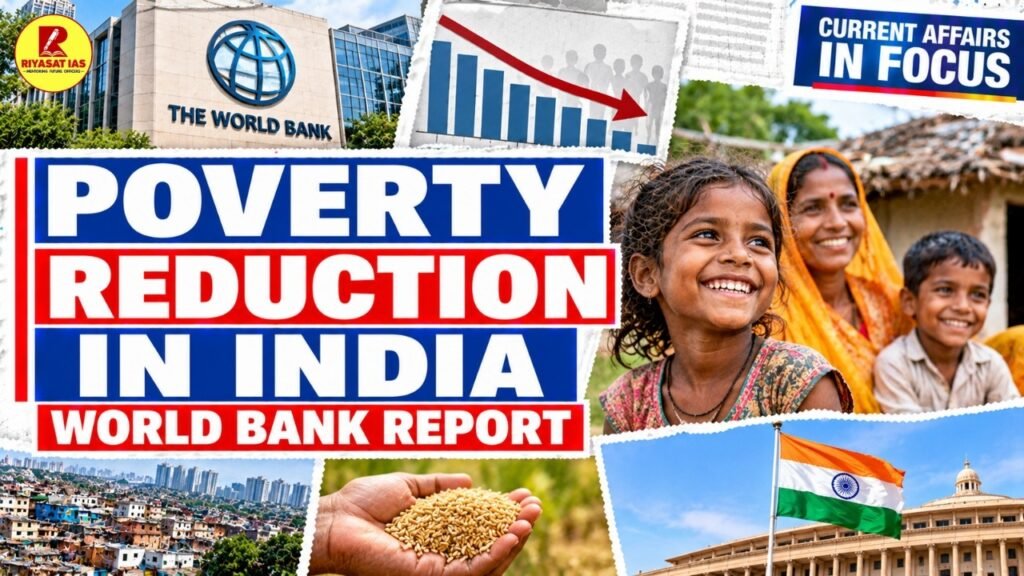
- The World Bank’s October 2026 Poverty and Equity Brief indicated that India’s extreme poverty rate had decreased drastically to 2.6 percent in 2023, as compared to 27.1 percent in 2011.
- Ongoing Problems: Wage differences remain and regions with high levels of poverty continue to exist.
India’s Progress in Poverty Reduction
- Global Ranking: In its October 2026 Poverty and Equity Brief, the World Bank stated that India has had one of the highest rates of reduction in poverty globally during the last ten years.
A. Lower Middle-Income Poverty Line ($4.20/day)
- From 2011 to 2023, the percentage of people in India who live below the poverty line decreased from 57.7% to 16.1%.
- An estimated 496 million people moved above that poverty threshold.
B. Extreme Poverty ($3/day)
- Extreme poverty declined substantially from 27.1% in 2011 to 2.6% in 2023.
- The decrease in extreme poverty during the years of 2022-2023, as well as the year of 2023, indicates that the rate has been cut in half.
Multidimensional Poverty Reduction
- OPHI-based MPI: Based on the Oxford Poverty and Human Development Initiative (OPHI) methodology, India’s Multidimensional Poverty Index (MPI) dropped from 53.8% in 2005–2006 to 16.4% in 2019–2021.
- The World Bank’s Multidimensional Poverty Index (MPI) for India was estimated to be 15.5 percent during the period of 2022-23.
- These indicators indicate that the improvement in this area goes beyond the consumption and income of households.
Factors Behind Poverty Reduction
- Strong Consumption Growth: The growth of strong consumption has improved the quality of life through the improvement of living conditions.
- Employment Growth: Between 2017 and 2023, the number of employed individuals rose by about 13.4 crore, which is almost double the growth of the labor force.
- Women’s Participation in the Labor Force: A large portion of the employment growth resulted from rural women entering the paid workforce and thereby increasing the number of wage-earners in each household.
- Social Transfers: The increased level of government support, such as food subsidies, has enhanced the welfare of households.



Persistent Challenges: Inequality and Regional Concentration
A. Wage Inequality
- Wage disparities remain pronounced in India.
- In 2023, median income for the upper 10 percent of workers was about 13 times that of the lower 10 percent.
- Consumption-based Gini Index:
- Declined from 28.8 in 2011–12 to 25.5 in 2022–23.
- Further declined to 23.0 in 2023.
- The World Bank has stated that consumption surveys of households do not provide a complete picture of the consumption habits of high income households, which can lead to an underestimation of wealth inequality.
B. Geographical Concentration of Poverty
- Poverty is becoming increasingly concentrated geographically.
- Approximately 57% of India’s poor people are living in an unbroken strip across the country from Uttar Pradesh to West Bengal.
- Reducing poverty even further is dependent upon creating more job opportunities and providing productive work for people living in the states.
C. Employment Quality and Youth Unemployment
- Employment Growth: From 2017 to 2023 there was a large increase in the number of employed people, but their actual income did not change very much.
- Low Productivity: Employment was created in areas of the economy that are less productive than other parts of the economy.
- Rising Youth Unemployment:
- The rate of unemployment among young people grew from 14.6 percent in the initial quarter of fiscal year 2025-2026 to 15.9 percent in the same period of fiscal year 2026-2027.
- The increase was particularly notable among rural young women.
- The differences in employment growth versus job stability, productivity and adequate pay are apparent through these trends.
Way Forward
- Sustaining Poverty Reduction: Maintain continuous action to decrease poverty in terms of money as well as in other aspects of life.
- Reducing Wage Inequality: Address long-term income gaps between those who make the most money and those who make the least.
- Regional Development: The regional development strategy should concentrate on the concentrated poverty areas that exist along the U.S. East Coast (from Uttar Pradesh to West Bengal).
- Productive Employment: Productive employment means promoting stable, productive and fair-paying jobs.
- Women’s Labor Market Participation: Increase available paid jobs for women living in rural areas.
- Youth Employment: Emphasize job opportunities for young people, specifically rural young women.
- Inclusive Growth: Ensure that changes to the levels of consumption, employment and social transfers result in long-term improvement to the welfare of households.
Conclusion
- India has made significant progress in reducing poverty through increases in household spending power, job creation, increased female labor force participation and social welfare programs.
- However, major obstacles exist in the form of wage disparities, geographic concentration of poor populations, poor productive employment opportunities, and increasing young adult unemployment.
- Inclusive growth is dependent upon shifting from poverty reduction alone to sustainable livelihoods, productive employment, and equal opportunity for all.
UPSC Mains Practice Question
Q. India has achieved significant progress in reducing monetary and multidimensional poverty. However, persistent wage inequality, regional concentration of poverty and employment-related challenges raise concerns about the inclusiveness of this progress. Discuss.



 Ravi Raaz
 Hassan Khan
 Shadab Ali