
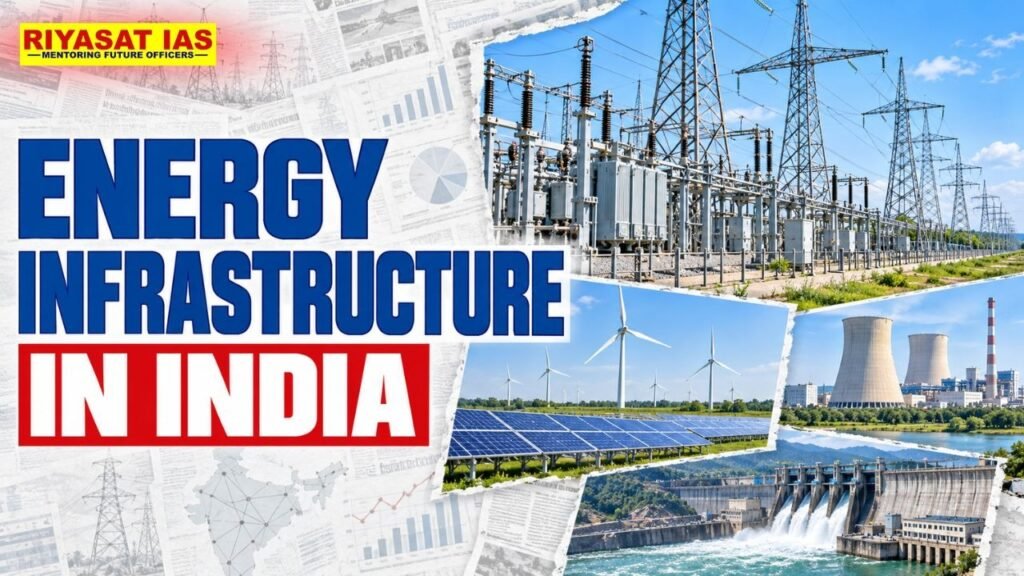
Energy infrastructure refers to networks and facilities used to extract, produce, transmit, and deliver power. From factories and electric vehicles to agricultural pumps and urban lighting, everything in India depends on a steady and affordable electricity supply. India’s energy infrastructure connects thermal power plants and ultra-high voltage transmission lines to overseas oil terminals, gas pipelines, and renewable energy installations.
Electricity in India
- India’s electricity grid is one of the largest synchronous power grids in the world in terms of total electricity generation and consumption. As of the first half of 2024, the country’s total utility installed electricity generation capacity reached about 446 GW, setting new records in summer due to record-breaking peak demand.
- The electricity transmission system comprises over 4,85,544 circuit kilometers of electric power lines and 1,18,740 MW of interconnectors. This network ensures that electricity generated in one part of the country, such as a wind farm in coastal Tamil Nadu, can reach another part of the country, such as the industrial belt of Gujarat.
Key Government Initiatives
The major initiatives include:
- Integrated Power Development Scheme (IPDS): Focuses on smart meters and distribution transformer upgradation to reduce transmission losses in urban areas.
- DDUGJY: Aims to provide separated feeders for agricultural and domestic electricity consumption in rural areas.
- Saubhagya: Targets last-mile electricity connectivity by providing direct domestic electricity connections in rural and urban India.
- SAMARTH: Promotes the co-firing of biomass in thermal power plants to reduce carbon emissions and dependence on coal.
- One Sun, One World, One Grid (OSOWOG): Aims to interlink electricity grids of different countries and continents to share renewable energy.
- UJALA: Promotes energy-efficient LED bulbs, tubes, and fans through subsidies to reduce peak electricity demand.
- Street Lighting National Programme: Aims to replace street lights with electronic controls and LEDs to save energy and reduce costs for local governments.
Coal
Coal provides the backbone of India’s electricity generation and has the highest percentage among all energy sources. India is the second-largest producer and consumer of coal in the world, recording 997.83 million tonnes of coal production in FY2023-24.
Challenges
The high dependence on coal poses several challenges for the government, policymakers, and the economy. Coal combustion causes greenhouse gas emissions and air pollution. Indian coal also contains high levels of ash, averaging 35–45%, which complicates electricity generation and creates millions of tonnes of waste every year.
Other major challenges include:
- Capital-intensive mining and the difficulty of reaching deep-seated coal seams.
- Concentration of coal mining in Odisha, Jharkhand, and Chhattisgarh, requiring long-distance transportation to northern and western India.
- Dependence on railways for transporting coal to electricity-producing regions.
- Expensive retrofitting of coal plants to reduce emissions.
Government Initiatives
The government is taking steps to increase coal production and reduce reliance on imported coal, including opening the coal sector to private companies through auctions.
It also promotes cleaner and more efficient coal-based technologies and biomass co-firing:
- Supercritical and ultra-supercritical technologies allow coal to be burned at higher temperatures and pressure.
- These technologies help generate more electricity and reduce emissions.
- Biomass co-firing is promoted in coal power plants.
Crude Oil
Petroleum-based energy sources play an essential role in India’s energy mix and economy. India relies on imported crude oil for about 85% of its domestic crude oil requirements. At the same time, oil exploration and production suffer from declining production rates from aging fields such as Mumbai High. India has become highly dependent on imported crude oil, which has become increasingly expensive due to exchange rate risks, geopolitical tensions, and price volatility.
To ensure a stable and predictable supply of oil, India has built strategic reserves in:
- Visakhapatnam
- Mangalore
- Padur
These are strategically located underground rock caverns.
On the exploration front, the government introduced the Hydrocarbon Exploration and Licensing Policy (HELP) to encourage private exploration and production by allowing oil and gas companies to bid for oil blocks on an acreage basis with revenue-sharing instead of profit-sharing.
On the demand side, the Ethanol Blending Programme aims to reduce reliance on imported crude oil by replacing petrol with ethanol. The programme targets 20% ethanol blending in the 2025-26 fuel year.



Natural Gas
Natural gas is a vital energy source for India, helping to reduce carbon emissions and air pollution in urban centres. It is a cleaner-burning alternative to coal, although its production and use in India face several challenges.
Challenges
The main challenges associated with natural gas include:
- Lack of pipeline infrastructure, particularly to eastern and southern India.
- Lack of domestic production from deep-water fields.
- Pricing volatility.
- Regulatory complexities.
Government Initiatives
The government is addressing these challenges through the Natural Gas Grid and Pradhan Mantri Urja Ganga projects. These projects construct pipelines and gas transmission infrastructure to connect eastern and southern India with domestic gas fields and LNG terminals.
Other measures include:
- City Gas Distribution (CGD): Provides PNG to end-users and CNG for transport.
- Easing of domestic gas pricing regulations, allowing prices to be determined based on specific indices.
Renewable Energy in India
India aims to install 500 GW of non-fossil fuel-based electricity generation capacity by 2030. Renewable energy sources have become increasingly important as a way to reduce carbon emissions and promote economic growth.
Solar Energy
Solar power has been the backbone of India’s renewable energy promotion efforts and has become an increasingly important source of electricity generation. As of mid-2024, solar power in India reached about 85 GW of installed capacity and has an estimated potential of 748 GW.
Challenges
The major challenges associated with solar energy include:
- Land acquisition: Large solar plants require significant areas of land, which can lead to community opposition and regulatory issues.
- Supply chains: Domestic manufacturers face challenges in securing polysilicon, wafers, and other materials.
- Operations and maintenance: Solar plants require complex cleaning procedures, particularly in arid and hot climates.
- Financing: Aggressive reverse auctioning can reduce prices and profit margins, making developers vulnerable to financing and interest-rate fluctuations.
- E-waste: Solar panel waste will need to be processed and recycled when photovoltaic modules are decommissioned.
Government Initiatives
Major government initiatives supporting solar energy include:
- PM-KUSUM: Helps farmers install solar pumps and sell excess electricity to the grid.
- Production Linked Incentive (PLI): Provides financial incentives for domestic manufacturing of photovoltaic modules, cells, wafers, and ingots.
- Solar Parks Scheme: Provides allocated land and supporting infrastructure such as evacuation lines and road access.
- PM-Surya Ghar: Muft Bijli Yojana: Promotes rooftop solar power through capital subsidies and low-interest loans.
Wind Energy
India has a wind power installed capacity of over 46 GW as of 2024. Coastal areas and mountainous states of Tamil Nadu, Gujarat, Rajasthan, and Karnataka offer the best wind power generation potential.
Challenges
The major challenges include:
- High upfront capital expenditure associated with wind turbines.
- Requirement for transmission lines to remote wind-farm locations.
- Seasonal variability of wind power.
Government Initiatives
Two key initiatives are:
- National Wind-Solar Hybrid Policy: Promotes hybrid wind-solar power plants to optimize land use and smooth out power generation.
- Green Energy Corridor: Constructs interstate and intrastate transmission lines to evacuate wind and solar electricity to the grid.
Hydroelectricity
Hydroelectricity is a crucial component of India’s electricity generation mix, with around 47 GW of installed hydropower capacity as of 2024. Hydroelectric power plants provide flexible peaking power and serve as load-balancing mechanisms for solar and wind energy.
Challenges
The major challenges include:
- High construction costs.
- Resettlement of displaced people.
- Long project gestation periods.
Government Initiatives
India promotes hydroelectricity through the Green Energy Corridor, which constructs transmission lines to evacuate hydropower to the grid.
Biofuels
India has abundant biofuel feedstocks, such as sugarcane juice, molasses, and bagasse, that can be refined into ethanol and biodiesel to displace petrol and diesel consumption while supporting farmers’ incomes.
Challenges
The main challenges include:
- Availability of feedstocks.
- High capital expenditure of biofuel refineries.
- Logistical challenges associated with ethanol transportation.
Government Initiatives
The major initiatives include:
- National Policy on Biofuels: Allows the use of various feedstocks, including maize, surplus grains, and sugarcane, to produce ethanol.
- PM JI-VAN Yojana: Provides financial support to ethanol refineries adopting advanced 2G technologies to refine agricultural waste into ethanol.
- Global Biofuels Alliance: Launched by India during its G20 presidency to promote international cooperation on biofuel production and use.
Green Hydrogen
Green hydrogen is a clean energy source produced by splitting water molecules with renewable electricity. It plays a critical role in decarbonizing hard-to-abate sectors like steel, refining, fertilizers, and transport.
Challenges
The main challenges include:
- High production costs.
- Storage and transportation complexities.
- Need for supportive regulations.
Government Initiatives
India promotes green hydrogen through the National Green Hydrogen Mission, which sets a target of 5 MMT of hydrogen production by 2030 and aims to make India a global manufacturing and trading hub for green hydrogen.
The SIGHT programme provides financial incentives for domestic hydrogen electrolyzer manufacturing and production-linked incentives for hydrogen manufacturers.
Green hydrogen hubs will facilitate large-scale green hydrogen production and distribution, linking India’s renewable electricity production with the transport, refining, fertilizer, and steelmaking sectors.
Energy Infrastructure in India: Future Outlook
India’s future energy infrastructure will play a critical role in supporting the country’s economic development and energy security while addressing climate change and environmental concerns. The following are the key recommendations for India’s energy infrastructure:
Strengthening Electricity Transmission, Smart Grids, and Storage
High-voltage direct current transmission, smart grids, and large-scale battery storage will play a critical role in reducing electricity transmission losses and balancing electricity supply and demand.
Reducing Coal and Imported Oil
India needs to reduce its reliance on coal, natural gas, and imported oil while transitioning to zero-emission energy sources.
Three key ways include:
- Developing oil and gas fields.
- Electrifying railways.
- Promoting biogas and ethanol blending.
These measures can help reduce India’s reliance on coal, natural gas, and imported oil.
Expanding Solar, Wind, Hydro, and Biofuels
India should prioritize expanding its electricity generation from renewable energy sources to achieve net-zero emissions by 2070.
Key measures include:
- Maintaining the current pace of solar and wind power development.
- Promoting hybrid and round-the-clock electricity generation projects.
- Encouraging rooftop solar electricity generation.
Domestic Manufacturing
India needs to build domestic manufacturing capacity to produce:
- Solar PV modules
- Batteries
- Wind turbines
- Hydrogen electrolyzers
This can help reduce dependence on imports and support local manufacturers.
Green Hydrogen
India needs to develop an extensive green hydrogen value chain that connects renewable electricity producers with hydrogen consumers in hard-to-abate sectors to contribute to its goal of net-zero emissions by 2070.
Social Responsibility
India needs to invest in eastern and central India to offset the loss of economic opportunities in coal mining and power plants and ensure a just transition to net-zero emissions by 2070.
FAQs about Energy Infrastructure
What are the main components of energy infrastructure?
The main components of energy infrastructure are the networks and facilities that enable the extraction, production, transmission, and distribution of electricity and other forms of energy.
What are India’s renewable energy goals?
India aims to achieve 500 GW of non-fossil fuel-based installed power capacity by 2030.
What is the National Green Hydrogen Mission?
The National Green Hydrogen Mission promotes green hydrogen production and use in India and sets a target of 5 MMT of hydrogen production by 2030.
What are the main challenges of renewable energy?
Some of the main challenges of renewable energy concern the intermittency of electricity generation and the high capital expenditures of storage, transmission, and grid stability. Other challenges include land acquisition, supply chains, and e-waste management.


 Ravi Raaz
 Hassan Khan
 Shadab Ali