
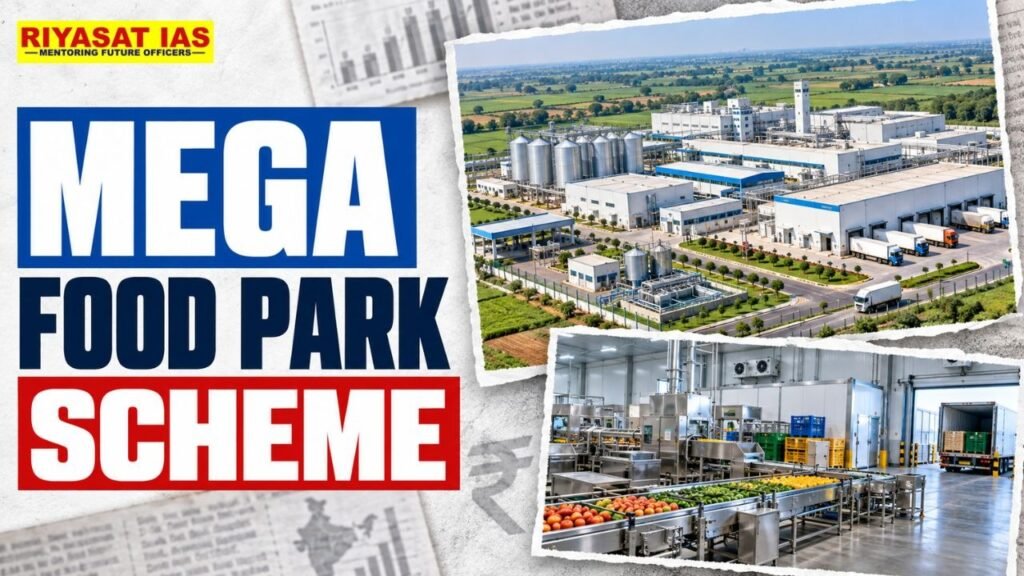
The Mega Food Park Scheme (MFPS) was a scheme introduced by the Ministry of Food Processing Industries (MoFPI) in 2008 to strengthen the country’s food-processing sector. The fundamental approach was an integrated approach to creating infrastructure that would link farmers, processors and markets.
The scheme specifically targeted perishable agricultural and horticultural produce, with the goal of reducing wastage, increasing value addition, improving farmers’ market linkages and creating employment in rural areas.
What Is the Mega Food Park Scheme?
- The Mega Food Park Scheme followed a cluster-based approach, aiming to create modern infrastructure in areas with significant agricultural or horticultural production to facilitate efficient movement of raw material from farms to processing units and then to the markets.
- In essence, the model was simple: farmers supplied produce to Collection Centres, which provided primary processing, which then moved through a cold chain to the Central Processing Centre before going to the markets.
- The approach aimed to create strong backward linkages with the farmers and forward linkages with processors and markets.
Objectives of the Mega Food Park Scheme
The Mega Food Park scheme aimed to:
- Reduce post-harvest losses, especially of perishable commodities.
- Promote value addition to agricultural and horticultural products.
- Connect farmers with processors and markets.
- Improve food-processing supply chains’ efficiency.
- Encourage private investment in food processing.
- Create employment in rural areas.
- Provide modern infrastructure for food-processing businesses.
- Strengthen backward and forward linkages across the value chain.
The scheme targeted to ensure that agricultural produce generated more value rather than being sold as raw commodities.
Cluster-Based Approach
- The Mega Food Park model was based on the creation of a large integrated food-processing cluster.
- Instead of each processing company creating its own infrastructure, common facilities could be created within the park to be shared by various enterprises.
- The original model included a well-defined agricultural or horticultural production zone connected to the processing facilities via an organised supply chain, expected to create procurement, storage and distribution efficiencies.
Major Components of a Mega Food Park
A Mega Food Park model typically consisted of several facilities covering different aspects of the supply chain.
- Collection Centres: Collection Centres (CCs) were the ones responsible for collecting agricultural produce from farmers and adjacent production areas.
- Primary Processing Centres: Primary Processing Centres (PPCs) provided facilities for cleaning, sorting, grading and initial processing activities.
- Central Processing Centre: The Central Processing Centre (CPC) functioned as the central component of the food park, with the provision of common infrastructure and facilities for food-processing units.
- Cold-Chain Facilities: Cold-chain infrastructure was an integral part of the model, especially for fruits, vegetables, dairy, meat, fish etc.



Cold-chain facilities help in maintaining the quality and shelf-life of the product during storage and transportation.
Industrial Plots
- The parks also provided developed industrial plots for setting up food-processing units.
- These facilities were expected to create an integrated farm-to-market supply chain.
Financial Assistance Under the Mega Food Park Scheme
The Central Government provided capital grant assistance of up to ₹50 crore per project.
The assistance was of:
- Up to 50% of eligible project cost in general areas.
- Up to 75% of eligible project cost in difficult and hilly areas.
- Subject to a maximum ceiling of ₹50 crore per project.
The assistance aimed to support the development of common infrastructure and facilities required for the food-processing cluster.
Role of Special Purpose Vehicle
- A Special Purpose Vehicle (SPV) was utilised for implementing a Mega Food Park project.
- The SPV was a body corporate registered under the Companies Act and was responsible for developing and managing the project.
- The idea was to bring the participating stakeholders together under a professionally managed structure, as opposed to individual processing units handling infrastructure development.
Mega Food Park Scheme and PMKSY
- The Mega Food Park Scheme was one of the components associated with the Pradhan Mantri Kisan SAMPADA Yojana (PMKSY).
- However, an important current update is that the Mega Food Park component has been discontinued from 1 April 2021, with existing commitments relating to already approved projects dealt with separately.
- The Government subsequently gave more emphasis to other infrastructure models, such as the Infrastructure for Agro-Processing Clusters (APC) scheme.
Current Status of Mega Food Parks
- The figure of 22 operational Mega Food Parks is no longer the latest official figure, according to the current information from the Ministry of Food Processing Industries. According to current information, 41 Mega Food Park projects have been approved, of which 25 are operational.
- The scheme itself is not open for new projects, having been discontinued as of 1 April 2021.
- This distinction is important when preparing current exam notes: Mega Food Parks continue to exist as operational projects, but the original scheme has been discontinued for new projects.
Why Was the Mega Food Park Scheme Discontinued?
- The Government’s review found the implementation of the scheme to be relatively slow, and the requirement of a large land area was considered a constraint, especially in hilly and difficult areas.
- The Government subsequently introduced the Infrastructure for Agro-Processing Clusters (APC) model, which follows a similar cluster-based approach but is designed for comparatively smaller geographical areas.
- Thus, the policy focus shifted from the mega food park model to agro-processing clusters and other food-processing infrastructure schemes.
Mega Food Parks vs Agro-Processing Clusters
| Feature | Mega Food Parks | Agro-Processing Clusters |
| Approach | Large integrated food-processing cluster | Smaller processing cluster |
| Main focus | Farm-to-market infrastructure | Common infrastructure for processing units |
| Land requirement | Larger land area under the original model | Comparatively smaller area |
| Current status | Discontinued for new projects from 2021 | Continuing under PMKSY |
| Basic objective | Reduce wastage and promote value addition | Strengthen processing infrastructure and value chains |
Significance of the Mega Food Park Model
- The significance of the Mega Food Park concept goes beyond the park itself. It attempted to tackle several problems encountered by India’s food-processing sector at the same time.
- It aimed to bring production, collection, storage, processing and marketing closer together. Shared infrastructure could reduce setup costs for processing facilities, while the cold-chain and primary-processing facilities could reduce losses of perishable produce.
- The model also aimed to strengthen links between farmers and food-processing companies, encouraging value addition rather than the simple sale of raw agricultural commodities.
Conclusion
The Mega Food Park Scheme represented an integrated approach to developing India’s food-processing infrastructure. Its focus was on creating strong supply chains, reducing post-harvest losses, promoting value addition, improving farmer-market linkages and generating rural employment.
Although the scheme was discontinued for new projects from 1 April 2021, its core objectives continue through other food-processing infrastructure initiatives, particularly Agro-Processing Clusters and cold-chain programmes, under PMKSY.
Frequently Asked Questions (FAQs)
When was the Mega Food Park Scheme launched?
The Mega Food Park Scheme was launched in 2008 by the Ministry of Food Processing Industries (MoFPI).
What was the main objective of the Mega Food Park Scheme?
The Mega Food Park scheme aimed to create modern shared food-processing infrastructure, strengthen farm-to-market linkages, reduce post-harvest losses and promote value addition.
What is the hub-and-spoke model of the Mega Food Parks?
The Mega Food Parks model links rural collection centres and primary processing centres to a central processing hub that connects to domestic and export markets.
What was the maximum financial assistance under the scheme?
The government provided a capital grant of up to ₹50 crore per project, subject to the applicable percentage of eligible project cost.
What was the grant for general areas?
For general areas, assistance was 50% of eligible project cost, subject to a maximum of ₹50 crore per project.
What was the grant for difficult and hilly areas?
For difficult and hilly areas, assistance was 75% of eligible project cost, subject to a maximum of ₹50 crore per project.
How many Mega Food Parks were approved?
41 Mega Food Parks have been approved under the scheme.
How many Mega Food Parks are currently operational?
As per current MoFPI records, 25 Mega Food Parks are currently operational across the country.
When was the Mega Food Park Scheme discontinued?
The scheme was discontinued for new sanctions with effect from 1 April 2021, with provisions retained for committed liabilities of ongoing projects.
What replaced the Mega Food Park approach?
The government introduced the Agro-Processing Clusters (APC) approach under PMKSY, which provide similar common infrastructural facilities within smaller geographic footprints of at least 10 acres.



 Ravi Raaz
 Hassan Khan
 Shadab Ali