
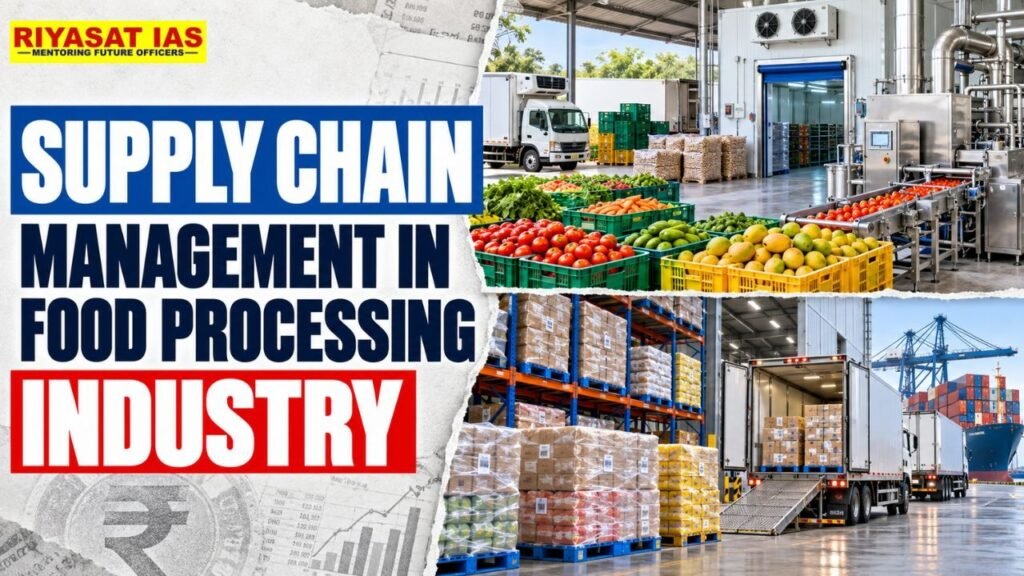
While talking about food processing, most people think of canning lines, large-scale pasteurization vats or gleaming tetra-pack machines. However, this capital intensive machinery often lies idle without a functioning supply chain to support it.
Food supply chain management (SCM) works as the bridge, transporting a harvest from village fields to urban dining tables. This SCM in this sector is very different from other industries in general dealing with auto components, garments, etc. Steel components don’t rot when a lorry is stuck for 12 hours at an interstate check-post; fresh produce, dairy and fish do.
SCM in this sector is a race against time, and proper SCM acts as a buffer against seasonal price crashes, ensures processing units operate round-the-year and offers reliable retail outlets both in domestic and overseas markets.
What is Supply Chain Management in Food Processing?
Food supply chain management is the entire process of getting agricultural harvest, dairy, livestock and marine produce to the consumer’s plate.
The logistics generally work out as:
Farm → Aggregation Point → Sorting & Grading → Pre-cooling / Cold Storage → Processing Plant → Packaging → Warehousing → Wholesale & Distribution → Retail Shelf → Consumer
Since freshly harvested milk, poultry, berries and green vegetables start rotting immediately after harvest, even delays at a single node in this chain leads to heavy losses.
Importance of Supply Chain Management in Food Processing
Stemming Post-Harvest Waste: A benchmark survey by NABCONS (2020-22) showcased that 6.02% to 15.05% fruits, 4.87% to 11.61% of vegetables and 3.89% to 5.92% cereals rot before reaching a consumer. Packing houses, reefer vans and local chilling units are the only way to cut down seasonal wastage.
Ensuring Fair Returns to Growers: Small growers with no storage facilities are forced to sell their harvest at a throwaway price to local commission agents at the time of bumper harvest. Creating FPOs (Farmer Producer Organisations) and contract farming ensures direct procurement, with assured prices to the growers.
Protecting Food Safety at Farm Level: Processing units cannot undo rotting or chemical contamination. Ensuring farmers use clean plastic crates instead of jute bags, chilling milk immediately after milking and simple pesticide residue tests goes a long way in protecting food safety.
Creating Rural Value Addition: Value of raw agricultural produce is limited. Processing this into puree, juice concentrates or canned products requires uninterrupted supply of raw material. A steady supply chain helps keep processing lines running even outside harvest seasons, generating employment in rural areas.
Fueling Exports: Overseas buyers tend to be particular about quality and regular supply schedules. A proper SCM has helped India transform from exporting raw grains to value-added food products. As per MoFPI (Ministry of Food Processing Industries) reviews, percentage of processed products in India’s total agri-food exports rose from 13.7% in 2014-15 to 23.4% in 2023-24.
Dampening Price Volatility: During winter, with vegetable glut, wholesale prices nose dive, only to shoot up during summer. Processing excess harvest into frozen, canned or dehydrated products serves as a buffer against erratic price movements, benefiting both consumers and growers.
Generating Non-Farm Employment: As mentioned earlier, SCM is highly labor-intensive, offering jobs across rural districts in sorting, cold storage, quality testing, loading/unloading and transportation.
Clearing Distribution Bottlenecks: A smooth logistics network helps clear red-tapism, manual unloading cycles and routing problems, which cause spoilage of fresh produce on the highway.
Challenges in Food Processing Supply Chain
Extreme Land Fragmentation: Most Indian farmers practice subsistence farming on small plots of land of less than two hectares. This makes procurement of hundreds of quintals of processing-grade potatoes, tomatoes or other vegetables difficult, since it has to be sourced across dozens of growers.
Perishability and Time Factor: Unlike grain bags that can be stored in a godown for months, horti-crops and animal husbandry products start decaying immediately after harvest and require immediate processing.
Severe Gaps in Farm-Gate Cold Chains: Cold storage in India has so-far been used to store raw potatoes in bulk. With public funding, 408 cold-chain projects have been approved by March 2026 under MoFPI. However, number of reefer trucks and pack-houses at village collection points are still inadequate.
Post-Harvest Handling Damage: Manual harvesting causes bruising of delicate skin of fruits/vegetables, followed by transfer to jute gunny bags and loading onto open-top tractors, leading to bacterial rot during transit.
Buyer-Farmer Trust Deficit: Processors complain about farmers selling their contracted produce to local commission agents when open market prices rise. Similarly, farmers complain about processors cutting off supply when their quality specifications are not met.
Deficits in Rural Infrastructure: Poor feeder roads, unreliable three-phase electricity and inadequate rural telecom connectivity increase transportation costs and disrupt cold-chain logistics.
Food Safety and Chemical Residues: Meeting international Maximum Residue Limits (MRLs) of pesticides, fungicides and heavy metals is extremely difficult when sourcing from hundreds of small farms. A contaminated consignment can lead to rejection of an entire container at the foreign port.
Prohibitive Domestic Logistics Costs: India has disproportionately high logistics costs compared to emerging economies. Reliance on diesel-run road transport, multiple manual unloadings and interstate border checks inflate costs for processors.
Seasonal Surpluses Against Constant Demand: Processing units have to work around the clock for 6-8 weeks during harvest season, followed by frantic searching for raw material during the rest of the year.
Opaque Traceability and Manual Stock Records: Outside leading consumer brands, most Indian food processing relies on manual stock records. During a food-safety scare, it is almost impossible to trace back the affected consignment and isolate it.
High Market Volatility: Unseasonal rains, pest attacks and export bans lead to violent price swings, impacting the bottom-line of food companies that sell branded products at fixed prices.
Location of Factories Away from Fields: Processing plants are located close to metro cities to reduce transportation costs. This requires long distance transportation of delicate horti-crops without temperature control, resulting in heavy losses.
Capital Scarcity for Micro-Enterprises: Cold rooms, stainless-steel sorting lines and reefer vans are capital-intensive. Small processors and FPOs (Farmer Producer Organisations) are unable to get collateral-free loans from banks.
Deficit of Technical Field Personnel: There is a shortage of field staff in the food processing sector, with lack of expertise in food technology, HACCP (Hazard Analysis Critical Control Point), cold-chain temperature monitoring and commercial sorting.
Cumbersome Regulatory Clearances:Multiple clearances for separate licenses, local APMC (Agricultural Produce Market Committee) cess, disclosure of packing material, pollution board consent and food safety audit add to the cost for small processors.
Way Forward
Push Infrastructure to Farm-Gate
Pack-houses, primary grading lines and small solar-powered pre-cooling chambers should be located at the village level and not in distant industrial parks. Chilling of produce should be done immediately after harvest to prevent deterioration.



Build Unbroken Cold Highway
Temperature control is not enough at the warehouses; India needs seamless reefer truck connection from farm-gate collection points to processing hubs, rail-heads and ports.
Scale Up Farmer Producer Organisations
FPOs should be encouraged to not only aggregate raw produce but also perform washing, sorting, grading and preliminary pulping or drying at source.
Draft Transparent, Enforceable Supply Contracts
Long-term contract farming requires clearly defined grading criteria, automated weigh-bridge, minimum-guaranteed-price formulae and local dispute-resolution bodies.
Roll Out Accessible Digital Traceability
QR code stickers on transport crates, real-time IoT temperature sensors inside reefer trucks offer complete transparency, fetching credibility with modern consumers and international phytosanitary (plant health) inspectors.
Incentivize Agro-Processing Hubs in Farming Belts
State governments should provide land, power and shared effluent treatment infrastructure within major horti-crop growing belts and not push for agro-processing in metro cities.
Decentralize Testing Infrastructure
Processing companies and exporters require quick lab test results. Setting up regional testing hubs with NABL (National Accreditation Board for Testing and Calibration Laboratories) accreditation as per MoFPI guidelines helps local processors and FPOs test for pesticide residues and aflatoxins.
Shift Freight to Rail and Multimodal Corridors
Shifting long-distance perishables and processed cargo from national highways to rail wagons and inland waterways can cut logistics costs and time.
De-Risk MSME Financing
Micro enterprises and startups in small towns need collateral-free credit lines and shared testing-packaging facilities to help local brands break into formal retail chains.
Harness Real-Time Data and AI for Procurement
Satellite-based crop-acreage estimates, ground weather forecasts and historical retail sales data can help food companies with demand forecasting and procurement planning.
Invest in Skill Centers
Polytechnics and ITIs (Industrial Training Institutes) need to offer courses in cold-chain maintenance, automated packaging operation, food technology and hygiene.
Create Unified Single-Window Gateway
Doing away with overlapping approvals and switching to automated digital clearances and risk-based food safety audits will save entrepreneurs’ time and effort.
Government Initiatives Supporting Food Supply Chains
The central government has several targeted schemes for removing logistics bottlenecks, modernising infrastructure and scaling up:
Pradhan Mantri Kisan SAMPADA Yojana (PMKSY)
This is the main national infrastructure scheme, focusing on creating modern agro-processing clusters, mega food parks, integrated cold chains and preservation infrastructure in production belts.
Pradhan Mantri Formalisation of Micro Food Processing Enterprises (PMFME)
PMFME targets the unorganized rural micro-players, providing credit-linked capital subsidy, technical upgradation and institutional hand-holding to help SHGs (Self Help Groups) and small cooperatives scale up and enter organized markets.
Production Linked Incentive Scheme for Food Processing Industry (PLISFPI)
With adequate budgetary allocation, this scheme provides volume-based financial incentives to large food manufacturing companies to boost processing volumes and build competitive Indian food brands internationally.
FAQs on Supply Chain Management in Food Processing
What is Supply Chain Management in the Food Processing Industry?
It is the entire process of transporting agricultural harvest from rural fields to urban dining tables through collection, sorting, cold storage, industrial processing, packaging, warehousing and wholesale-retail networks.
Why is Supply Chain Management Uniquely Important for Food?
Unlike hard goods, food commodities tend to decay rapidly and react adversely to heat and rough handling. An efficient chain reduces physical waste, secures fair farm-gate prices, maintains hygienic standards and ensures steady supply of raw material to factories.
What are the Biggest Challenges India Faces in Food Logistics?
Fragmented smallholder land plots, absence of cold storage near village gates, high harvest-transit waste, weak buyer-seller contracts, high road transport expenses and shortage of trained food-handling technicians.
How do FPOs Strengthen Food Supply Chains?
FPOs aggregate crops from hundreds of small growers, helping them bypass exploitative village commission agents and negotiate directly with commercial processors.
Why are Cold Chains So Critical for Perishables?
Dairy, seafood, meat, berries and vegetables tend to rot rapidly and develop harmful bacteria at warm temperatures. Cold-storage rooms and reefer trucks bring down temperatures immediately after harvest, arresting bacterial growth.
How Does Technology Improve Supply Chain Efficiency?
IoT temperature loggers, batch-level QR codes, automated optical sorting lines and AI demand-forecasting software eliminate guesswork, cutting down spoilage during transit and helping trace food safety back to the originating farm plot.
How Does Processing Help Curb Agricultural Waste?
During winter, with vegetable glut, unprocessed produce rots or has to be dumped at throwaway prices. Processing converts this into shelf-stable goods, preserving both the food and its commercial value for the off-season.


 Ravi Raaz
 Hassan Khan
 Shadab Ali