
Social influence refers to the process by which individuals adjust their thoughts, feelings, or behaviors in response to the real or imagined presence of others. According to social psychologists Kelman and Hovland, social influence can be categorized into three distinct types:
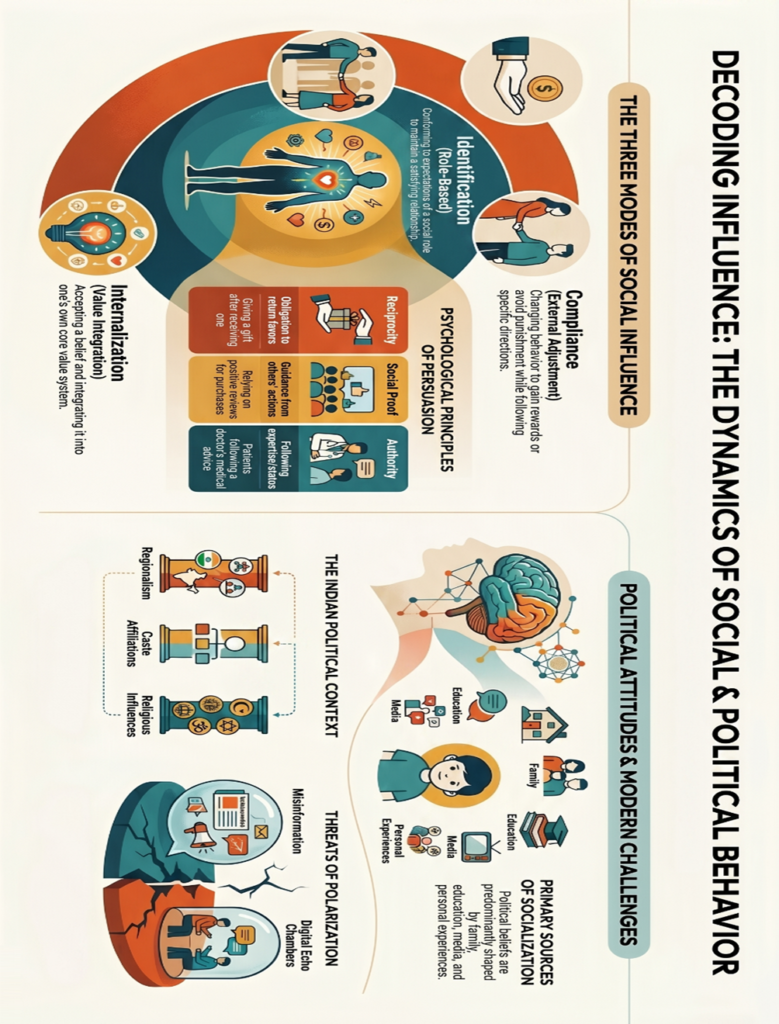
- Compliance: Involves changing one’s behavior due to the direct request or direction of another person or group. It is often driven by the desire to gain immediate rewards or avoid potential punishment. For example, a civil servant following executive orders from superiors to implement a specific local policy, even if they personally disagree with its underlying mechanics.
- Identification: Occurs when individuals conform to the expectations of a social role or group that they identify with. It is deeply influenced by the desire to establish or maintain a satisfying, self-defining relationship with that group. For example, a young politician deliberately adopting the speech patterns, attire, and public behaviors of a respected senior leader to gain acceptance and credibility within their party.
- Internalization: Happens when individuals completely accept a belief or behavior and integrate it deeply into their own personal value system. It is based on a genuine, independent belief in the objective correctness of the behavior or idea. For example, an environmental activist adopting strict sustainable lifestyle practices because they fundamentally believe in the moral importance of protecting the planet.
Mechanisms of Social Influence
- Normative Influence: Driven by the fundamental human desire to be liked, approved, and accepted by others within a social circle. For example, dressing in a specific manner to seamlessly fit in with peers at a formal social event.
- Informational Influence: Occurs when individuals look to others for reliable guidance in uncertain, ambiguous, or critical situations, treating others’ choices as evidence of correct reality. For example, strictly following the running direction and actions of a crowd during an emergency evacuation.
- Cultural Influence: Shaped by the overarching cultural norms, values, and historical scripts that are prevalent in a given society. For example, observing specific religious rituals and customs that are widely practiced and normalized within one’s community.
Principles of Social Influence
- Reciprocity: People naturally feel psychologically obligated to return favors, gifts, or kindness received from others. For example, if a friend buys you coffee, you feel a strong structural inclination to buy them a drink next time as a reciprocal gesture of goodwill.
- Consistency: Individuals strive to align their current actions and future choices with their past statements, public commitments, or behaviors to maintain cognitive harmony. For example, if someone commits to an expensive gym membership, they are significantly more likely to continue attending to remain consistent with their public commitment to fitness.
- Social Proof: People routinely look to others’ actions to guide their own behavioral choices, especially in ambiguous or high-risk situations. For example, if an online product displays thousands of positive reviews, new customers are far more likely to purchase it, trusting the collective judgment of previous consumers.
- Liking: We are naturally far more likely to be persuaded and influenced by people we genuinely like, relate to, or admire. For example, a highly charismatic public speaker can persuade a diverse audience more effectively because the listeners feel an instant connection or deep admiration for them.
- Authority: People possess a strong tendency to follow the guidance, instructions, or commands of designated authoritative figures or certified experts. For example, patients are highly likely to follow a doctor’s medical advice due to their institutionalized professional expertise and status.
- Scarcity: Limited availability or a perceived shortage drastically increases the estimated value of an item, service, or opportunity. For example, marketing phrases like “limited time offer” generate an immediate sense of urgency, making consumers more eager to purchase the product before it becomes unavailable.
Social Influence in the Indian Context
- Family Influence: Families play an absolute, foundational role in shaping individual behaviors, academic choices, and major lifecycle decisions. Deep respect for familial elders and strict adherence to parental expectations remain common social norms. For example, personal career choices and matrimonial decisions are frequently guided by parental expectations and long-standing family traditions.
- Caste and Community: Caste and community affiliations significantly channelize social interactions, localized networking, and personal choices in India. For example, major life milestones, community functions, and marital alliances are often arranged within the same caste or community boundaries.
- Religious Influence: Religious beliefs, rituals, and philosophical scripts exert a profound impact on daily lifestyles, community interactions, and social expectations. For example, strictly observing specific dietary restrictions or organizing community life around major religious festivals.
- Educational Influence: Educational institutions act as primary platforms for socializing individuals, instilling moral values, and shaping long-term ideological perspectives. Schools and colleges promote standardized social norms, deeply influencing students’ worldviews, civic duties, and career aspirations.
- Media Influence: Mass media, including television, regional cinema, and digital social networks, aggressively impacts social attitudes, public opinions, and behavioral trends. Popular culture and news media outlets continuously mold public opinion on various complex issues, from fashion trends to geopolitical views.



Social Influence in Civil Services
- Peer Influence: The systemic behaviors, ethical benchmarks, and attitudes of colleagues can significantly impact a civil servant’s actions, working style, and choices. For example, newly recruited civil servants frequently adopt specific administrative practices, formatting methods, and work ethics modeled by their experienced senior peers.
- Public Expectation: Civil servants are highly responsive to public sentiments and may prioritize administrative issues that are highly visible, politically pressing, or heavily demanded by the public, such as rapid urban infrastructure development or public safety overhauls.
- Political Influence: Political leaders and their agendas significantly shape the baseline priorities, project timelines, and strategic actions of civil servants. This includes aligning long-term departmental goals with the manifesto or welfare visions of the ruling political party.
- Legal and Regulatory Framework: Strict adherence to statutory laws, civil service rules, and institutional policies directly dictates the formal scope, boundary conditions, and execution of a civil servant’s duties and judicial decisions.
- Professional Ethics and Standards: A primary internal driver for civil servants is their professional code of conduct and ethical standards. Upholding unconditional integrity, objectivity, and transparency in public service delivery serves as the core moral compass guiding their bureaucratic conduct.
Political Attitudes
Political attitude refers to an individual’s specific perspectives, core beliefs, and deep emotional feelings about political issues, leaders, governing institutions, and civic events. These underlying psychological tendencies significantly influence ultimate political behavior, including voting patterns, civic participation, and public opinion.
Political scientists Gabriel Almond and Sidney Verba, in their seminal work “The Civic Culture,” emphasized that political attitudes are absolutely essential in shaping a healthy, sustainable democratic culture. They argued that a stable, resilient democracy relies on a functional mix of active and passive political attitudes among its citizens.
Formation of Political Attitudes
- Family Influence: Political socialization begins early at home, where family political discussions, values, and parental beliefs can strongly influence a child’s initial political leanings and long-term party affiliations.
- Education: Schools and universities shape political attitudes by providing structured knowledge about governance systems, history, and civic rights, while encouraging critical thinking about complex political choices.
- Media: Mass media channels, including television news and algorithmic social media feeds, heavily affect political attitudes by framing specific issues, setting agendas, and dynamically altering public opinion.
- Peer Groups: Friends, professional colleagues, and digital social networks act as an interactive filter, continuously reinforcing, validating, or challenging an individual’s political beliefs.
- Personal Experiences: First-hand life encounters, such as severe economic hardships, systemic unemployment, or personal interactions with law enforcement and the legal system, can profoundly impact an individual’s political attitudes.
- Cultural and Historical Factors: The broader cultural environment, historical legacies, and major generational political movements (such as anti-corruption struggles) deeply define collective political attitudes.
Implications of Political Attitudes
- Voting Behavior: Heavily dictates explicit voting patterns. Strong partisan attitudes or ideological alignments lead to highly predictable, consistent support for a specific political party.
- Political Participation: Individuals with strong, high-intensity political attitudes are significantly more likely to engage in active political behaviors, such as attending rallies, donating to campaigns, participating in protests, or engaging in public policy discussions.
- Public Opinion: Aggregated political attitudes shape the macro public opinion on social and economic issues, which in turn influences legislative agendas, party manifestos, and judicial oversight.
- Policy Support: Political attitudes determine the structural level of acceptance or resistance toward specific governance reforms. For example, public attitudes toward economic liberalization, universal social welfare subventions, or stringent environmental protection guidelines directly affect eventual policy sustainability.
Political Attitudes in the Indian Context
- Regionalism: Political attitudes in India are strongly shaped by distinct regional identities, local languages, and state-specific socio-economic priorities. For example, political attitudes in Tamil Nadu toward federal language policies are historically rooted in social movements protecting Tamil linguistic identity.
- Caste and Community: Identity-based affiliations wield an immense influence on political attitudes in India. Political parties frequently tailor their mobilization strategies, candidate selections, and welfare promises to appeal to specific caste equations, heavily channelizing localized voting behavior.
- Economic Policies: Attitudes toward major structural economic interventions—such as rapid privatization, foreign direct investments, or agricultural subsidies—vary widely across different socio-economic strata of Indian society.
- Youth Engagement: The political attitudes of the Indian youth are rapidly evolving, marked by an escalating, data-driven engagement with contemporary issues like administrative corruption, environmental governance, unemployment, and digital privacy rights.
Challenges and Reinforcement of Political Attitudes
Primary Challenges
- Polarization: High-intensity, unyielding political attitudes can lead to intense societal polarization, making legislative compromise, civil dialogue, and bi-partisan consensus exceptionally difficult. For example, sharp ideological divisions over major legislative reforms like the Citizenship Amendment Act (CAA) showcase deep polarization between different groups.
- Misinformation: The hyper-viral spread of coordinated misinformation, digital deepfakes, and doctored media can severely distort public political attitudes, leading to misguided civic beliefs and destabilizing actions.
- Populism: Populist leaders can manipulate collective political attitudes by bypass-reasoning, appealing to raw emotions, and offering simplistic, hyper-emotional solutions to complex systemic challenges, ultimately undermining democratic conventions.
- Echo Chambers and Confirmation Bias: Social media recommendation algorithms create digital echo chambers by continuously serving users content that exclusively aligns with their pre-existing beliefs. This reinforces confirmation bias, causing individuals to aggressively favor information that validates their political attitudes while completely ignoring contrary empirical evidence.
Strategies for Reinforcing Healthy Political Attitudes
- Civic Education: Promoting robust civic literacy programs in schools and communities that actively encourage independent critical thinking, constitutional morality, and informed, objective decision-making.
- Media Literacy: Educating citizens to critically evaluate digital information, identify deepfakes, and check sources before sharing content, which mitigates the impact of misinformation.
Example:
Crowdsourced Fact-Checking Modules: Independent platforms like Alt News, alongside standard verification cells of major news agencies, conducting massive public fact-checking workshops and deploying automated AI bots to help Indian net-citizens easily distinguish verified news from toxic misinformation.
- Inclusive Dialogue: Intentionally designing and encouraging institutional platforms for inclusive public dialogue, debates, and town halls across diverse political perspectives to actively reduce polarization and foster mutual respect.
- Community Engagement: Involving citizens directly in local governance to build a deep, practical sense of civic responsibility and administrative transparency.
Example: Participatory Urban Budgeting: The continuous success of the “My City My Budget” initiative in Bengaluru, where citizens directly vote on the allocation of municipal funds for local ward improvements. This builds public accountability and transforms passive political complaints into active civic co-creation.
- Encouraging Political Participation: Institutionalizing platforms like the “Youth Parliament” competitions across universities to allow young minds to constructively debate national policies, directly fostering a sophisticated, systemic understanding of legislative governance.
Previous Year Questions
Q. Law and ethics are considered to be the two tools for controlling human conduct so as to make it conducive to civilized social existence. Discuss how they achieve this objective. Giving examples, show how they differ in their approaches. (20 Marks)
Practice Questions
Question 1 Evaluate the impact of social influence on promoting civic responsibility and ethical behavior among Indian citizens. What strategies can be employed to foster a culture of vigilance and accountability in public life? (10 marks, 150 words)
Question 2 How does exposure to diverse political viewpoints through media and public discourse affect the development of political attitudes? (10 marks, 150 words)
Question 3 “The proliferation of algorithmic echo chambers and digital confirmation bias has transformed political attitudes from instruments of democratic consensus into tools of identity-based polarization.” Critically analyze this statement and suggest how public administrators can leverage social influence principles to rebuild social trust in fractured local communities. (10 marks, 150 words)



 Ravi Raaz
 Hassan Khan
 Shadab Ali