
Dr. Michael Sandel defines moral attitudes as “the perspectives through which individuals assess actions and situations in terms of moral principles. These attitudes shape our sense of duty, justice, and what we owe to others.” According to Sandel, moral attitudes are not merely passive reflections of societal norms but active components of our moral reasoning that inform how we respond to ethical dilemmas and complex societal issues.
Example: Ethical Supply Chains and Human Rights: Global consumers and sovereign procurement agencies actively boycotting solar panels or semiconductor components sourced from manufacturing plants utilizing state-sponsored forced labor or modern slavery. This demonstrates how a moral attitude against exploitation translates into geopolitical economic decisions.
Influence of Moral Attitude
- Positive Moral Attitude: Drives individuals to take proactive steps for societal well-being.
Example:
Community-Led Urban Micro-Forests: Citizens and youth collectives voluntarily creating urban Miyawaki forests and restoring depleted wetlands in highly populated metros to build micro-climate resilience, showcasing an active commitment to environmental ethics.
- Negative Moral Attitude: Results in regressive prejudices that justify exclusion or discrimination.
Example:
Algorithmic Bias and Xenophobia: Individuals harboring deep-seated negative moral attitudes toward specific migrant worker communities or minority groups, leading them to design or validate biased predictive policing algorithms that unfairly profile those groups under the guise of maintaining law and order.
Key Components of Moral Attitude
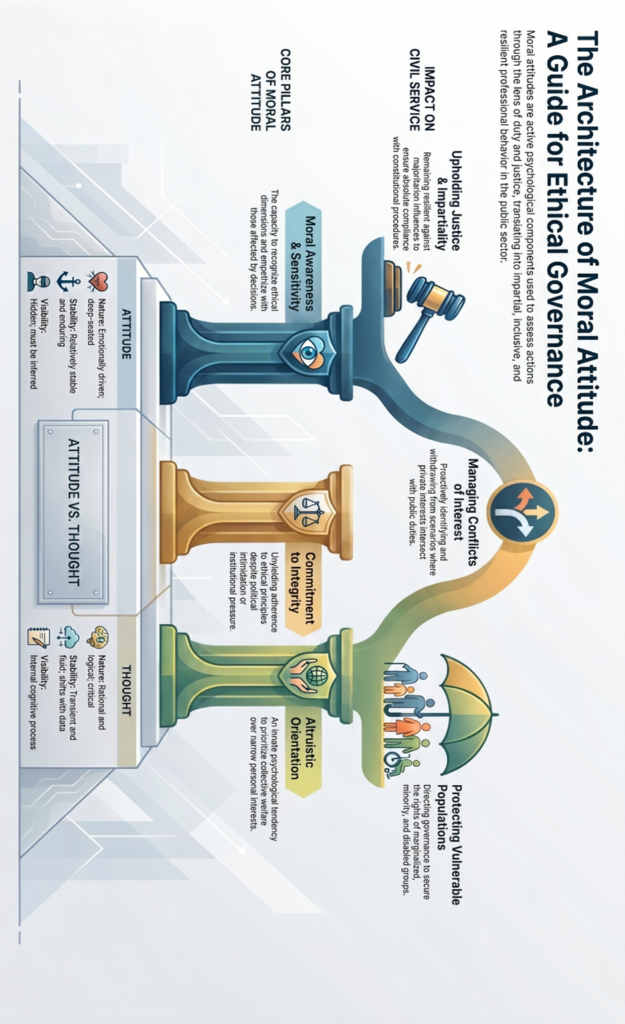
- Moral Awareness: The capacity to recognize the ethical dimensions of a situation and fully comprehend its broader moral implications. For example, a senior administrative officer recognizing the direct ethical conflict between rapid industrial land acquisition and protecting the habitat rights of indigenous tribal populations.
- Moral Sensitivity: The empathetic capacity to appreciate how one’s official decisions or personal actions affect the well-being of others. For example, a municipal commissioner going beyond statutory rules to design night shelters equipped with healthcare facilities for urban homeless populations during severe weather anomalies.
- Altruistic Orientation: An innate psychological tendency to prioritize public and collective welfare over narrow personal interests, frequently leading to self-sacrificial choices. For example, medical professionals and frontline administrators choosing to serve in highly volatile, epidemic-hit or conflict-ridden areas to provide critical care despite immense personal health risks.
- Commitment to Integrity: A steadfast, unyielding adherence to moral and ethical principles, ensuring absolute consistency between internal beliefs and external actions. For example, an investigative journalist or whistleblowing bureaucrat refusing to bury reports on illegal mining syndicates despite facing severe political intimidation or institutional pressure.
- Emotional Engagement: The intense emotional responses—such as moral outrage or deep compassion—that accompany moral beliefs, acting as a catalyst to motivate ethical intervention.
- Respect for Diversity: Intentionally recognizing and valuing different moral perspectives and cultural practices, actively promoting systemic tolerance and cross-cultural understanding.
- Dedication to Truth: An absolute commitment to honesty, verification, and transparency in all communications.
Example: Scientific Integrity in Climate Research: Environmental scientists and data analysts publishing unvarnished, accurate metrics on regional carbon emissions and industrial non-compliance, entirely resisting corporate or political pressures to dilute the severity of the findings to preserve economic investments.
Importance of Moral Attitude
- Expression of Core Beliefs: Moral attitudes serve as direct reflections of an individual’s deeply held ethical convictions, forming the psychological baseline for how they evaluate societal crises.
- Foundation for Social Cohesion: Shared moral frameworks are critical for maintaining peace and civil order. When an entire community collectively holds a positive moral attitude toward public resource management, it naturally establishes effective, localized conservation protocols.
- Personal Ethical Consistency: Consistently upholding one’s moral attitude ensures internal harmony, personal integrity, and authenticity, preventing the onset of psychological fragmentation.
- Professional Ethics: Guides professionals across sectors to prioritize long-term humanitarian considerations over immediate organizational profits or narrow material gain.
Moral Attitudes for Civil Servants
- Upholding Justice and Rule of Law: Ensures absolute impartiality and compliance with constitutional procedures, remaining completely resilient against political pressure or majoritarian influences.
- Managing Conflicts of Interest: Demands a high degree of transparency where civil servants actively identify, declare, and step away from scenarios where their private interests intersect with public duties, safeguarding public trust.
- Protecting Vulnerable Populations: Directs the operational focus of governance toward securing the statutory rights and social welfare of historically marginalized, minority, and disabled groups.
- Promoting Ethical Leadership: Involves setting an unyielding behavioral example within an organization, ensuring that every administrative decision is grounded in constitutional morality.
- Ethical Resource Management: Guarantees that public funds, infrastructure, and welfare materials are deployed optimally, equitably, and transparently, completely preventing leakage and patronage networks.
- Commitment to Inclusive Governance: Encourages grass-roots democratization by deliberately bringing the voices of marginalized communities into the active policy-making and implementation loop.



Challenges in Maintaining Moral Attitudes
- Systemic Corruption: Confronting deep-seated institutional rot where non-compliance with corrupt networks leads to administrative isolation.
- Personal Risk: Facing immediate career risks, punitive transfers, false litigations, or physical threats to safety as a consequence of choosing the ethical path.
- Institutional Inertia: Navigating rigid, slow-moving bureaucratic structures that actively resist modernization, transparency reforms, and progressive overhauls.
- Lack of Ethical Frameworks: Facing complex, unprecedented administrative dilemmas where formal guidelines are either ambiguous or lagging behind.
Strategies for Reinforcing Moral Attitudes
- Ethical Training: Case-study-driven, immersive moral reasoning modules that prepare administrators to effectively navigate complex ethical grey zones.
- Supportive Organizational Culture: Institutionalizing strong, automated protective frameworks for whistleblowers while tangibly rewarding exemplary integrity.
- Clear Ethical Guidelines: Formulating unambiguous, easily accessible codes of ethics and standard operating procedures to anchor administrative clarity.
- Recognition: Publicly honoring and documenting the achievements of upright officials to build a positive cultural template for newer officers.
- Mentorship Programs: Pairing young civil servants with seasoned, ethically sound mentors to help them successfully handle early professional friction.
- Ethical Performance Reviews: Structurally integrating parameters of probity, fairness, and empathy into annual performance appraisal metrics.
Comparison Frameworks
Attitude vs Thought
| Aspect | Attitude | Thought |
| Definition | A stable predisposition or internal feeling toward an object, person, or situation. | The cognitive process of active analysis, calculation, and evaluation. |
| Nature | Emotionally driven, involving deep-seated likes, dislikes, and moral valences. | Rational and logical, involving critical thinking, information processing, and reasoning. |
| Stability | Relatively stable and enduring over time; highly resistant to superficial change. | More transient and fluid; can shift rapidly with immediate logic or data input. |
| Formation | Shaped by long-term socialization, cultural conditioning, and past emotions. | Developed through conscious mental evaluation, logical inference, and data analysis. |
| Influence | Filters incoming information, frequently leading to confirmation bias. | Evaluates incoming evidence based on empirical parameters and rational weightage. |
Attitude vs Behaviour
| Aspect | Attitude | Behaviour |
| Definition | A mental, emotional, and evaluative stance toward an entity. | The explicit, observable actions or reactions executed by an individual. |
| Nature | Internal, cognitive, and psychological state. | External, physical, and empirically measurable response. |
| Visibility | Hidden from direct view; must be inferred from choices or expressions. | Directly observable, auditable, and quantifiable. |
| Consistency | Serves as the blueprint for consistency but can be overridden by contexts. | Can directly contradict inner attitudes due to intense external constraints. |
The Interplay of Attitude, Thought, and Behaviour
How Attitudes Shape Thoughts
- Framing Effects: Attitudes dictate the initial cognitive prism through which information is filtered. An administrator holding a positive moral attitude toward social welfare will instantly interpret an increased welfare budget as an essential investment, whereas an officer with an market-centric attitude may view it as a fiscal liability.
- Cognitive Elaboration: Possessing a high-intensity attitude drives deep, highly detailed mental processing regarding related issues. A person intensely passionate about biodiversity will dedicate significant cognitive effort to analyzing the complex, long-term impacts of infrastructure projects on local ecosystems.
- Stereotyping: Deeply entrenched, unchallenged negative attitudes lead directly to automated cognitive shortcuts and harmful generalizations.
How Thoughts Shape Attitudes
- Thought Polarization: Dedicating long periods of intense deliberation to an issue frequently solidifies and pushes an attitude toward a more extreme valence.
- Counter-Attitudinal Reflection: Systematically analyzing opposing arguments can paradoxically help individuals identify flaws in the counter-narrative, thereby strengthening their initial attitudinal stance.
- Integration of New Experiences: Consciously processing novel cultural or professional environments leads to the gradual cognitive realignment of one’s attitudinal baselines.
How Attitudes Shape Behaviors
- Attitudinal Confidence: Holding an evaluation with absolute conviction drastically reduces internal hesitation, ensuring corresponding outward action.
- Subjective Norms: When an individual’s personal attitude is actively reinforced by the dominant ethical culture of their surrounding institution, it creates a robust intent for consistent moral action.
- Perceived Behavioral Control: Believing in one’s functional capacity to execute a task interacts with a positive attitude to sustain disciplined, long-term habits.
How Behaviors Shape Attitudes
- Behavioral Confirmation: Executing an action pushes individuals to psychologically justify their choices, which fundamentally reinforces the corresponding attitude.
Example: Adopting Green Technologies: An administrative department head transitioning their official vehicle fleet to electric options primarily due to a government mandate. After experiencing the smooth utility and low emissions firsthand, they develop a genuine, permanent pro-environmental attitude.
- Overjustification Effect: When an ethical behavior is driven entirely by massive, compelling external material incentives, it can erode internal, intrinsic motivation, shifting the underlying moral attitude negatively.
- Self-Attribution: In scenarios where external justifications are minimal, individuals analyze their own past behaviors to infer what their internal attitudinal convictions must be.
Previous Year Questions
- Q. Examine the importance of moral courage in civil service. How can moral attitudes towards courage and integrity empower civil servants to stand against unethical practices? (10 marks, 150 words)
- Q. How can cognitive dissonance lead to changes in attitudes among public officials, particularly in adapting to progressive policies that challenge traditional values? Discuss strategies to manage this dissonance effectively. (10 marks, 150 words)
Case Study Analysis
Context & Dilemma
A region characterized by complex ethnic dynamics experiences a severe outbreak of inter-community violence sparked by inflammatory speeches, digital misinformation, and a controversial policy perceived as highly non-inclusive. The crisis has caused immense loss of life, displacement, and a total collapse of public trust, alongside heavy allegations of systemic bias and human rights overreach by law enforcement agencies. As the newly appointed Chief Secretary, you must restore peace, secure victim justice, and rebuild institutional trust.
Ethical Considerations
- Maintaining impartiality and non-partisanship against localized administrative bias.
- Balancing immediate law enforcement expedience against the non-negotiable protection of fundamental human rights.
- Upholding the spirit of compassion and distributive justice for displaced victims.
Action Plan
- Immediate De-escalation: Establish automated monitoring cells to flag digital deepfakes and inflammatory content while coordinating with neutral, inter-community peace committees to restore communication.
- Impartial Investigation: Set up an independent, time-bound multi-agency probe led by officers from outside the regional cadre to comprehensively audit all human rights complaints, ensuring absolute transparency.
- Long-Term Reconciliation: Decentralize grievance redressal, ensure equitable rehabilitation funds reach the worst-hit families, and organize community dialogues to rebuild the fractured social capital of the state.
Practice Questions
Question 1 Examine how the ‘Overjustification Effect’ can impact the long-term sustainability of citizen-centric volunteer programs. Suggest methods to preserve intrinsic moral motivation in public service delivery. (10 marks, 150 words)
Question 2 Distinguish between Moral Awareness and Moral Sensitivity. Illustrate how an administrator can utilize both components to handle structural discrimination against marginalized groups during an urban rehabilitation drive. (10 marks, 150 words)
Question 3 “An official’s moral attitude can easily become fragmented when a rigid, formal law demands strict execution, but internal conscience identifies that execution as profoundly unjust.” Critically evaluate how a public servant can preserve personal ethical consistency in such scenarios. (10 marks, 150 words)



 Ravi Raaz
 Hassan Khan
 Shadab Ali