
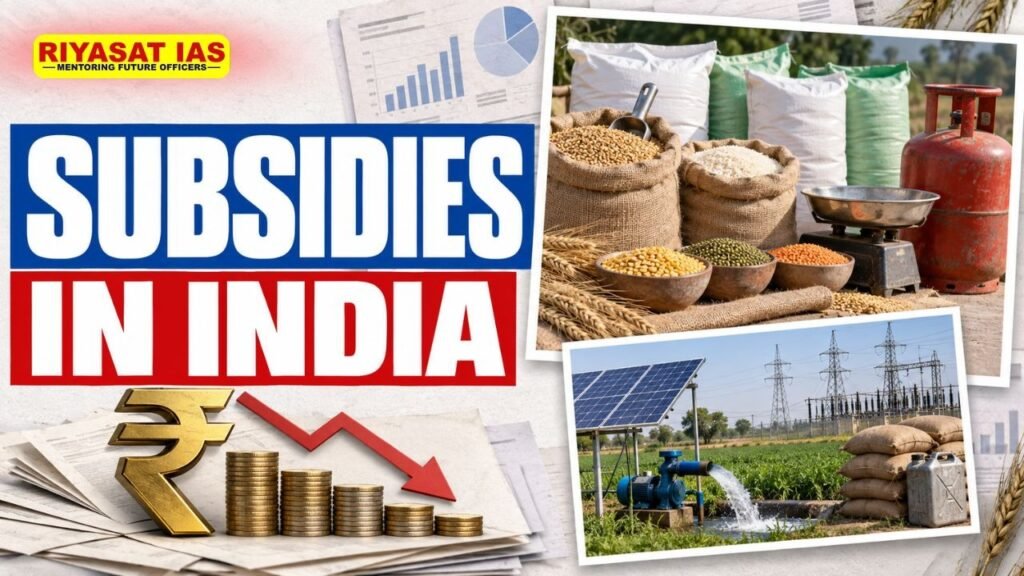
Subsidies in India refer to government assistance in the form of financial or price support, grants, tax concessions and other means to make goods and services affordable and accessible to the vulnerable sections of society, promote certain activities and reduce the burden on essential services.
These interventions take various forms, ranging from direct monetary support to indirect compensation in terms of price differential. In India, subsidies play a significant role in reducing the cost of agricultural inputs like fertilisers and credit and provide food security by making foodgrains affordable. However, at the same time, subsidies also entail adverse impacts like fiscal strain and negative economic and environmental consequences if not well targeted.
What is a Subsidy?
A subsidy refers to financial or economic support provided by the government to individuals, farmers, corporations and other entities.
The primary objectives of subsidies are to:
- Make goods and services affordable to vulnerable populations
- Augment the income of individuals and entities
- Encourage production of certain goods and services
- Promote socially desirable activities
- Offer relief to consumers and producers against economic shocks
Major Types of Subsidies in India
Agricultural Subsidies
These subsidies are provided to support farmers and reduce their production costs.
- Direct subsidies: Such subsidies take the form of direct monetary transfers to individuals and entities. For instance, the PM-KISAN scheme provides direct financial assistance of Rs 6,000 to eligible farmer families annually in the form of three installments.
- Indirect subsidies: These subsidies are provided in the form of compensation on the price of goods and services. Examples of indirect subsidies are fertiliser subsidies and interest subsidies on agricultural credit.
Fertiliser subsidy
Fertiliser subsidy is a key component of agricultural subsidies in India.
- Nutrient based subsidy (NBS): NBS was launched to provide subsidies on Phosphatic and Potassic (P&K) fertilisers on the basis of nutrients contained in them. The allocation of subsidy under NBS is done by the government on yearly basis.
- Urea subsidy: Urea is provided to farmers at a government-fixed Maximum Retail Price (MRP). The government provides subsidy to cover the difference between the MRP and the cost of urea.
Food subsidy
The government provides food subsidy in the form of food grains to eligible people under various food security schemes. The National Food Security Act (NFSA), 2013 provides for subsidised food grains to entitled people under the Public Distribution System. The food subsidy aims to provide nutritional security to vulnerable populations.
Interest subsidy
By providing a concession on the interest rate, the government offers financial support to certain groups of borrowers. These subsidies are targeted to promote certain economic activities, such as agriculture, education and housing. For instance, the Central Sector Interest Subsidy Scheme (CSIS) provides interest subsidy support to students under specific criteria.
Why are subsidies important?
- Supporting farmers: Subsidies make agricultural inputs affordable and enable farmers to focus on improving their production levels. Further, agricultural subsidies reduce the selling price of farm products, thereby supporting farmers’ income.
- Food security: By making foodgrains and other essentials affordable, food subsidies play a key role in ensuring food security in the country.
- Consumer protection: Subsidies offer relief to consumers, especially the vulnerable groups, by making goods and services affordable.
- Strategic sectors: Interest subsidies and other forms of financial assistance help in promoting strategic sectors like agriculture, fisheries and horticulture.



Disadvantages of subsidies
- Fiscal burden: Subsidies, particularly when provided in large volumes, create a huge fiscal burden on the government. This diverts government funds from other important expenditure, such as infrastructural development, thereby affecting the country’s fiscal health.
- Market distortions: By influencing the relative prices of goods and services and discouraging production of some goods and services, subsidies create market distortions.
- Environmental impact: Subsidies on agricultural inputs like fertilizers have adverse impact on environment. These inputs lead to overuse of fertilizers, water and other natural resources.
- Poor targeting: In many cases, subsidies are not targeted leading to exclusion of deserving recipients and inclusion of undeserving ones. Besides, the leakages in the subsidy distribution system also impact the effectiveness of various subsidy schemes.
Food and Fertiliser Subsidy Reforms in India
Targeted and efficient allocation of subsidies to farmers and other vulnerable groups is pivotal to ensure that subsidies serve their intended purpose. Food and fertiliser subsidies, in particular, require rational reforms to ensure efficient utilisation of scarce government resources. The rationale behind food and fertiliser subsidy reforms are discussed below:
- Fiscal burden: Due to large fiscal outlay, food and fertiliser subsidies have significantly affected the fiscal space for pro-growth public expenditure.
- Imbalance in fertiliser use: Subsidies on urea have resulted in its overuse leading to an imbalance in the ratio of nitrogen to phosphorus to potassium application across the country.
- Distorted cropping pattern: Combined with procurement policy, fertiliser and food subsidies encourage farmers to grow more rice and wheat.
- Inefficient distribution system: Despite introduction of various measures targeting efficient distribution of subsidies, such as Aadhaar seeding and Point of Sale (Pos) terminals and Direct Benefit Transfers (Dbt), problems associated with identification of beneficiaries and diversion of subsidies persist.
- Changing dietary patterns: With rising income levels and urbanisation, there has been a shift towards diversified and healthier dietary patterns. This has led to an increase in demand for pulses, fruits, vegetables and animal products, necessitating a need for rationalising subsidies provided on cereals.
How can subsidies be reformed?
- Ensuring targeted support: Subsidies need to focus on protecting the vulnerable, especially small and marginal farmers and consumers.
- Introduction of food coupons: Instead of providing direct subsidy on cereals, a digital food coupon/food-wallet scheme can be introduced as a means of providing targeted subsidy. Under such a scheme, eligible people can buy a variety of goods of their choice from specified retail outlets, subject to certain limits prescribed by the government. Apart from ensuring targeted support, such a scheme would also minimize exclusion and inclusion errors.
- Rationalising fertiliser subsidy: India needs to gradually move towards rationalising the fertiliser subsidy regime by introducing a more equitable pricing policy to ensure optimum utilisation of resources while safeguarding the interests of farmers.
- Encouraging balanced use of fertiliser: Farmers need to adopt scientific method of balanced application of fertiliser based on soil health to ensure sustainable crop production.
- Boosting agricultural research: Agricultural research and development need to be prioritised to meet the challenge of feeding India. The focus areas of research should include climate smart agriculture, water saving, efficient use of fertiliser and other relevant technologies.
- Need for crop diversification: There is an urgent need to promote crop diversification in India, both in terms of geography and commodities. While there is a need to encourage pulses, oilseeds, coarse grains and horticultural crops, diversification should also take place within the crops.
Way forward for subsidy policy
A good subsidy policy should focus on targeting rather than expansion, and ensure that the benefits of subsidies accrue to the intended recipients. Technology can play a crucial role in ensuring efficient targeting. Further, rationalising the price of select agricultural inputs would help in reducing market distortions. At the same time, the savings achieved by curbing inefficient subsidies can be channelised into enhancing agricultural research and development, improving irrigation, storage, processing, infrastructure and other allied areas related to climate change and sustainable agriculture.
The ultimate aim of a progressive subsidy policy should be to ensure food security and farm prosperity while avoiding fiscal waste and resource misallocation.
Conclusion
Subsidies play a critical role in supporting farmers and ensuring food security. However, inefficient subsidy design negates the benefits of subsidies. An appropriate subsidy regime should focus on ensuring food security to vulnerable groups and making essential goods and services affordable without putting undue strain on the exchequer.
FAQs on subsidies in India
What is a subsidy?
A subsidy refers to financial or economic support provided by the government in the form of direct or indirect assistance.
What are the major types of subsidies in India?
The major types of subsidies in India are agricultural subsidies, food subsidy, fertiliser subsidy and interest subsidy.
What is an agricultural subsidy?
An agricultural subsidy refers to a type of government subsidy that aims to provide financial or cost support to farmers.
What is a fertiliser subsidy?
A fertiliser subsidy refers to a government subsidy that aims to provide concession on the price of fertilisers to farmers. The subsidy covers both urea and P&K fertiliser through the NBS scheme.
What is a food subsidy?
A food subsidy refers to a government subsidy that aims to provide concession on the price of food to vulnerable populations.
What are the advantages of subsidies?
The advantages of subsidies are that it provides support to farmers, makes goods and services affordable and promotes certain activities.
What are the major disadvantages of subsidies?
The major disadvantages of subsidies are that it creates a fiscal burden, causes market distortions, leads to environmental degradation, and poor targeting.
How do subsidies impact agriculture?
Subsidies can impact agriculture in various ways. While subsidies on agricultural inputs can cause overuse of fertilisers and water, they can also encourage farmers to grow specific crops.
Why is fertiliser subsidy reform needed?
The need for fertiliser subsidy reform arises due to the fiscal strain and environmental impact caused by the subsidy and the need to shift towards balanced application of fertilisers.
What is the way forward for subsidies in India?
The way forward for subsidies in India focuses on providing targeted support, promoting research, encouraging diversion of subsidy from cereals to other agricultural products and addressing the issue of inclusion and exclusion.



 Ravi Raaz
 Hassan Khan
 Shadab Ali