
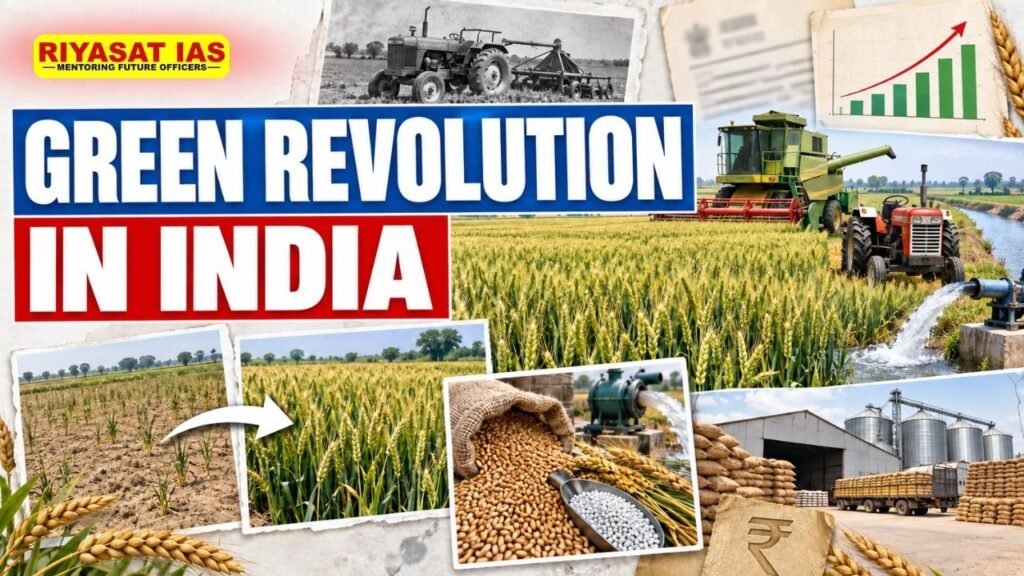
The Green Revolution in India is a great milestone of the country’s agricultural production during the period of mid-20th century. It is a process of increasing food-grain output through the extensive use of high-yielding varieties, irrigation, chemical fertilisers, pesticides, mechanisation and improved farming practices. The revolution was primarily related to wheat and rice production.
What was the Green Revolution?
The Green Revolution is the process of adopting modern technologies to overcome food shortages and to improve agricultural production. The Green Revolution in India was led by international agricultural research institutes like CIMMYT and IRRI.
It consisted of major components such as:
- High-Yielding Varieties (HYVs) of seeds
- Chemical fertilisers
- Increased irrigation
- Pesticides and herbicides
- Agricultural mechanisation
- Multiple cropping and improved farm-management practices
Positive Impacts of Green Revolution in India
Food Self-Sufficiency and Food Security
India was highly dependent on imports before introducing the Green Revolution to bridge its domestic requirement gap. Thus, the revolution helped India to become self-reliant in terms of food-grain production and food security.
Increased Agricultural Production and Productivity
Modern agricultural practices such as the use of HYV seeds, irrigation, fertilisers and pesticides led to a significant increase in crop yield. Moreover, short-duration varieties enabled multiple cropping which in turn added to the agricultural production.
Increase in Farmers’ Incomes
Farmers in the country’s regions with assured irrigation and modern agricultural inputs such as Punjab, Haryana and western Uttar Pradesh witnessed a significant rise in farmers’ income. As a result, more investment in farming activities and improvement in living standards ensued.
Commercialisation of Agriculture
Higher agricultural production and profits encouraged commercialisation of agriculture.
Allied Industries Flourish
Modern agricultural practices created a market for agricultural implements such as tractors, threshers, pump-sets, fertilisers and pesticides. In addition, increased yields provided raw materials for agro-processing and food-processing industries.
Improvement in Rural Infrastructure and Living Standards
Higher farm incomes triggered demand for goods and services in rural areas which in turn led to improved infrastructural development.



Negative Impacts of Green Revolution in India
The revolution’s benefits were largely offset by adverse environmental, social and regional impacts particularly in areas that adopted the intensive package of irrigation and fertiliser use.
Soil Degradation
Continuous crop production using HYVs and heavy application of fertilisers caused micronutrient deficiency and imbalance in the soil.
Soil Salinity, Water-Logging and Alkalinity
These are resulted from improper irrigation practices, and the problem is reported to be rampant in the Green Revolution belt especially in Punjab and Haryana.
Groundwater Depletion
Intensive irrigation agriculture led to a serious fall in groundwater levels particularly in water-intensive agricultural systems.
Water Pollution
Runoff from fields contains fertilisers and pesticides which constitute pollutants that when added to water bodies, cause eutrophication.
Decline in Biodiversity
The adoption of a few high-yielding varieties of wheat and rice resulted in the disappearance of many traditional varieties of these crops.
Social and Regional Impacts
Growing Inequality
Technology-intensive agriculture favoured wealthy farmers over the poor ones leading to divergence between large and small-scale farmers in terms of benefits accrued from the revolution.
Regional Disparities
The revolution was more successful in regions that had assured irrigation and better agricultural infrastructure such as Punjab, Haryana and western Uttar Pradesh. These areas recorded higher agricultural production than the rain-fed and less-developed agricultural regions.
Migration
Migration from rural to urban areas increased due to employment opportunities in the cities.
Nutritional Imbalance
The replacement of traditional grains and legumes by wheat and rice resulted in nutritional imbalance especially in some localities.
Way Forward: From Green Revolution to an Evergreen Revolution
India’s next agricultural revolution should be focused in enhancing productivity while conserving natural resources, climate-resilience and profitability.
Promoting Sustainable Farming
Farmers should be encouraged to use organic manures, bio-fertilisers and bio-pesticides. These manures and bio-fertilisers enhance soil fertility.
Improved Integrated Nutrient Management
Integrated Nutrient Management (INM) should be adopted to maintain soil fertility by supplementing inorganic fertilisers with organic materials based on crop and soil requirements. Similarly, Integrated Pest Management should be used to minimise the use of pesticides.
Improved Water Use Technology
Farmers should be encouraged to adopt water-saving irrigation technology such as drip irrigation and sprinklers to avoid wastage of this precious natural resource.
Crop Diversification
A shift from the over-reliance on rice-wheat cropping system should be encouraged to enhance biodiversity and sustainability of agricultural production.
Establishing Farmer Producer Organisations
These organisations are meant to empower smallholder farmers by providing them with alternative marketing channels and access to credit, technology, quality seeds and fertilisers.
Improved Post-Harvest Facilities
Investments should be made in cold storage, warehousing and transportation to reduce losses and help farmers get good prices for their produce.
Agricultural Researches
More researches should be conducted to come up with improved crop varieties that are resistant to pests, diseases, drought and that utilise nitrogenous fertilisers efficiently. Agricultural research institutes such as ICAR and the State Agricultural Universities should lead the fight in transforming Indian agriculture through cutting-edge researches.
Conclusion
India’s Green Revolution is a great milestone that has changed the country’s agricultural production landscape by increasing food-grain output, productivity and food security. However, it has resulted in adverse environmental, social and regional impacts. Therefore, the country’s agricultural system should shift from the Green Revolution to an evergreen revolution that is focused in enhancing productivity while conserving natural resources, climate-resilience and profitability.
FAQs
What is the Green Revolution?
The Green Revolution was a period of revolution in Indian agricultural history involving HYV seeds, irrigation, fertilizers, pesticides, mechanization, and new agricultural practices in order to increase agricultural production.
What were the main crops associated with the Green Revolution in India?
The Green Revolution was strongly associated with the crops of wheat and rice.
What were the major benefits associated with the Green Revolution?
The Green Revolution has been associated with increased production, increased food security, increased farmer income, agro-based industries, and food self-sufficiency.
What were the major environmental impacts of the Green Revolution?
The Green Revolution has been associated with groundwater depletion, soil degradation, water pollution, salinity, waterlogging, and a loss of biodiversity in agriculture.
Why did the Green Revolution create regional disparities?
The Green Revolution resulted in higher yields in some areas where irrigation was assured, infrastructure was present, and there was an availability of agricultural inputs.
What is an Evergreen Revolution?
An Evergreen Revolution refers to increasing agricultural productivity while conserving the environment and natural resources necessary for climate resilience, sustainable agriculture, and developing farmers.
How can India make agriculture more sustainable after the Green Revolution?
Crop diversification, efficient irrigation, integrated nutrient and pest management, strengthening FPOs, post-harvest infrastructure, and agricultural research are some of the key steps that can be taken to make Indian agriculture more sustainable.



 Ravi Raaz
 Hassan Khan
 Shadab Ali