
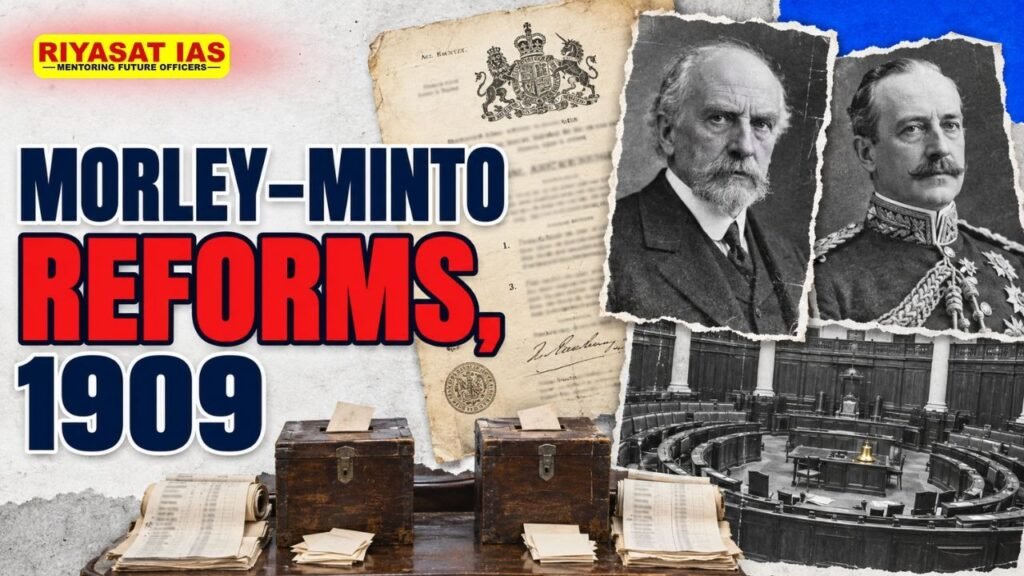
Morley–Minto Reforms, officially enacted through the Indian Councils Act, 1909, were introduced under John Morley, the Secretary of State for India, and Lord Minto, the Viceroy of India. The reforms increased Indian representation in legislative councils, but did not establish responsible government. Their most important and controversial feature was the introduction of separate electorates for Muslims.
Background
- Failure of the earlier Indian Councils Act of 1892 to provide meaningful representation increased Indian dissatisfaction with colonial rule.
- The Swadeshi Movement and the rise of militant nationalism created a stronger political challenge to the British government.
- British also wanted to win the support of moderate nationalists and reduce the growing influence of the extremist section of the nationalist movement.
- Simla Deputation of 1906, led by Aga Khan, demanded separate political representation for Muslims. This demand subsequently became an important basis for the reforms.
- All-India Muslim League was founded in 1906 at Dacca, and protection of Muslim political interests became an important part of the constitutional debate.
- Indian nationalists were demanding much more than limited representation. They increasingly sought self-government and greater control over administration, whereas the British government wanted to retain ultimate political authority.
Key Provisions
· Expansion of Legislative Councils: The Central Legislative Council consisted of 60 members and 9 ex-officio members. Of these 69 members, 37 were government officials and 32 were non-official members. Among the 32 non-official members, 5 were nominated and 27 were elected. Of the 27 elected members, 8 seats were reserved for Muslims under separate electorates, while 4 seats were reserved for British capitalists and 2 for landlords. The remaining 13 seats fell under the general constituency category.
· Introduction of Elections: The reforms gave greater recognition to the elective principle. Indians could now enter the legislative councils through elections, although the system was indirect and highly restricted. Representation was provided through different constituencies and electoral bodies rather than through universal adult franchise.
· Separate Electorates for Muslims: The most important provision was the introduction of separate electorates for Muslims. Under this system, Muslim voters elected Muslim representatives from separate constituencies.



· Representation of Special Interests: The Act also provided representation for certain organised interests such as zamindars, chambers of commerce, universities and presidency corporations.
· Greater Deliberative Powers: The legislative councils received wider opportunities to discuss the budget, ask questions and move resolutions.
· Indian in the Viceroy’s Executive Council: A provision was made to appoint an Indian member to the Governor-General’s Executive Council. Satyendra Sinha was appointed as the first Indian member.
· Powers of the legislative bodies were expanded. Members were granted the right to debate financial proposals, move amendments to them, vote on certain matters, ask questions, vote and debate on general issues, and introduce resolutions concerning the public interest. Despite granting these powers to the legislatures, the Governor retained the authority to disallow resolutions within the legislative bodies.
Outcomes and Impact
· Limited Growth of Representative Politics: Reforms marked an important step in the development of elective representation in India. Indians received greater opportunities to enter legislative bodies and raise public grievances.
· Legislative Debate Became More Important: Indian leaders used the councils to question government policies and discuss issues such as education, repressive measures, labour conditions and administrative expenditure. Leaders such as Gopal Krishna Gokhale made effective use of these opportunities.
· Separate Electorates Institutionalised Communal Politics: Introduction of separate electorates gave communal representation an official place in constitutional politics. This became an important feature of subsequent constitutional reforms and contributed to the increasing political importance of communal identities.
· British Strategy of Political Accommodation: Reforms helped the British government appease sections of moderate nationalists and Muslim political elites while keeping real power in British hands.
· No Responsible Government: These reforms did not make the executive responsible to elected representatives. Therefore, Indians could participate in discussions but could not exercise effective control over the administration.
Criticism
- These reforms did not provide responsible government. Executive remained largely independent of the legislative councils.
- Franchise was extremely limited. Only a small section of the population could participate in elections.
- Electoral system was indirect and complicated, which restricted genuine popular representation.
- Central Legislative Council retained an official majority, allowing the government to maintain control over legislation.
- Governor-General retained extensive powers, including the ability to override legislative opposition.
- Separate electorates encouraged communal political identities. Instead of developing a common political constituency, the system encouraged representation on religious lines.
- Indian aspirations were much wider than the reforms. Nationalists were increasingly demanding self-government, while the British offered only limited participation.
Conclusion
The Morley–Minto Reforms represented a cautious expansion of Indian participation in colonial governance, but they stopped far short of self-government. Their lasting importance lies in the introduction of separate electorates, which shaped subsequent constitutional politics and strengthened communal representation. In this sense, the reforms combined limited constitutional progress with a significant political division.
FAQs
1. What were the Morley–Minto Reforms?
They were constitutional reforms enacted through the Indian Councils Act, 1909, which expanded legislative councils and increased Indian participation.
2. What was the most important provision of the reforms?
The most significant provision was the introduction of separate electorates for Muslims.
3. Who was the first Indian appointed to the Viceroy’s Executive Council?
Satyendra Prasad Sinha became the first Indian member, serving as the Law Member.
4. Did the reforms introduce responsible government?
No. The executive remained responsible to the British authorities rather than to elected Indian representatives.
5. Why are the reforms criticised as inadequate?
They provided only limited and indirect representation, retained strong executive control and introduced separate electorates, while the Indian nationalist demand was increasingly moving towards self-government.



 Ravi Raaz
 Hassan Khan
 Shadab Ali