GS-II – Governance | GS-III – Indian Economy | Gold Standard Scheme
Context
- Speenhamland System: English magistrates met at the Pelican Inn in Speenhamland, Berkshire in May of 1795. So in a world of soaring food prices and the French Revolution shaking England’s ruling class, they turned to complementing agricultural wages from parish funds with benefits linked to bread prices and family size.
- Hungarian Economic Historian Karl Polanyi: Hungarian economic historian Karl Polanyi later regarded this as an early affirmation of a human “right to exist” in the face of market brutality.
- Criticism: Once wage assistance, aid for the poor and public finance were combined into a single instrument, it was unclear what the system protected: poor families, the wage structure, employers or social peace.
- The Impact of Subsidising: Wage subsidy using taxpayers money under conditions offered by the Speenhamland system dulled price signals and demotivated incentives.
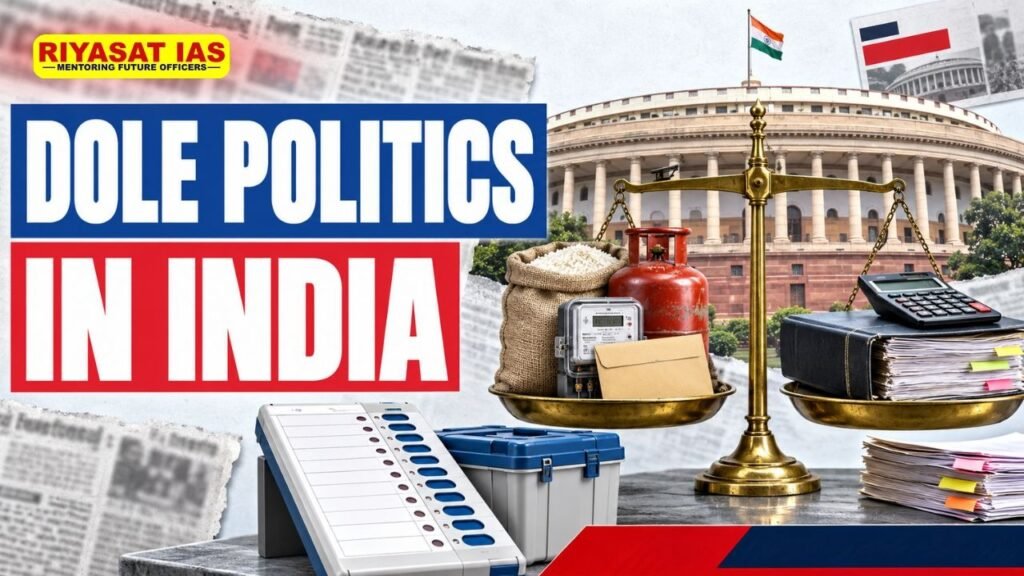
- India Dole Politics: Relief may be defensible, but the tool had to be assessed by its consequences. Now, the latter has to work its way through India` x27 s dole politics.
Importance of Cash Support
- Cash Support : Cash support can be critical indeed in the context of a poor informal economy.
- Economic Survey 2025–26 : Transfers to women constitute 11-24% of monthly earnings of female daily-wage workers and 11-87% among self-employed females.
- Fiscal Commitments: Money that starts as relief can become a permanent fiscal commitment unless there are clear accounts of who it goes to, what it changes, and where the money is displaced from.
Dole Politics in India
- Dole Politics Is Now An Intrinsic Part of Indian Statecraft (Regular Feature): Dole politics is now an intrinsic part of Indian statecraft.
- Manifestations: Consider free electricity, free public transport, cash transfers once a month, subsidised food, utility subsidies.
- Unconditional Cash Transfers to Women Alone: PRS Legislative Research estimates that, in only ₹1.68 lakh crore (about 0.5% of GDP) this amount increased from 2 States in 2022-23 to 12 states till $25 state yr.
- West Bengal: From Lakshmir Bhandar to Annapurna Yojana, a one-time transfer of ₹3,000 each for about 1.3 crore women, at a budget of ₹36,000 crore.
- Tamil Nadu: The ₹14,412 crore provision for the Kalaignar Magalir Urimai Thogai in the interim budget of 2026–27 by Tamil Nadu — which is just part of a much broader income transfer scheme — lacks source-level feedback from beneficiaries.
- Assam: Assam allocated ₹5,000 crore for Orunodoi.
- State Finances: Such schemes make a big claim on State finances.
Need for Accountability
- Welfare: Cash in as improving welfare, but if not substitutes for the public goods that make welfare durable.
- Public Services: These range from good health (health centre), childcare, better work. The same woman who aspires for ₹1,500-₹3,000 may want public services in the form of decent schools, a stably performing government school or access to the next level higher schools for her children.
- Institutional Weakness: Cash transfers may alleviate the pressure created by weak institutions, but they cannot solve it on their own.
- Social Purposes: The authors say that social purposes – governments always attach ludicrously high and excellent social purposes (dignity, empowerment etc) to these transfers, but the return link model is rarely published.
Evidence-Based Welfare
- Targeting: Who is being targeted?
- Baseline Data: What baseline data justifies the scheme?
- Anticipated Impact: What impact is expected on consumption, debt, nutrition, schooling, health spending, labour supply or women bargain power?
- Moral Language: Much of India’s dole politics today is not backed by data, but rather answered in the language of morality.
- ADB Study: A report prepared by the Asian Development Bank (ADB) for the 16th Finance Commission has found that India does not have a systematic dataset on government expenditure through cash-transfer schemes.
Lessons from Other Democracies
- Welfare Politics: Other democracies redistribute and are themselves not immune to welfare politics.
- Eligibility and Conditionality: Unemployment insurance, food support or healthcare subsidies normally depend on eligibility rules, employment contributions (e.g., whether an individual worked for a certain minimum period), job-search obligations or periodic reassessment.
- India: But India do not have to be cloned these systems.
- Unconditional Transfers: Some transfers (especially to women in poor households) may be best left unconditional.
- Evidence: However, the less conditional is underpinned, then more must be held by governments to provide with evidence.
Welfare Impact Statement
- Who Needs a Welfare Impact Statement Before Rollout: Largely recurrent transfer.
- Objective: Detailing the objective.
- Eligibility: Eligibility rule.
- Coverage: Expected coverage.
- Fiscal Cost: Five-year fiscal cost.
- Alternatives: Alternatives considered.
- Leakage and Exclusion: Most likely leakage and exclusion error.
- Outcomes: Measurable outcomes.
Post-Rollout Assessment
- Household Surveys: After rollout, household surveys should capture not only take-up of the transfer but also its impact on consumption, debt, health spending, schooling, mobility as well as work incentives and control over household expenditure and subjective well-being.
- Microdata: Then anonymised microdata must be released to allow independent researchers to conduct in-depth analyses.
- Scrutiny: Second, schemes that spend public money at this scale must have tough scrutiny.
Democratic Fairness
- Tied to the Case for Evidence: Tied to the case for evidence is also a case of fair representation: Evidence and Politics.
- An Honest Politics of Welfare: Examples will not free welfare from politics, but they may promote a more honest politics regarding welfare.
Conclusion
- However, while introducing cash-transfer policies in India factors like immediate welfare vs. fiscal sustainability and institutional development, measurable outcomes need to be taken into account.
- Evidence, transparent fiscal assessment and independent evaluation for large periodic transfers.
- Evidence will not take politics out of welfare, but it might just render that politics more honest.
UPSC Mains Practice Question
Q. “Cash transfers can offer short term welfare, but no replacement for lasting public goods and strong institutions.” advocates for enhanced accountability and evidence-based impact assessment of welfare transfers in India.

 Ravi Raaz
 Hassan Khan
 Shadab Ali