
2. (b) Discuss how national security can be balanced with concerns of human rights. (Answer in 150 words)
Introduction
National security is necessary to protect citizens, territorial integrity and social order. However, security cannot become a reason to ignore human dignity and constitutional freedoms. The real challenge is to protect the nation while ensuring that citizens do not feel that their rights are the price of security.
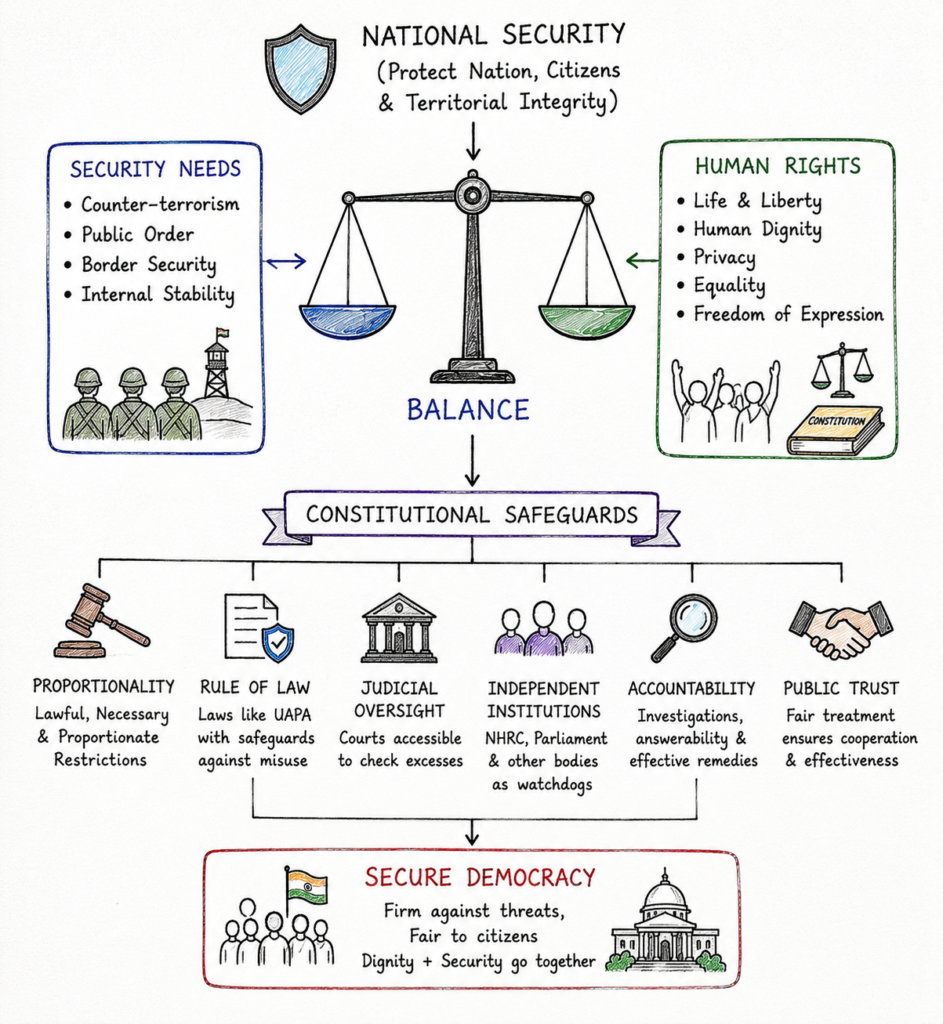
Balancing Security with Human Rights
- Proportionality: Restrictions should be lawful, necessary and proportionate to the threat, as emphasised in Anuradha Bhasin v. Union of India.
- Rule of law: Laws such as UAPA should be implemented with adequate safeguards against arbitrary detention and misuse of authority.
- Judicial oversight: Courts must remain accessible so that citizens can challenge excessive or arbitrary executive action.
- Independent institutions: Bodies such as the NHRC and parliamentary mechanisms can help check custodial excesses, surveillance and abuse of power.
- Human-centric security: Border communities, minorities and vulnerable groups should not be treated as potential threats merely because of their identity or location.
- Accountability: Security agencies should be answerable for violations, with mechanisms for investigation and appropriate remedies.
- Public trust: Treating citizens fairly encourages cooperation with security agencies, making counter-terrorism and law enforcement more effective.



Example: The Supreme Court’s judgment in Anuradha Bhasin v. Union of India illustrates the need to balance national security and public order with fundamental freedoms by requiring restrictions to satisfy constitutional standards of proportionality.
Way Forward
Security agencies should combine intelligence-led action, due process, transparency and accountability, while using technology in a targeted manner rather than relying on indiscriminate surveillance.
Conclusion
National security and human rights are not opposites. A secure democracy is one in which the State protects citizens from external and internal threats without making citizens fearful of the State itself. Thus, lasting security comes from combining firmness against threats with restraint, dignity and constitutional morality.



 Ravi Raaz
 Hassan Khan
 Shadab Ali