
UPSC Mains preparation in Hindi begins with recognising that Mains is a fundamentally different examination from Prelims — descriptive, analytical, time-pressured, and demanding a specific quality of written expression. For Hindi medium aspirants, Mains preparation carries an additional dimension: developing the precise, formal, analytically structured Hindi that UPSC’s evaluators expect, while covering nine papers worth 1750 marks in a syllabus that does not differ in content from the English medium version.
This guide walks through a complete strategy for UPSC Mains preparation in Hindi — covering the GS papers, Essay, the Optional Subject, and the answer writing discipline that ties them together.
UPSC Mains Preparation in Hindi: Paper Structure and What Each Demands
| Paper | Marks | Specific Hindi Medium Consideration |
| Essay | 250 | Requires sustained, coherent argumentation across 1000–1200 words in Hindi — a register distinct from short-answer writing; needs dedicated practice in long-form Hindi composition |
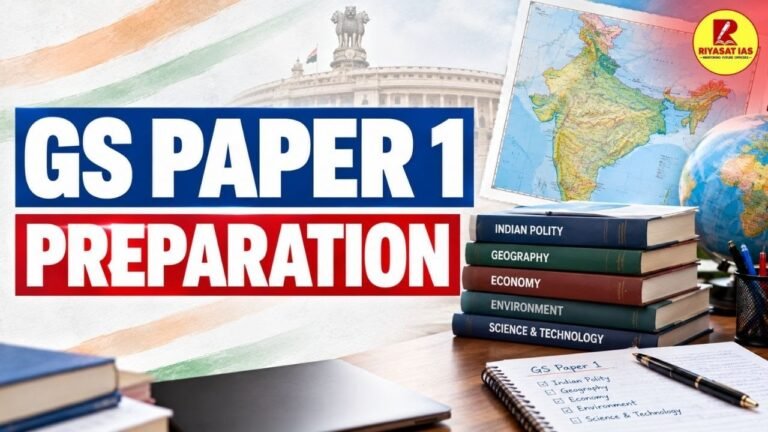
| GS Paper I | 250 | Heavy History, Geography, and Society content — Hindi terminology for historical periods, geographical features, and sociological concepts needs to be precise and exam-standard |
| GS Paper II | 250 | Governance and Polity vocabulary in Hindi (constitutional terms, judicial terminology) must match UPSC’s own usage exactly — imprecise terms cost marks even when the underlying understanding is correct |
| GS Paper III | 250 | Economy and Science & Technology content often originates in English-language sources; converting this into precise Hindi economic and technical terminology is a specific skill requiring practice |
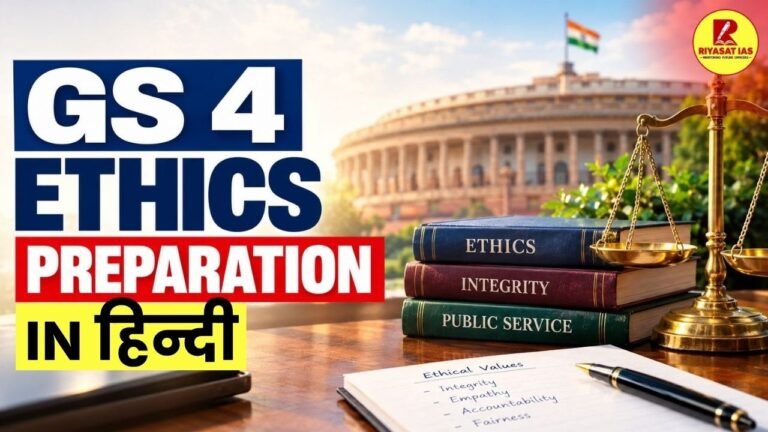
| GS Paper IV (Ethics) | 250 | Case study answers require nuanced ethical reasoning expressed clearly in Hindi — colloquial moral language needs to be elevated to the formal analytical register UPSC rewards |
| Optional Subject (2 Papers) | 500 | Highly dependent on the specific Optional chosen — Hindi material quality and answer-writing convention varies significantly by subject |
Building Hindi GS Answer Writing: A Structured Approach
1. Master the Standard Answer Structure in Hindi
Every Mains answer benefits from a clear structure: a brief introduction that directly addresses the question’s core demand, a body organised into clearly delineated points or dimensions (often with sub-headings for longer answers), and a conclusion that is forward-looking or synthesising rather than merely repetitive. Regularly practise a reasoned, balanced, and structured writing style in Hindi instead of relying on everyday conversational language, as UPSC Ethics answer writing demands a formal and analytical approach.
2. Build a Repository of Hindi Keywords and Phrases by GS Paper
UPSC rewards precision. Moreover, maintain a running list of the correct Hindi terminology for key concepts in each GS paper as you study. As a result, you will avoid scrambling for the right words under exam pressure and improve both clarity and time management during the actual exam.



3. Practice Diagram and Flowchart Use Within Hindi Answers
Furthermore, use well-placed diagrams, flowcharts, and tables to present information more efficiently than continuous text. UPSC evaluators value these visual elements when you use them appropriately, especially in GS Paper III to explain economic and scientific processes. Therefore, Hindi medium aspirants should regularly practise integrating these visuals with concise Hindi labels instead of relying solely on continuous text.
4. Time Yourself Strictly From the Beginning
A standard 10-mark question typically allows roughly 6 minutes; a 15-mark question roughly 9 minutes. Writing comfortably within these limits in Hindi — including the time needed to plan the answer’s structure before writing — is a skill that needs dedicated, timed practice from early in the Mains preparation cycle, not something to address only in the final weeks.
| Want examiner-calibrated feedback on your Hindi GS and Optional answers? → Explore Mentorship Resources for Answer Writing |
Essay Paper Strategy for Hindi Medium
The Essay paper rewards sustained, coherent argument-building across a much longer format than GS answers — and it is where many Hindi medium aspirants, accustomed to shorter GS-style answers, struggle most with structure and flow. Key strategies:
- Plan before writing: Spend 8–10 minutes outlining your essay’s structure — introduction, 4–5 core dimensions, and conclusion — before beginning to write. An unplanned Hindi essay frequently loses coherence partway through.
- Use Hindi literary and philosophical references where genuinely relevant: References to Indian philosophical traditions, well-known Hindi literary figures, or relevant proverbs can strengthen an essay when used precisely and relevantly — but should never feel forced or decorative.
- Practice multidimensional essays specifically: UPSC essay topics increasingly reward arguments that address a theme from multiple angles (social, economic, ethical, historical) rather than single-dimension arguments. Build this habit through deliberate practice, with each essay covering at least 3–4 distinct dimensions.
Optional Subject in Hindi: Specific Strategic Considerations
The Optional Subject carries the highest mark concentration in Mains (500 marks across two papers), and Hindi medium material quality varies significantly by subject. Before committing to an Optional, Hindi medium aspirants should specifically verify:
- Are there at least 2–3 genuinely comprehensive Hindi reference books for this Optional, written natively in Hindi rather than translated?
- Are previous years’ top-scoring Hindi medium answers in this Optional available for reference, even informally?
- Is there a mentor or evaluator available who can give Hindi-specific feedback on this particular Optional’s answer writing?
Subjects like History, Sociology, Political Science and International Relations, Public Administration, and Hindi Literature generally have stronger native Hindi material availability than more technical or niche optionals — though the right choice always depends on individual background and genuine interest.
A Sample 12-Week Hindi Mains Preparation Schedule (Post-Prelims)
| Weeks | Focus |
| Week 1–2 | Rapid assessment of GS coverage status; build week-by-week schedule; begin daily Hindi answer writing immediately |
| Week 3–6 | Deep revision of GS I and GS II at Mains depth; 2–3 timed Hindi answers daily; weekly mentor review of submitted answers |
| Week 7–9 | Deep revision of GS III and GS IV; continue daily answer writing; intensive Optional Subject revision and practice |
| Week 10–11 | Essay practice (2–3 full essays with feedback); full-length GS paper mock tests under timed conditions in Hindi |
| Week 12 | Final consolidation; revise condensed notes only; light practice to maintain writing rhythm without new content |
Frequently Asked Questions
Does UPSC penalise Hindi medium candidates for translation-style or grammatically imperfect Hindi?
UPSC evaluates content, structure, and analytical quality primarily — minor grammatical imperfections are not heavily penalised on their own. However, imprecise terminology that obscures meaning, or writing so colloquial that it undermines the formal analytical register expected, can affect how clearly your understanding comes across to the evaluator — which indirectly affects marks.
Should I write my Essay and GS answers in pure Hindi, or is using some English terms acceptable?
Using widely accepted English technical or proper-noun terms (the names of specific schemes, internationally standard terminology without a common Hindi equivalent) is generally acceptable and common practice. The goal is precision and clarity, not avoiding English terms at all costs — but the surrounding analytical prose should be in clear, formal Hindi.
How is GS Paper IV (Ethics) different to prepare for in Hindi compared to other GS papers?
Ethics case studies require articulating nuanced moral reasoning — weighing competing considerations, applying ethical frameworks, and justifying a course of action — in a register that is analytical rather than preachy or colloquial. Develop a reasoned, balanced, and structured writing style in Hindi through regular practice, as ethical answer writing differs significantly from everyday conversation.
Can I get Optional Subject answer writing feedback in Hindi for less common optionals?
This depends significantly on the specific Optional and the availability of evaluators with both subject expertise and Hindi fluency. Before committing to a less common Optional, it is worth directly verifying — through a mentor or test series — that quality Hindi-medium evaluation is actually available for that subject.
Conclusion
UPSC Mains preparation in Hindi requires the same fundamental work as English medium preparation — structured answer writing, deep GS coverage, a well-chosen and well-prepared Optional, and disciplined Essay practice — combined with specific attention to Hindi’s formal examination register, precise terminology, and the availability of genuinely Hindi-native sources and feedback.Prepare strategically, choose reliable sources, and evaluate them carefully. By doing so, Hindi medium aspirants can compete on equal terms with English medium aspirants despite having a smaller pool of readily available resources.
| Riyasat IAS Mentorship — Personal Guidance for UPSC CSE Direct mentorship from Riyasat Ali Sir │ Hindi & English Medium │ 100% Online — Apply Now |


 Ravi Raaz
 Hassan Khan
 Shadab Ali