
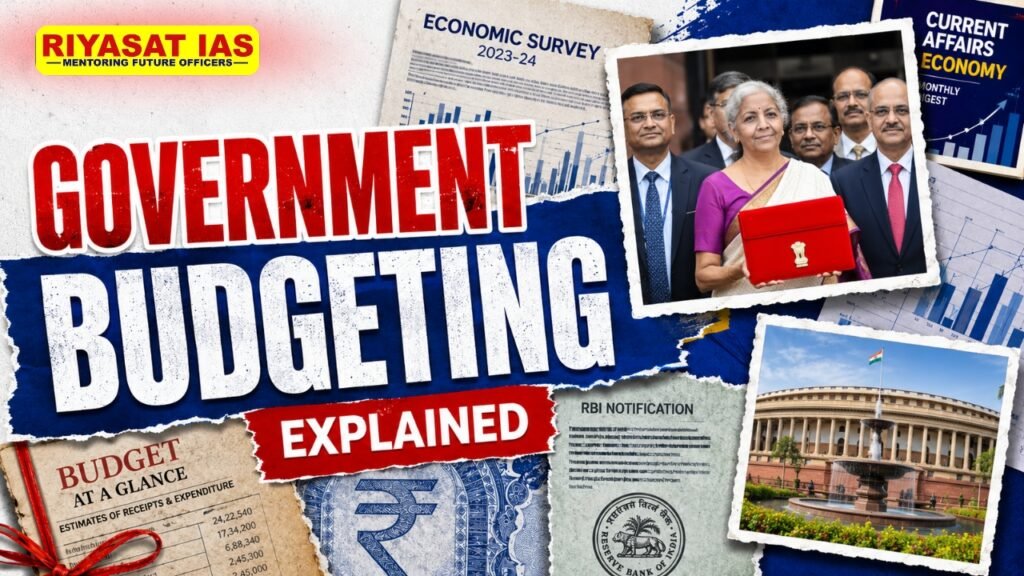
Every year, the government has to make a basic financial plan; the plan includes how much money will come in, how much will be spent, and where that money should go. This plan is called the Government Budget.
For a country like India, the Budget is not just a statement of income and expenditure. It also reflects the government’s priorities in areas such as infrastructure, healthcare, education, welfare and economic development.
What Is Government Budgeting?
Government Budgeting: It is the process through which the government estimates its income and expenditure and decides how public money will be used during a financial year.
Government receipts mainly come from taxes, non-tax revenue and borrowings. This money is then used for public services, development programmes, infrastructure and other government responsibilities.
Constitutional Provision
Under Article 112 of the Indian Constitution, the Union Budget is officially called the Annual Financial Statement (AFS).
It gives an estimate of the government’s receipts and expenditure for the coming financial year. It also provides details about revenue and capital receipts, proposed expenditure, taxation measures and the government’s broader financial plans.
The Budget Division of the Department of Economic Affairs, Ministry of Finance, is responsible for preparing the Union Budget.
How Does the Budget Pass Through Parliament?
The Budget process broadly involves six stages:
- Presentation of the Budget
- General Discussion
- Examination by Departmental Committees
- Voting on Demands for Grants
- Passing of the Appropriation Bill
- Passing of the Finance Bill
Major Changes Made in 2017
Budget on 1 February: The Union Budget began to be presented on 1 February, instead of the last working day of February.
Railway Budget Merger: The separate Railway Budget was merged with the Union Budget.



Plan and Non-Plan Spending: The earlier distinction between Plan and Non-Plan expenditure was discontinued.
Why Does the Government Prepare a Budget?
Resource Allocation: Money can be directed towards important areas such as infrastructure, education, healthcare and rural development.
Reducing Inequality: Taxes and welfare programmes can help support poorer and vulnerable sections of society.
Supporting Economic Growth: Public investment in infrastructure and productive sectors can encourage investment and create economic opportunities.
Maintaining Economic Stability: Government spending and taxation can be adjusted according to the economic situation.
Supporting Public Enterprises: The government can provide financial support to public sector organisations working in important sectors.
Reducing Regional Gaps: Public investment can be directed towards less-developed regions to promote more balanced growth.
Main Components of the Government Budget
The Government Budget is broadly divided into two parts: the Revenue Budget and the Capital Budget.
Revenue Budget
The Revenue Budget covers Revenue Receipts and Revenue Expenditure.
Revenue Receipts: These are regular government receipts that do not create a liability or reduce government assets. They include:
- Tax revenue such as income tax, GST and customs duties
- Non-tax revenue such as dividends, interest, fees and other receipts
Revenue Expenditure: This is spending required for the regular functioning of the government. It includes salaries, pensions, interest payments, subsidies and administrative expenses.
Capital Budget
The Capital Budget covers Capital Receipts and Capital Expenditure.
Capital Receipts: These either create a liability or reduce government assets. Examples include borrowings, recovery of loans and disinvestment proceeds.
Capital Expenditure: This spending is generally aimed at creating assets or reducing liabilities. Investment in roads, infrastructure and other long-term public assets comes under this category.
Why Is the Government Budget Important?
The Budget gives us a clear idea of what the government considers important and how it plans to pay for those priorities.
It can influence economic growth, public investment, welfare delivery and income distribution. At the same time, the government has to keep borrowing and deficits under control.
So, good budgeting is ultimately about finding a sensible balance between development, public welfare and fiscal discipline.
Conclusion
The Government Budget is one of the most important tools of economic policy. It determines how public resources are collected and used and provides a financial framework for the government’s plans.
For India, the challenge is to ensure that public money is spent carefully, efficiently and on priorities that create long-term economic and social benefits.
Frequently Asked Questions (FAQs)
What is the Government Budget?
It is the government’s annual financial plan showing its expected receipts and expenditure.
Which Article deals with the Union Budget?
It provides for the Annual Financial Statement (AFS) of the Union Government.
What are the two main parts of the Government Budget?
The Revenue Budget and the Capital Budget.
What is the Revenue Budget?
It contains Revenue Receipts and Revenue Expenditure.
What is the Capital Budget?
It contains Capital Receipts and Capital Expenditure.
What is India’s financial year?
It runs from 1 April to 31 March.


 Ravi Raaz
 Hassan Khan
 Shadab Ali