
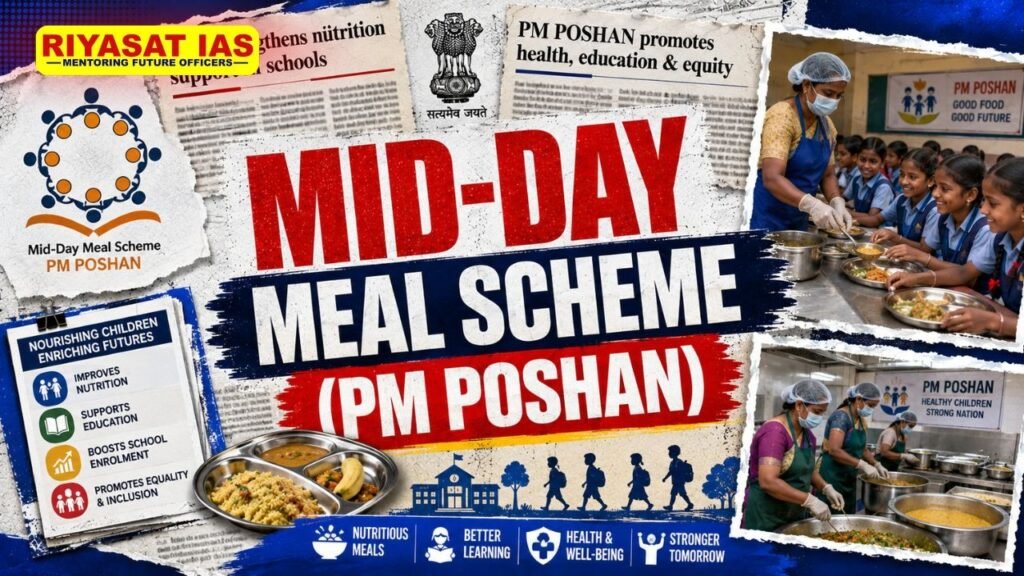
About
The Mid-Day Meal Scheme, officially known as the National Programme of Nutritional Support to Primary Education (NP-NSPE), was launched in 1995 to improve children’s nutrition while encouraging school enrolment, attendance and retention. Following the Supreme Court’s 2001 directions, the programme shifted towards providing hot cooked meals in government and government-aided schools. It was subsequently expanded to upper-primary classes and later renamed Pradhan Mantri Poshan Shakti Nirman (PM POSHAN) in 2021.
Today, PM POSHAN is a rights-based Centrally Sponsored Scheme under the National Food Security Act (NFSA), 2013, providing one hot cooked meal on every school working day to eligible children. The scheme currently covers Bal Vatika and Classes I–VIII in government and government-aided schools.
Objectives
- The primary objective of PM POSHAN is to improve the nutritional status of school-going children.
- The scheme seeks to address the twin problems of hunger and education by providing a nutritious meal during the school day.
- It aims to encourage children, particularly those from economically and socially disadvantaged sections, to attend school regularly.
- It also seeks to improve children’s concentration and classroom participation by reducing classroom hunger.
- The scheme contributes to social equity by bringing children from different social and economic backgrounds together for a common meal.
Key Features
Hot Cooked Meal: PM POSHAN provides one hot cooked meal to eligible children on all school working days rather than merely providing dry rations.
Coverage: The scheme currently covers approximately 11.20 crore children in 10.36 lakh government and government-aided schools, according to the latest Ministry of Education data cited in April 2025.
o The coverage also includes children studying in Bal Vatika/pre-primary classes attached to government and government-aided primary schools.
Nutrition Standards: The nutritional standards are prescribed under the National Food Security Act, 2013.
| Nutritional Norm | Primary/Bal Vatika | Upper Primary |
| Calories | 450 kcal | 700 kcal |
| Protein | 12 g | 20 g |
Food Quantity Norms: For each child per school day, the prescribed food norms include 100 g of foodgrains, 20 g of pulses, 50 g of vegetables and 5 g of oil/fat for primary classes, while the corresponding quantities for upper-primary children are 150 g, 30 g, 75 g and 7.5 g, respectively.
Funding and Implementing Agency
Implementing Agency: The scheme is implemented by the Ministry of Education, Department of School Education & Literacy, in partnership with State Governments and Union Territory administrations. The States/UTs have the overall responsibility for providing hot cooked meals to eligible children.



Funding Pattern
PM POSHAN is a Centrally Sponsored Scheme, with expenditure shared between the Centre and States/UTs according to the approved funding pattern.
- The Centre provides 100% assistance for foodgrains, transportation assistance and Management, Monitoring & Evaluation (MME).
- For the shared components, the Centre-State contribution is generally 60:40 for most States and UTs with legislatures.
- The ratio is 90:10 for North-Eastern States, two Himalayan States and Jammu & Kashmir.
- The Centre provides 100% assistance to UTs without a legislature.
Current Material Cost
· From 1 December 2024, the material cost was revised to ₹6.19 per child per day for Bal Vatika/Primary and ₹9.29 for Upper Primary. The material cost covers ingredients such as pulses, vegetables, oil and condiments.
· The material cost was subsequently increased by 9.5% from 1 May 2025, based on inflation in the PM POSHAN food basket.
Mid-Day Meal to PM POSHAN
· The Government renamed the National Programme of Mid-Day Meal in Schools as Pradhan Mantri Poshan Shakti Nirman (PM POSHAN) while approving its continuation for 2021–22 to 2025–26.
What changed after the renaming?
The change was not merely a change of name. PM POSHAN introduced or strengthened several features:
· Bal Vatika Inclusion: Children studying in Bal Vatika/pre-primary classes of government and government-aided primary schools were brought into the scheme in addition to Classes I–VIII.
· School Nutrition Gardens: Schools are encouraged to develop School Nutrition Gardens, enabling children to learn about nutrition, agriculture and environmental sustainability. The produce can also supplement school meals.
· Tithi Bhojan: The scheme promotes Tithi Bhojan, under which community members can provide special nutritious food to children on festivals or important occasions.
· Social Audit: Social audit has been made mandatory in all districts, strengthening transparency and community participation in implementation.
· Supplementary Nutrition: A 5% flexi component of the total recurring budget can be used by States/UTs for School Nutrition Gardens and supplementary nutrition interventions in identified districts.
· Local Food and Millets: States and UTs are encouraged to design menus according to local food habits and cultural preferences and to procure locally grown items such as millets and vegetables.
Achievements
· Large-Scale Coverage: PM POSHAN currently provides nutritional support to approximately 11.20 crore children in 10.36 lakh government and government-aided schools.
· Positive Impact on Nutrition and Learning: A NITI Aayog-commissioned independent third-party evaluation conducted in 2025–26 concluded that PM POSHAN has had a positive impact on improving child nutrition and learning outcomes.
· Improvement in School Participation: The scheme has historically contributed to school enrolment, attendance and retention, particularly among children from disadvantaged communities, by reducing the burden of classroom hunger.
· School Nutrition Gardens: School Nutrition Gardens have expanded substantially, with the Ministry reporting their development in more than 3 lakh schools in recent official updates.
· Social Equity: The common-meal approach promotes social interaction and equality among children from different caste, class and social backgrounds, making PM POSHAN both a nutritional and social-inclusion intervention.
Challenges
- Ensuring uniform quality and nutritional standards across all States remains a challenge because implementation depends heavily on State-level systems.
- Delays in fund flow, procurement and supply chains can affect the regular provision of meals.
- The quality of meals can vary because of differences in local infrastructure, kitchen facilities, manpower and monitoring capacity.
- Ensuring adequate quantities of pulses, vegetables and fortified ingredients remains important for achieving the prescribed nutritional standards. Official programme reviews have identified instances where prescribed quantities of pulses and fortified products were not consistently used.
- Food safety and hygiene require continuous monitoring because meals are prepared and served on a very large scale.
- Social audits and community participation need to be strengthened in places where local monitoring institutions have limited capacity.
Way Forward
- PM POSHAN should move beyond calorie provision towards dietary diversity and micronutrient adequacy.
- Greater use of millets, locally available vegetables, pulses and fortified ingredients can improve nutritional diversity.
- School Nutrition Gardens should be integrated with nutrition education and experiential learning.
- Technology can be used for real-time monitoring of attendance, meal delivery, fund utilisation and food quality.
- States should strengthen food-safety protocols, kitchen infrastructure and training of cook-cum-helpers.
- Social audits should become a meaningful mechanism for community-based accountability rather than merely a compliance exercise.
- PM POSHAN should be closely integrated with POSHAN Abhiyaan, school health programmes, WASH facilities and nutrition education.
Conclusion
PM POSHAN has evolved from a school-meal programme into an important human-capital intervention linking nutrition, education and social equity. Its expansion to Bal Vatika, School Nutrition Gardens, Tithi Bhojan, social audits and supplementary nutrition reflects a broader approach to child development. The next priority should be to ensure that every meal is not merely available but safe, nutritious, diverse and capable of supporting children’s learning and development.
FAQs
1. What is PM POSHAN?
Ans: PM POSHAN is the renamed form of the Mid-Day Meal Scheme, providing hot cooked meals to eligible children in government and government-aided schools.
2. What is the nutritional norm under PM POSHAN?
Ans: The meal provides 450 kcal and 12 g protein for primary/Bal Vatika children, and 700 kcal and 20 g protein for upper-primary children.
3. What changes were introduced under PM POSHAN?
Ans: PM POSHAN expanded coverage to Bal Vatika, promoted School Nutrition Gardens and Tithi Bhojan, made social audits mandatory, and encouraged the use of locally available nutritious foods and millets.
4. Who implements and funds PM POSHAN?
Ans: It is a Centrally Sponsored Scheme implemented by the Ministry of Education in collaboration with State/UT governments, with expenditure shared between the Centre and States according to the prescribed funding pattern.
5. How does PM POSHAN contribute to education?
Ans: By reducing classroom hunger and improving children’s nutrition, PM POSHAN supports school attendance, retention, concentration and learning outcomes, particularly among disadvantaged children.


 Ravi Raaz
 Hassan Khan
 Shadab Ali