
Overview
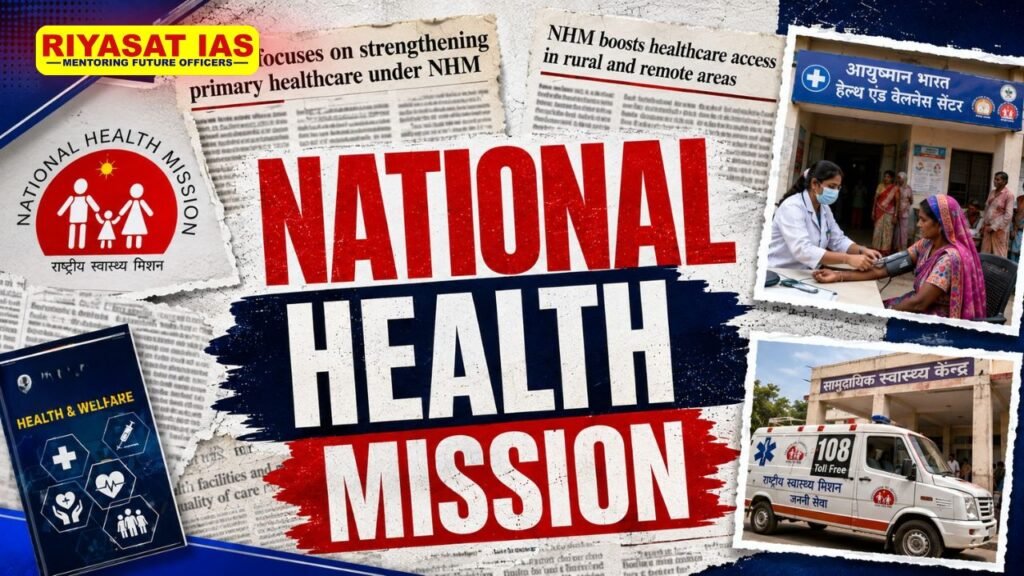
The National Health Mission (NHM) is the Government of India’s flagship programme for strengthening the public health system and ensuring equitable, affordable and quality healthcare. It was created in 2013 by bringing the National Rural Health Mission (NRHM) and the National Urban Health Mission (NUHM) under one umbrella. NRHM was launched in 2005, while NUHM was added as a sub-mission in 2013.
NHM focuses particularly on primary healthcare, maternal and child health, communicable and non-communicable diseases, health-system strengthening and reducing disparities between regions and population groups.
Components of NHM
· National Rural Health Mission (NRHM): It focuses on providing accessible, affordable and quality healthcare to rural and vulnerable populations, with special attention to high-focus States and underserved areas.
· National Urban Health Mission (NUHM): It focuses on the healthcare needs of the urban poor and vulnerable populations, particularly those living in slums and other underserved urban settlements.
· Major Programme Components: According to the NHM framework, the major components include:
o Health System Strengthening
o RMNCAH+N
o Communicable Disease Control
o Non-Communicable Disease Control
o Infrastructure Maintenance
Objectives of NHM
· To ensure universal access to equitable, affordable and quality healthcare.
· To strengthen public health infrastructure and human resources.
· To improve maternal, newborn, child and adolescent health outcomes.
· To prevent and control communicable and non-communicable diseases.
· To reduce regional and social disparities in healthcare access.
· To increase access to comprehensive primary healthcare.
· To reduce out-of-pocket expenditure and financial hardship.
· To promote community participation, decentralised planning and accountability.
Key Achievements of NHM
- NHM Engaged over 12 Lakh Additional Healthcare Workers between FY 2021-24
- 220 Crore Covid-19 vaccine doses administered nationwide under NHM
- MMR declined by 83% since 1990, which is higher than the global decline of 45%
- India demonstrated a higher decline of 75% in the reduction of Under 5 Mortality Rate in comparison to the global reduction of 60% since 1990
- TB incidence reduced from 237 per 1,00,000 population in 2015 to 195 in 2023; TB mortality rate decreased from 28 to 22 in the same period
- 1.56 lakh Ni-kshay Mitra volunteers are supporting over 9.4 lakh TB patients under the Pradhan Mantri TB Mukt Bharat Abhiyan
- Ayushman Arogya Mandir Centers reach 1.72 Lakh mark by FY 2023-24
- National Sickle Cell Anemia Elimination Mission screens over 2.61 Crore Individuals
- India achieves 97.98% Coverage in Measles-Rubella Vaccination Campaign
- Malaria Control Efforts Leads to Decreased Mortality and Cases
- Kala Azar Elimination targets successfully met
- U-WIN Pilot Launched to Track Vaccination Events Across India
- Pradhan Mantri National Dialysis Programme has benefited over 4.53 lakh dialysis patients in FY 2023-24



Major NHM Initiatives
- Ayushman Arogya Mandirs
- Janani Suraksha Yojana (JSY)
- Janani Shishu Suraksha Karyakram (JSSK)
- Surakshit Matritva Aashwasan (SUMAN)
- Pradhan Mantri Surakshit Matritva Abhiyan (PMSMA)
- LaQshya
- Rashtriya Bal Swasthya Karyakram (RBSK)
- Rashtriya Kishor Swasthya Karyakram (RKSK)
- Universal Immunisation Programme (UIP)
- National TB Elimination Programme (NTEP)
- National Vector Borne Disease Control Programme
- National Sickle Cell Anaemia Elimination Mission
- Pradhan Mantri National Dialysis Programme
- National Ambulance Services
- Free Drugs & Diagnostics Initiative
- e-Sanjeevani
- U-WIN
Major Challenges of NHM
· Unequal Healthcare Infrastructure: Health facilities and resources remain unevenly distributed, with rural, tribal and remote regions often facing greater shortages.
· Human-Resource Shortages: Shortages of doctors, specialists, nurses, technicians and other healthcare professionals affect the capacity of public facilities.
· Urban Health Challenges: Rapid urbanisation has created new challenges involving slums, migrant populations, overcrowding, sanitation and access to affordable healthcare.
· High Out-of-Pocket Expenditure: Despite expansion of public healthcare and insurance programmes, households continue to bear a significant share of healthcare expenditure.
· Growing NCD Burden: India is experiencing a rising burden of diabetes, hypertension, cardiovascular diseases, cancer and other non-communicable diseases, requiring long-term and continuous care.
· Quality of Healthcare: Increasing the number of health facilities does not automatically ensure quality, availability of medicines, diagnostics and patient-centred care.
· Regional Disparities: States and districts differ significantly in health outcomes because of differences in infrastructure, human resources, financing and administrative capacity.
· Implementation and Monitoring Gaps: The effectiveness of NHM depends heavily on State-level implementation, timely financing, data quality, monitoring and convergence with other sectors.
Way Forward
· Strengthen Primary Healthcare: Continue shifting the focus from curative care towards preventive, promotive and comprehensive primary healthcare.
· Address Human-Resource Gaps: Improve recruitment, training, rural incentives, accommodation and career progression for healthcare workers.
· Focus on Vulnerable Regions: Give greater attention to tribal, remote, aspirational and high-burden districts.
· Integrate Public Health and Primary Care: Strengthen referral linkages between AAMs, PHCs, CHCs and district hospitals.
· Improve Quality: Focus not only on the number of facilities but also on quality standards, availability of medicines, diagnostics and patient experience.
· Strengthen Digital Health: Use digital platforms and telemedicine to improve access while ensuring that digitalisation does not exclude people without connectivity or digital literacy.
· Increase Community Participation: Strengthen VHSNCs, ASHAs, Panchayats and local health committees in planning and monitoring.
· Converge Health with Other Sectors: Nutrition, sanitation, drinking water, education and gender equality should be integrated into health planning, as health outcomes are strongly influenced by these determinants.
Conclusion
NHM has played a major role in transforming India’s public-health system by expanding primary healthcare, strengthening health infrastructure and workforce, and improving maternal, child and disease-control outcomes. The decline in MMR, under-5 mortality and TB burden demonstrates significant progress. However, the next phase must move from expansion of services to quality, continuity and outcomes. Stronger primary healthcare, better human resources, reduced regional disparities and greater community participation are essential for achieving Universal Health Coverage and SDG 3.
FAQs
1. What is the National Health Mission?
Ans: NHM is India’s flagship public-health programme, launched in 2013 by integrating NRHM and NUHM to provide accessible and affordable healthcare.
2. What are the two major components of NHM?
Ans: The two major components are National Rural Health Mission (NRHM) and National Urban Health Mission (NUHM).
3. What are the major achievements of NHM?
Ans: NHM has contributed to improvements in maternal and child health, immunisation, TB control, primary healthcare and expansion of the public-health workforce.
4. What are the major challenges of NHM?
Ans: Major challenges include shortage of health personnel, regional disparities, inadequate infrastructure, high out-of-pocket expenditure and the growing burden of NCDs.
5. How can NHM be strengthened?
Ans: NHM should focus on stronger primary healthcare, better human resources, quality services, digital health, community participation and targeted support for underserved regions.


 Ravi Raaz
 Hassan Khan
 Shadab Ali