
About
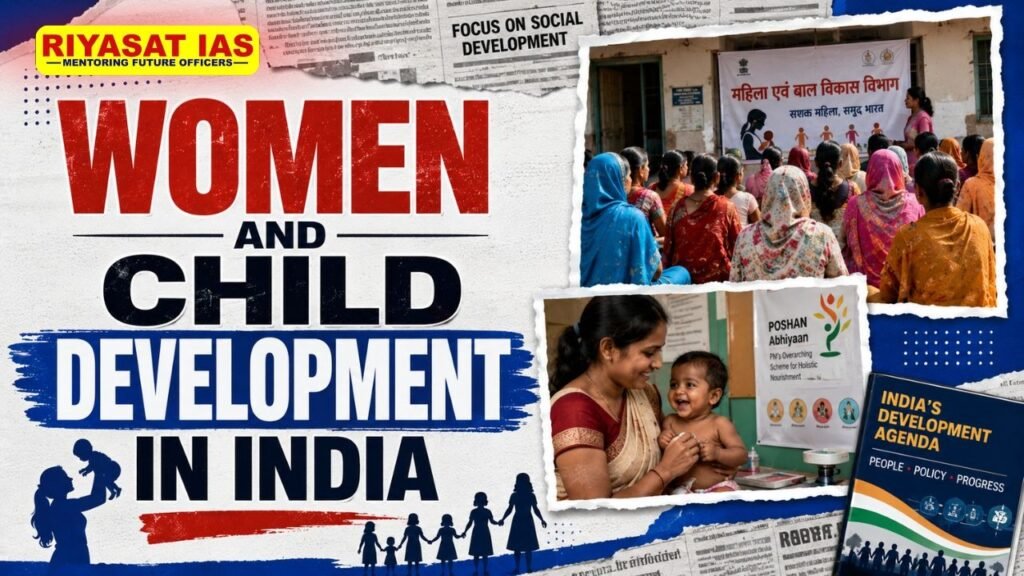
· Women and children constitute a major part of India’s human-capital base, and their development has a direct bearing on nutrition, education, health, employment and intergenerational poverty. Government policy has therefore moved from welfare-oriented interventions towards a broader approach of rights, empowerment, protection and capability building.
o For example, the national Sex Ratio at Birth increased from 918 in 2014–15 to 929 in 2024–25, while girls’ secondary-level gross enrolment ratio rose from 75.51% to 80.2% over the same period.
Beti Bachao Beti Padhao (BBBP)
Objective: BBBP aims to address gender discrimination, declining sex ratio at birth and the educational and social empowerment of girls.
Target Group: The programme focuses on girls and women, with emphasis on changing social attitudes towards the girl child.
Key Features
o It was launched on 22 January 2015.
o It focuses on social and behavioural change, awareness generation and promoting girls’ education rather than functioning as a direct cash-transfer scheme.
o It also supports effective implementation of laws such as the PC&PNDT Act against sex-selective practices.
Current status
o Sex Ratio at Birth: increased from 918 (2014–15) to 929 (2024–25).
o Girls’ secondary-level GER: increased from 75.51% to 80.2% during the same period.
o A NITI Aayog third-party evaluation for FY 2019–20 to 2023–24 found the BBBP component under Mission Shakti highly relevant in addressing gender-related challenges through integrated and data-driven interventions.
SUMAN (Surakshit Matritva Aashwasan)
About
SUMAN (Surakshit Matritva Aashwasan) is an initiative of the Ministry of Health & Family Welfare, launched in October 2019. It aims to provide assured, dignified, respectful and quality healthcare at no cost to every woman and newborn visiting a public health facility, with zero tolerance for denial of services.
Objective: The main objective is to eliminate preventable maternal and newborn deaths and morbidity and ensure a positive and respectful birthing experience.
Target Group: SUMAN covers all pregnant women, mothers up to 6 months after delivery and sick infants accessing public health facilities.
Key Features
o It brings existing maternal and neonatal health initiatives under one umbrella to provide a comprehensive service-assurance framework.
o It provides free and assured healthcare, including appropriate maternal and newborn services, without denial of essential care.
o It emphasises respectful maternity care, dignity, women’s autonomy and a positive birthing experience.
o It provides mechanisms for grievance redressal, client feedback and community participation.
o It focuses on continuum of care, linking antenatal, childbirth, postnatal and newborn services.
o Latest Data
o As of 31 December 2025, 96,481 public health facilities had been notified under SUMAN, according to the Ministry of Health & Family Welfare’s Annual Report 2025–26.
Sukanya Samriddhi Yojana (SSY)
Objective: SSY encourages families to build long-term financial savings for the education and future needs of a girl child.
Target Group: An account can be opened for an Indian girl child below 10 years of age by her parent or legal guardian.
Key Features
o Minimum annual deposit: ₹250.
o Maximum annual deposit: ₹1.5 lakh.
o Current interest rate: 8.2% per annum.
o Partial withdrawal is permitted for higher education, subject to scheme conditions.
o The account generally matures after 21 years from the date of opening.
o Deposits qualify for tax benefits under Section 80C, subject to applicable rules.
Current status: As of December 2025, more than 4.53 crore accounts had been opened, with deposits exceeding ₹3.33 lakh crore.



Ujjawala Scheme
The earlier Ujjawala Scheme has been merged with Swadhar Greh under Mission Shakti and is now implemented through Shakti Sadan.
Objective: The scheme was designed to prevent trafficking of women and children for commercial sexual exploitation and provide rescue, rehabilitation and reintegration support to victims.
Target Group: It covers women and children vulnerable to trafficking and victims of trafficking.
Key Features
o The original Ujjawala framework covered five major components:
o Prevention → Rescue → Rehabilitation → Re-integration → Repatriation
o Rehabilitation included shelter, food, medical care, counselling, legal aid, education and vocational training.
o Current Form – Shakti Sadan
o Under Mission Shakti, Ujjawala Homes and Swadhar Greh were merged into Shakti Sadan from 1 April 2022.
o As of March 2026, 419 Shakti Sadans were functional, and about 19,960 women were rehabilitated during FY 2025–26 up to 31 December 2025.
Janani Suraksha Yojana (JSY)
Objective: JSY aims to reduce maternal and neonatal mortality by promoting institutional deliveries.
Target Group: It primarily targets pregnant women, particularly those from vulnerable and low-income households.
Key Features
o It is a centrally sponsored scheme under the National Health Mission.
o It provides cash assistance through DBT to encourage institutional delivery.
o ASHAs play an important role in connecting pregnant women with institutional healthcare.
Current status
o As of March 2025, JSY had benefited more than 11.07 crore women since its inception.
o India’s Maternal Mortality Ratio declined to 80 per lakh live births in 2023, according to the UN Maternal Mortality Estimation Inter-Agency Group.
Janani Shishu Suraksha Karyakram (JSSK)
Objective: JSSK seeks to ensure that pregnant women and sick newborns receive free and cashless healthcare in public health institutions.
Target Group: It covers pregnant women delivering in public health institutions and sick newborns/infants accessing public facilities.
Key Features
o Entitlements include:
o Free delivery, including C-section
• Free drugs and consumables
• Free diagnostics
• Free diet during hospital stay
• Free transportation
• Free blood transfusion, where required
o Similar entitlements are available for sick newborns and infants.
SC/ST Welfare and Women & Child Development
Women and children belonging to SC and ST communities can face multiple and overlapping disadvantages involving poverty, nutrition, education, healthcare and geographical isolation. Therefore, women and child development programmes need to converge with social-justice and tribal-development interventions.
Major Areas of Government Intervention
o Scholarships: Pre-matric and post-matric scholarships support educational participation of SC/ST children.
o Residential Education: Eklavya Model Residential Schools (EMRS) provide quality residential education to ST students, particularly in tribal areas.
o Nutrition: Anganwadi and POSHAN interventions target nutritional deprivation among children and mothers.
o Health: Maternal and child-health programmes such as JSY, JSSK and Mission Indradhanush help improve access to healthcare.
o Livelihoods: SHGs, skill development and financial-inclusion programmes support economic empowerment of women from disadvantaged communities.
Tribal Development
The Ministry of Tribal Affairs continues to implement programmes covering education, health, housing, livelihoods, infrastructure and social protection for ST communities.
The 2025–26 allocation for Eklavya Model Residential Schools was ₹7,088.60 crore, while DAJGUA had an allocation of ₹2,000 crore in the Ministry’s scheme-wise financial summary.
Vanbandhu Kalyan Yojana (PMVKY)
Objective: PMVKY seeks to improve the socio-economic development and quality of life of Scheduled Tribes by addressing gaps in education, healthcare, livelihoods, infrastructure and basic services.
Target Group: The primary beneficiaries are Scheduled Tribes and tribal-concentration areas.
Key Features
o PMVKY works as an umbrella framework covering interventions such as:
o Pre-Matric and Post-Matric Scholarships for STs
o Support to Tribal Research Institutes
o Development of PVTGs
o PM-JANMAN
o PM Adi Adarsh Gram Yojana, now revamped and subsumed under Dharti Aaba Janjatiya Gram Utkarsh Abhiyan (DAJGUA)
o Administrative and institutional support.
Latest Development – DAJGUA
o Launched on 2 October 2024, DAJGUA brings together 25 interventions through 17 Ministries/Departments.
o It aims to address infrastructure, healthcare, education, Anganwadi services and livelihood gaps in 63,843 tribal villages, covering more than 5 crore tribal people across 549 districts and 2,911 blocks in 30 States/UTs over five years.
Major Challenges in Women & Child Development
· Gender discrimination: Social preference for sons, child marriage and gender-based violence continue to affect girls and women.
· Nutrition: Malnutrition and anaemia remain significant concerns among women and children.
· Low female economic participation: Women continue to face barriers related to employment, wages, mobility and unpaid care work.
· Child protection: Trafficking, child labour, abuse, exploitation and school dropout remain concerns.
· Regional disparities: Outcomes differ substantially across States, districts and rural–urban areas.
· SC/ST vulnerability: Women and children from SC/ST communities can experience multiple layers of social and economic disadvantage.
· Implementation gaps: Lack of awareness, inadequate frontline manpower, weak convergence and uneven last-mile delivery can reduce scheme effectiveness.
· Digital divide: Increasing digitisation of welfare delivery can exclude beneficiaries with limited access to devices, connectivity or digital literacy.
Way Forward
· Move from welfare to empowerment: Programmes should help women and children build capabilities, assets, skills and economic independence.
· Strengthen the first 1,000 days: Greater focus on maternal nutrition, breastfeeding, immunisation and early childhood development can generate long-term human-capital gains.
· Improve convergence: Women, child, tribal, health, education and social-justice programmes should work through integrated district-level planning.
· Invest in women-led development: Expand women’s access to credit, property, skills, markets, childcare and decent employment.
· Strengthen frontline institutions: Anganwadi workers, ASHAs, SHGs and local bodies should receive adequate training, resources and technological support.
· Focus on vulnerable groups: SC/ST women, tribal children, PVTGs, migrants, children with disabilities and victims of trafficking require targeted interventions.
· Measure outcomes: Monitoring should focus on indicators such as nutrition, school retention, learning outcomes, maternal health, employment and women’s economic independence, rather than merely counting beneficiaries.
Conclusion
Women and child development is not merely a welfare concern; it is central to human capital formation, demographic dividend and inclusive growth. India’s progress in sex ratio, girls’ education, maternal health and financial inclusion shows the impact of sustained policy intervention. The next step should be to move from scheme coverage to actual capability enhancement—ensuring that every girl receives nutrition, education, healthcare, safety and opportunities, while every woman has the ability to participate fully in economic and social life.
FAQs
1. Which ministry oversees women and child welfare in India?
The Ministry of Women and Child Development (MWCD) formulates policies and coordinates nationwide welfare programs for women and children.
2. What are the key umbrella schemes for women and child development?
The primary initiatives are Mission Poshan 2.0 (nutrition), Mission Shakti (women’s safety and empowerment), and Mission Vatsalya (child protection).
3. What are the main constitutional provisions supporting women and children?
Articles 15(3), 21A, 39, and 42 empower the State to provide special protections, free education, and maternity relief.
4. What role do Anganwadi Centres play at the grassroots level?
They deliver essential grassroots services including supplementary nutrition, basic healthcare, immunization, and early childhood education.
5. What are the key legal frameworks protecting women and children?
Key laws include the POCSO Act (2012), Juvenile Justice Act (2015), Protection of Women from Domestic Violence Act (2005), and the POSH Act (2013).


 Ravi Raaz
 Hassan Khan
 Shadab Ali