
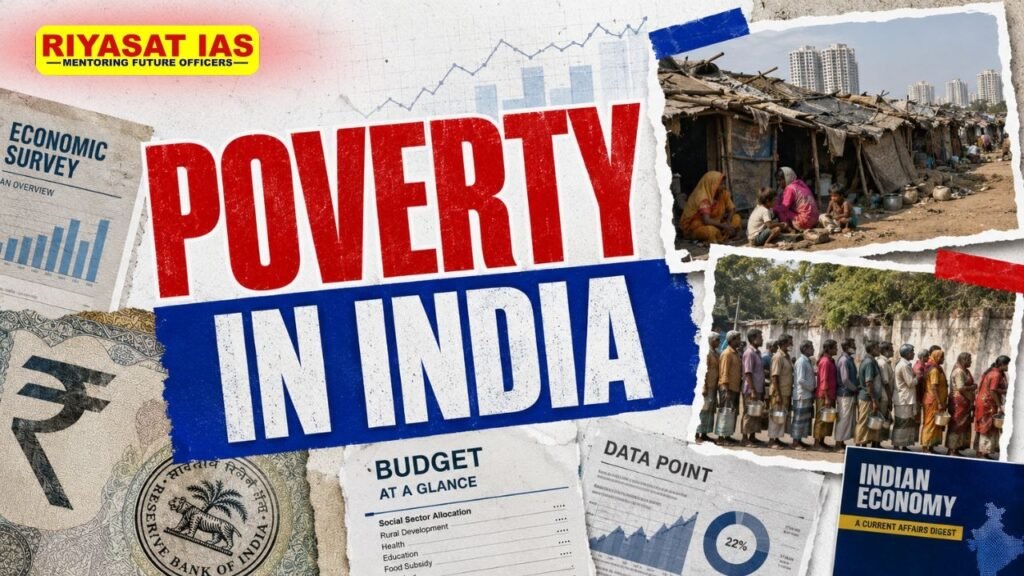
Poverty is not just about earning less money. It can also mean difficulty in accessing food, healthcare, education, housing and stable employment. India has made considerable progress in reducing poverty, but the experience is not the same across all regions and social groups.
Today, the discussion around poverty is gradually shifting from simply asking how many people are poor to also asking whether people have enough opportunities and security to improve their lives.
What Is Poverty?
Poverty: In simple terms, poverty is a situation where people do not have enough resources to meet their basic needs and maintain a reasonable standard of living.
The World Bank’s international extreme-poverty line is USD 3.00 per person per day at 2021 purchasing power parity (PPP). This line is mainly used to compare extreme poverty across countries.
In India, poverty has traditionally been estimated using household consumption expenditure and a poverty line.
How Is Poverty Measured in India?
India’s approach to measuring poverty has changed over time.
Alagh Committee (1979): It relied largely on calorie requirements and consumption expenditure.
Lakdawala Committee (1993): It refined the consumption-based approach and provided separate estimates for rural and urban areas.
Tendulkar Committee (2009): It moved away from a strict calorie-based approach and introduced a broader Poverty Line Basket (PLB).
Rangarajan Committee (2014): It proposed separate rural and urban poverty baskets and higher poverty thresholds. However, its recommendations were not officially adopted.
Multidimensional Poverty
Income alone does not tell the whole story. A family may have some income but still struggle with poor healthcare, inadequate housing, lack of sanitation or limited access to education.
This is why multidimensional poverty looks at several forms of deprivation together.
Multidimensional Poverty: It considers factors such as health, education and living standards, rather than income alone.
NITI Aayog’s National Multidimensional Poverty Index (NMPI) uses indicators drawn from the National Family Health Survey (NFHS).
According to NITI Aayog, multidimensional poverty declined from 29.17% in 2013–14 to 11.28% in 2022–23, with around 24.82 crore people estimated to have moved out of multidimensional poverty.
| Note: Multidimensional poverty and extreme poverty are different measures. Their figures should not be directly compared. |



Major Causes of Poverty in India
Poverty usually has more than one cause. A person’s income, education, employment opportunities and access to basic services can all affect their economic condition.
Low-Productivity Employment: A large number of workers depend on agriculture and informal employment, where incomes can be low or uncertain.
Education and Skill Gaps: Poor learning outcomes and a mismatch between available skills and job requirements can limit access to better employment.
Income Inequality: Unequal access to income and assets can make it harder for poorer households to invest in education, healthcare or businesses.
Social and Regional Gaps: Women, disadvantaged communities and people living in less-developed regions may face additional barriers to economic opportunities.
Climate Risks: Floods, droughts, heatwaves and other climate-related events can damage livelihoods and push vulnerable households into financial difficulty.
Recent Findings on Poverty in India
Recent research has brought fresh attention to India’s progress in reducing extreme poverty.
A study by Arvind Panagariya, Chairman of the 16th Finance Commission, and Vishal More estimates that India’s extreme poverty rate declined from 21.9% in 2011–12 to around 2.3% in 2023–24.
The study links this decline to factors such as rising consumption and improved access to welfare programmes and basic services.
It is important to note that the 2.3% figure is an estimate from this particular study. It should not be presented as the latest official World Bank estimate.
What Does the Study Show?
Sharp Fall in Extreme Poverty: The study estimates a substantial decline in extreme poverty between 2011–12 and 2023–24.
Improvement Across Social Groups: Poverty declined among SCs, STs, OBCs and Forward Castes, although STs continue to experience relatively higher poverty.
Rural Improvement: The study reports a significant decline in rural poverty, supported by higher consumption and wider access to welfare measures.
Narrowing Social Gaps: The study also points to a reduction in poverty differences across major social and religious groups.
Regional Differences Remain: While some states and Union Territories have reached very low levels of extreme poverty, poorer regions continue to face greater challenges.
What Do These Findings Mean?
The recent estimates suggest that India’s poverty story is changing. Extreme poverty has declined sharply, but this does not mean that economic vulnerability has disappeared.
A household can move above an extreme-poverty threshold and still struggle with an unstable job, medical expenses, poor housing or the cost of education. Such households can also fall back into poverty after a major economic or climate-related shock.
Therefore, the next stage of poverty reduction should focus not only on helping people cross a poverty line but also on creating stable incomes, better jobs and greater economic security.
Way Forward
Create Better Jobs: Expanding productive and labour-intensive employment is essential, especially for young people.
Improve Education and Healthcare: Quality public services can strengthen human capital and improve people’s earning opportunities.
Diversify Rural Incomes: Dairy, fisheries, food processing and other non-farm activities can provide additional sources of income for rural households.
Strengthen Social Protection: Food security, pensions, housing support and Direct Benefit Transfers (DBT) can protect vulnerable families during economic shocks.
Increase Women’s Economic Participation: Better access to education, skills, credit, childcare and employment can help women participate more actively in the economy.
Address Regional Gaps: Greater investment in poorer states, tribal areas and lagging districts can make poverty reduction more balanced.
Build Climate Resilience: Better water management, climate-resilient agriculture and disaster preparedness can protect vulnerable livelihoods.
Conclusion
India has made significant progress in reducing poverty, and recent research points to a sharp decline in extreme poverty.
However, poverty reduction should not stop at crossing an income threshold. The larger goal is to ensure that people have stable livelihoods, quality education, healthcare and enough economic security to withstand future shocks.
For India, the focus ahead should be on productive employment, stronger human capital, social protection, women’s economic participation and balanced regional development. This will help turn the gains made in reducing extreme poverty into more lasting improvements in people’s lives.
Frequently Asked Questions (FAQs)
What is poverty?
It is a situation where people do not have enough resources to meet their basic needs and maintain a reasonable standard of living.
What is extreme poverty?
The World Bank’s current international poverty line is USD 3.00 per person per day at 2021 PPP.
What is multidimensional poverty?
It measures deprivation in areas such as health, education and living standards, rather than income alone.
What is the recent trend in India’s extreme poverty?
The Panagariya–More study estimates that extreme poverty declined from 21.9% in 2011–12 to around 2.3% in 2023–24.
What is the recent trend in India’s multidimensional poverty?
NITI Aayog reports a decline from 29.17% in 2013–14 to 11.28% in 2022–23.
How can India reduce poverty further?
Better jobs, quality public services, stronger social protection, greater women’s participation and balanced regional development can help sustain poverty reduction.


 Ravi Raaz
 Hassan Khan
 Shadab Ali