
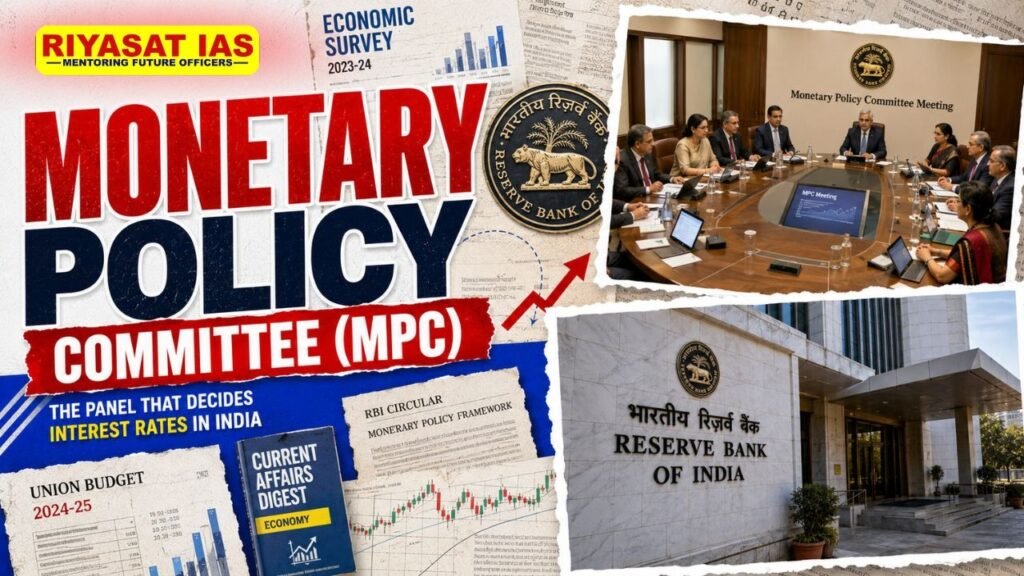
The Monetary Policy Committee (MPC) is the key institution responsible for determining India’s monetary policy stance, particularly the policy interest rate required to maintain price stability while supporting economic growth. It was established under the Reserve Bank of India Act, 1934, following the introduction of the flexible inflation-targeting framework.
What is Monetary Policy?
Monetary policy refers to the use of central bank instruments to influence interest rates, money supply, and credit conditions in the economy. In India, the Reserve Bank of India (RBI) conducts monetary policy under the provisions of the RBI Act, 1934.
The primary objective is price stability, while keeping economic growth in mind. Stable prices help create a favourable environment for sustainable economic growth and investment.
Inflation Targeting Framework in India
India formally adopted the flexible inflation-targeting framework after amendments to the RBI Act, 1934, in 2016.
Under this framework:
- The Government of India, in consultation with the RBI, determines the inflation target.
- The target is reviewed and notified once every five years.
- The MPC uses the policy interest rate as its principal instrument to achieve the inflation target.
What is the Monetary Policy Committee?
The Monetary Policy Committee (MPC) is a six-member committee constituted by the Central Government under Section 45ZB of the RBI Act, 1934.
It was created to make monetary policy decisions through a structured and transparent committee-based process, replacing the earlier system in which the RBI Governor had the final authority over monetary policy decisions, supported by the Technical Advisory Committee.
Main Function of the MPC
The primary responsibility of the MPC is to determine the policy interest rate (repo rate) required to achieve the inflation target.



Its decisions on the policy rate are binding on the RBI.
The Monetary Policy Department (MPD) of the RBI provides the MPC with the necessary technical and analytical support for monetary policy formulation.
Composition of the Monetary Policy Committee
The MPC consists of six members, representing both the RBI and the Government of India.
RBI Members
- RBI Governor – Chairperson of the MPC.
- Deputy Governor in charge of monetary policy.
- One RBI official nominated by the RBI’s Central Board.
Government-Nominated Members
- Three external members nominated by the Government of India.
Tenure of MPC Members
- External members have a four-year term.
- The MPC functions as a committee rather than allowing monetary policy decisions to rest solely with the RBI Governor.
MPC Meeting and Voting Rules
The MPC follows defined rules for conducting its meetings and taking decisions:
- Frequency: The MPC must meet at least four times a year.
- Quorum: At least four members must be present.
- Mandatory presence: The quorum must include the RBI Governor or, in the Governor’s absence, the Deputy Governor responsible for monetary policy.
- Decision-making: Decisions are taken through a majority vote.
- Casting Vote: In case of a tie, the RBI Governor has a casting vote.
Why is the MPC Important?
The MPC has strengthened India’s monetary policy framework by:
- Providing a committee-based approach to monetary policy decisions.
- Giving greater importance to price stability and inflation management.
- Improving transparency and accountability in monetary policy.
- Supporting economic growth while keeping inflation under control.
- Providing a clear institutional framework for India’s flexible inflation-targeting regime.
Conclusion
The Monetary Policy Committee (MPC) is a central pillar of India’s monetary policy framework. By deciding the policy interest rate within the flexible inflation-targeting framework, it plays a crucial role in maintaining price stability while keeping economic growth in view. Its six-member structure, defined voting mechanism and statutory mandate make monetary policy decisions more institutionalised and transparent.
Frequently Asked Questions (FAQs)
What is the Monetary Policy Committee?
The Monetary Policy Committee (MPC) is a six-member statutory committee responsible for determining India’s policy interest rate to achieve the inflation target.
Under which law was the MPC established?
The MPC was established under Section 45ZB of the RBI Act, 1934, following amendments made in 2016.
How many members are there in the MPC?
The MPC consists of six members—three from the RBI and three external members nominated by the Government of India.
Who is the Chairperson of the MPC?
The RBI Governor is the Chairperson of the Monetary Policy Committee.
How often does the MPC meet?
The MPC is required to meet at least four times a year.
What happens if there is a tie in MPC voting?
If the votes are equally divided, the RBI Governor has a casting vote.
What is the main objective of monetary policy in India?
The primary objective is maintaining price stability while keeping the objective of economic growth in view.


 Ravi Raaz
 Hassan Khan
 Shadab Ali