
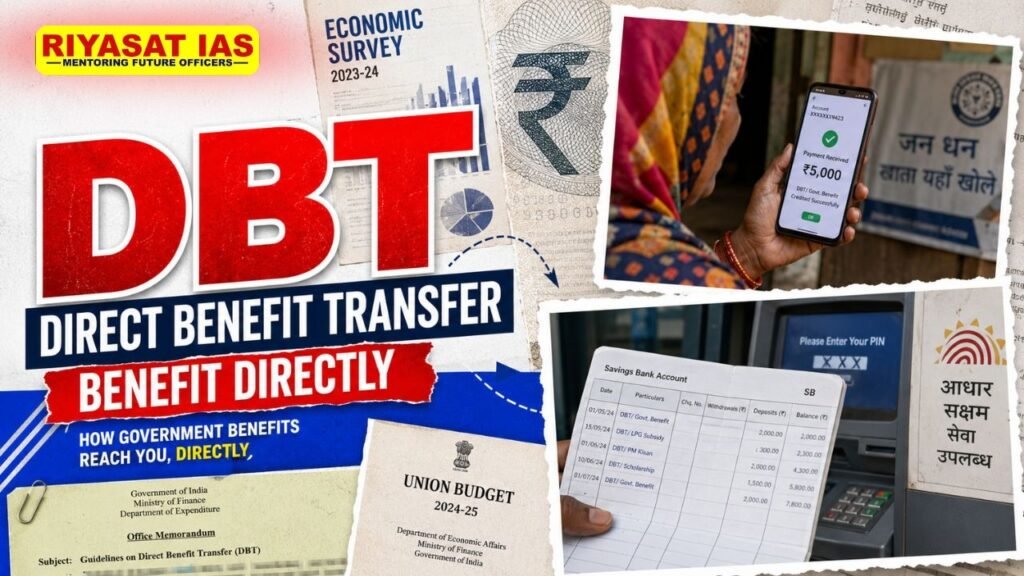
Direct Benefit Transfer (DBT) is a major digital governance initiative of the Government of India that enables welfare benefits, subsidies, and financial assistance to be transferred directly to eligible beneficiaries. Launched on 1 January 2013, DBT aims to improve transparency, reduce leakages, and make government payments faster and more efficient.
The DBT architecture has become an important part of India’s financial inclusion, welfare delivery, and digital governance framework.
What is Direct Benefit Transfer (DBT)?
Direct Benefit Transfer is a system through which government benefits are transferred electronically into the bank accounts of eligible beneficiaries, reducing dependence on intermediaries.
The key objectives of DBT are to:
- Ensure direct and timely delivery of government benefits.
- Reduce leakages, duplication, and fraud.
- Improve transparency in welfare expenditure.
- Lower transaction and administrative costs.
- Promote financial inclusion and digital payments.
When Was DBT Launched in India?
- The Direct Benefit Transfer scheme was launched on 1 January 2013 as part of efforts to reform India’s government benefit-delivery system.
- The Central Plan Scheme Monitoring System (CPSMS), subsequently developed into the Public Financial Management System (PFMS), was selected as the common platform for routing DBT payments.
- Over time, DBT has expanded from a limited number of welfare programmes to a broad digital payment architecture covering multiple sectors.
How Does the DBT System Work?
DBT connects government departments with beneficiaries through India’s digital financial infrastructure.
The system involves:
- Identification of eligible beneficiaries
- Validation of beneficiary and bank-account details
- Processing of payments by the concerned government department
- Routing of funds through the digital payment infrastructure
- Direct credit into the beneficiary’s bank account
- Digital tracking and reconciliation of transactions
The DBT ecosystem is supported by institutions and platforms such as PFMS, RBI, NPCI, banks, and core banking systems.
Key Components of DBT
- Beneficiary Account Validation: Bank-account details are validated to minimise payment errors and ensure that funds reach the intended beneficiary.
- Public Financial Management System (PFMS): PFMS provides the financial-management infrastructure for tracking and routing government payments.
- Aadhaar-Based Infrastructure: Aadhaar can assist with beneficiary identification and authentication and can be used through applicable payment mechanisms.
- Important: Aadhaar is not universally mandatory for every DBT scheme. Requirements depend on the particular scheme and applicable legal provisions.
- Banking and Payment Network: DBT uses the banking system, RBI settlement infrastructure, and NPCI payment mechanisms to facilitate electronic transfers.
Major Schemes Using DBT
DBT is used across several sectors, including agriculture, social security, housing, education, and energy.
Important examples include:
- PM-KISAN
- Pradhan Mantri Fasal Bima Yojana
- PAHAL (LPG subsidy)
- Pradhan Mantri Awas Yojana
- Atal Pension Yojana
- National Social Assistance Programme
- Scholarship schemes
- Various Central and State government welfare schemes



Benefits of Direct Benefit Transfer
- Reduces Leakages: Direct transfers reduce intermediaries and can minimise diversion, duplication, and fraudulent claims.
- Faster Delivery: Electronic payments enable beneficiaries to receive eligible benefits directly in their bank accounts.
- Greater Transparency: Digital transactions create an audit trail, making it easier to monitor the movement of public funds.
- Promotes Financial Inclusion: DBT encourages beneficiaries to use formal banking channels and strengthens access to financial services.
- Reduces Transaction Costs: Digital transfers can reduce the administrative and transaction costs associated with physical distribution of benefits.
- Improves Targeting: Digital beneficiary databases and authentication mechanisms can help governments identify and reach eligible beneficiaries more effectively.
- Supports Social Security: DBT provides the payment infrastructure for several pensions, scholarships, subsidies, and social assistance programmes.
- Strengthens Digital Governance: DBT represents a shift from traditional welfare distribution towards technology-enabled, transparent, and citizen-centric governance.
Challenges of DBT in India
Despite its advantages, DBT faces several implementation challenges:
- Digital Divide: Limited internet connectivity, digital literacy, and access to digital devices can restrict beneficiaries’ ability to use digital services.
- Banking Accessibility: Remote rural and tribal regions may still lack adequate banking facilities, ATMs, and banking correspondents.
- Payment Failures: Payments may fail because of:
- Incorrect bank-account details
- Aadhaar-bank account mismatch
- Inactive or frozen accounts
- Pending KYC
- Errors in beneficiary records
- Changes in bank-account information
- Documentation Problems: Beneficiaries may face difficulties obtaining, updating, or correcting documents required for registration and authentication.
- Lack of Awareness: Some eligible beneficiaries remain unaware of available schemes, eligibility conditions, and grievance-redressal mechanisms.
- Exclusion Errors: Errors in databases or authentication systems can sometimes prevent genuine beneficiaries from receiving benefits.
- Coverage Gaps: Beneficiaries such as tenant farmers, migrant workers, and other informal workers may face difficulties where eligibility depends on land ownership, employment records, or other formal documentation.
How Can DBT Be Improved?
- Strengthen Rural Digital Infrastructure: Improve internet connectivity, banking access, and Business Correspondent networks in rural and remote areas.
- Improve Last-Mile Delivery: Digital systems should be supported by physical assistance at the village, block, and district levels, particularly for vulnerable and digitally excluded groups.
- Strengthen Grievance Redressal: A simple and accessible grievance mechanism should enable beneficiaries to quickly resolve payment failures, authentication problems, and registration issues.
- Reduce Exclusion Errors: Alternative verification and authentication mechanisms should be available where genuine beneficiaries face technical difficulties.
- Promote Financial Literacy: Awareness programmes should educate citizens about:
- Scheme eligibility
- Registration procedures
- Payment status
- Banking services
- Grievance mechanisms
- Beneficiary rights
- Improve Data Management: Government databases should be regularly updated and interoperable while maintaining adequate safeguards for privacy and data security.
- Ensure Portability: Social-security and welfare benefits should increasingly become portable across States, particularly for migrant workers.
DBT and Financial Inclusion
One of the important indirect effects of DBT has been its contribution to financial inclusion.
When welfare payments are routed directly into bank accounts, beneficiaries become connected with formal financial institutions. This can reduce dependence on informal intermediaries and provide greater access to other financial services.
Thus, DBT links welfare delivery with financial inclusion and digital payments.
DBT and Good Governance
DBT contributes to several principles of good governance:
| Governance Objective | Contribution of DBT |
| Transparency | Creates a digital transaction trail |
| Accountability | Enables tracking of fund transfers |
| Efficiency | Reduces intermediaries and transaction costs |
| Targeting | Helps identify eligible beneficiaries |
| Financial Inclusion | Promotes formal banking access |
| Leakage Reduction | Reduces scope for diversion and duplication |
| Digital Governance | Enables technology-based welfare delivery |
Way Forward
The future of DBT should focus on inclusion along with digitisation.
Key priorities include:
- Strengthening rural banking and digital infrastructure.
- Improving beneficiary databases.
- Making grievance redressal faster and easier.
- Providing assisted services for digitally excluded citizens.
- Ensuring portability of benefits for migrant workers.
- Improving financial and digital literacy.
- Strengthening monitoring and social audits.
- Protecting beneficiary data and privacy.
- Reducing payment failures and exclusion errors.
Direct Benefit Transfer has transformed the way government benefits are delivered in India. By transferring welfare payments directly to beneficiaries, it can reduce leakages, improve transparency, promote financial inclusion, and make public expenditure more efficient.
However, the success of DBT depends not merely on digital transfers but on reliable infrastructure, accurate databases, accessible banking services, and effective grievance redressal.
The next phase of DBT should therefore focus on building a universal, inclusive, and resilient welfare-delivery system in which technology improves access rather than becoming a new source of exclusion.
FAQs on Direct Benefit Transfer
- What is Direct Benefit Transfer in India?
Direct Benefit Transfer (DBT) is a government mechanism through which eligible subsidies, pensions, scholarships, and other welfare benefits are transferred directly into beneficiaries’ bank accounts. - When was DBT launched in India?
DBT was launched on 1 January 2013 as an initiative to reform India’s government benefit-delivery system. - What is the main objective of DBT?
The main objectives are to reduce leakages, improve transparency, ensure timely payments, and make welfare delivery more efficient. - Is Aadhaar compulsory for DBT?
No. Aadhaar is not universally mandatory for all DBT schemes. The requirement depends on the specific scheme and applicable legal provisions. - What are examples of DBT schemes?
Important examples include PM-KISAN, PAHAL, Pradhan Mantri Awas Yojana, Atal Pension Yojana, National Social Assistance Programme, and various scholarship schemes. - What are the major benefits of DBT?
The major benefits include faster payments, reduced leakages, greater transparency, lower transaction costs, improved targeting, and financial inclusion. - What are the major problems with DBT?
Major challenges include digital exclusion, inadequate banking infrastructure, payment failures, documentation problems, database errors, and lack of awareness. - How does DBT promote financial inclusion?
DBT transfers government benefits through formal banking channels, encouraging beneficiaries to maintain and use bank accounts and reducing dependence on informal intermediaries. - What is the role of PFMS in DBT?
Public Financial Management System (PFMS) provides the financial-management infrastructure used for routing and monitoring government payments under DBT. - Why is grievance redressal important for DBT?
A beneficiary may be eligible but fail to receive a payment because of an account mismatch, KYC issue, authentication failure, or database error. Effective grievance redressal helps ensure that technical problems do not become permanent exclusion.


 Ravi Raaz
 Hassan Khan
 Shadab Ali