
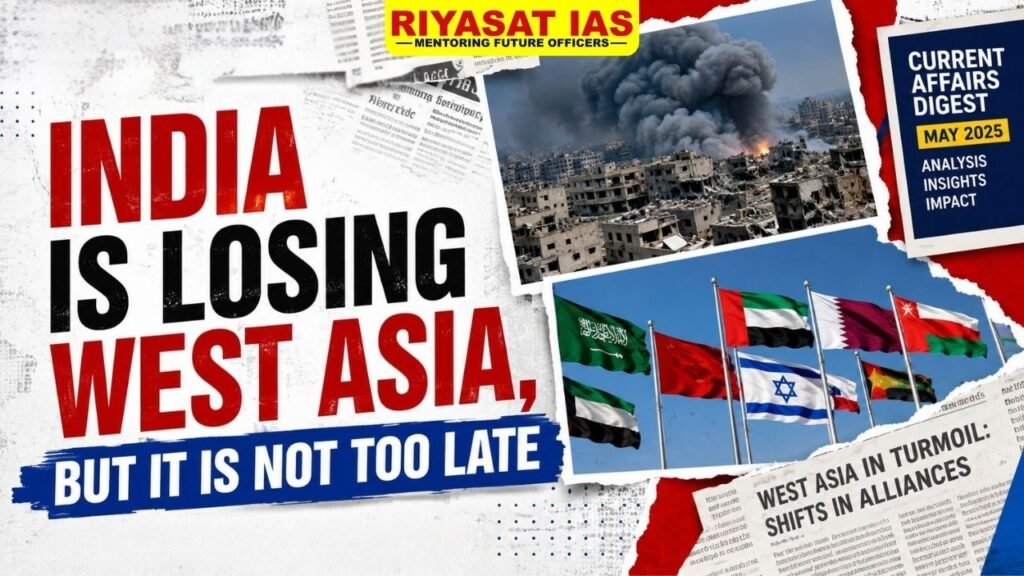
GS-II: International Relations | West Asia | India’s Foreign Policy | Maritime Security | Strategic Partnerships
Context
- Changing West Asian security architecture: West Asia is witnessing a major shift in its security architecture and political alignments.
- India’s declining strategic space: India’s earlier diplomatic gains in the region appear increasingly difficult to sustain.
- Earlier achievements: India’s growing footprint included Saudi Arabia’s highest civilian honour in 2016, the I2U2 agreement in 2021, and Iran’s lease of Chabahar to India in 2024.
- Regional conflict: The U.S.-Israel war with Iran has escalated into a wider regional conflict involving Iran, GCC countries, Israel, Saudi Arabia and the Houthis.
- Weakening U.S. security umbrella: Gulf countries are reconsidering the effectiveness of the U.S. security guarantee and face threats from both Iran and Israel.
Pakistan’s New Diplomatic Moment
- Pakistan as mediator: Pakistan’s role as a mediator in the U.S.-Iran conflict is giving it reputational benefits in the region.
- Diplomatic relevance: Pakistan entered the conflict at a time when efforts by Türkiye, Qatar and Egypt had failed to bring the U.S. and Iran to the negotiating table.
- Mecca collective defence pact: The collective defence pact between Saudi Arabia, Türkiye and Pakistan comes against this backdrop.
- Deterring Israel: The pact may be aimed less at Iran and more at deterring Israel.
- Pooling strengths: Saudi Arabia can contribute capital, Pakistan military strength and Türkiye technological capabilities.
- Challenge for India: A future conflict between Israel and Pakistan could draw India in because of India’s close partnership with Israel.
- Türkiye-Pakistan ties: Greater Turkish support for Pakistan in a future India-Pakistan conflict cannot be ruled out.
The Choices Before India
- Dependence on Israel-U.S. equation: India appears confident of Israel’s ability to prevail in regional conflicts because of its proximity to the U.S.
- Changing U.S. politics: Political support for Israel in the U.S. is no longer unquestioned, creating uncertainty over Israel’s ability to act independently.
- UAE partnership: India has cultivated a special relationship with the UAE due to Indian expatriate remittances, Indian investments and UAE strategic investments in India.
- UAE-Saudi differences: Growing differences between the UAE and Saudi Arabia create additional complications for India.
- Military alliances: Joining military alliances with Israel and the UAE could damage India’s remaining relationships with Iran and Saudi Arabia.
- Policy of inaction: Doing nothing could expose Indian merchant mariners to continuing risks in the Strait of Hormuz and Indian shipping to dangers in the Bab-el-Mandeb.
- Strategic credibility: A major power like India risks appearing constrained in its immediate maritime neighbourhood.



A Third Way for India
- Active regional strategy: India can pursue an independent and active political strategy rather than choosing between competing regional blocs.
- Re-engage Saudi Arabia: India can strengthen engagement with Saudi Arabia, with which it has no explicit differences.
- Arab-Iran trust-building: India can help rebuild trust between Arab countries and Iran, beginning with the UAE-Iran relationship.
- Support Jordan: India can engage in Jordan’s security by offering defensive technologies at a time when U.S. munitions are running low.
- Lebanon peacekeeping: India can participate in the future UN peacekeeping role in Lebanon amid uncertainty surrounding UNIFIL.
- Engage Türkiye: India can maintain a back-channel with Türkiye and communicate its red lines regarding Türkiye’s relationship with Pakistan.
- Protect Red Sea shipping: India can work with Egypt to safeguard India-bound shipping from the Suez Canal to Bab-el-Mandeb.
- Regional military presence: India can explore establishing a military presence in the Red Sea region, including Somaliland or Socotra.
- Military exercises: India can expand military training, drills and exercises with different countries in the region.
Think of Bridge-Building
- Special Envoy for West Asia: India can appoint a Special Envoy for West Asia who can coordinate different strands of India’s regional engagement.
- Beyond Israel-Palestine: The envoy need not focus only on the Israel-Palestine peace process but on securing India’s broader interests in West Asia.
- New security architecture: India can support a regional security architecture based on trust-building rather than new battle lines.
- Pro-active vision: All these initiatives can form part of a broader proactive Indian strategy for West Asia.
Why West Asia Matters for India
- Strategic neighbourhood: India cannot afford to remain a stranger to West Asia.
- Maritime security: Instability in the Strait of Hormuz and Bab-el-Mandeb directly affects India-bound shipping.
- Strategic partnerships: India has important relationships with Saudi Arabia, UAE, Iran, Israel and other regional actors.
- Regional stability: Peace and predictability in West Asia are important for India’s wider strategic interests.
Way Forward
- Active diplomacy: Move from a largely reactive approach to a proactive regional political strategy.
- Bridge-building: Use India’s relations with different sides to promote dialogue and trust.
- Strategic autonomy: Avoid being locked into any single regional military bloc.
- Maritime security: Strengthen efforts to protect Indian shipping through the Red Sea, Bab-el-Mandeb and Strait of Hormuz.
- Defence cooperation: Expand military training, exercises and defensive technology cooperation with regional partners.
- Institutional coordination: Appoint a Special Envoy for West Asia to bring together India’s different regional interests.
- Peace-oriented security architecture: Support a West Asian security framework based on trust-building rather than confrontation.
Conclusion
West Asia is undergoing a major transformation in its security architecture, creating both risks and opportunities for India. India cannot afford to remain passive while Pakistan gains diplomatic space and regional alignments change rapidly. Instead of choosing between competing blocs, India should pursue a third way based on active diplomacy, bridge-building, maritime security and strategic autonomy. India has both the capacity and the responsibility to contribute to peace and predictability in West Asia.
UPSC Mains Practice Question
Q. “India cannot afford to be a stranger to West Asia.” In the context of changing regional alignments and security architecture, discuss the challenges before India and suggest a proactive strategy for protecting its strategic interests.




 Ravi Raaz
 Hassan Khan
 Shadab Ali