
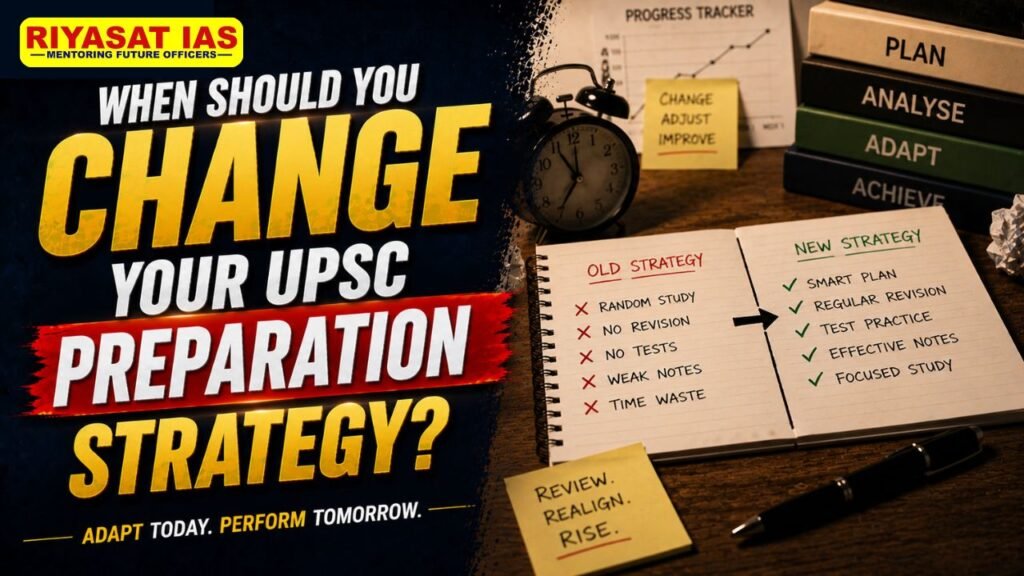
The question of when to change a preparation strategy is one of the most genuinely difficult decisions in UPSC preparation — because both premature changes and overdue changes are costly. Changing a preparation strategy too early — abandoning an approach that would have worked with more time — produces the accumulated costs of restarts and the lost compounding of a strategy that was beginning to work. Persisting too long with a strategy that is not working produces months of effort in the wrong direction that a course correction would have prevented.
This guide gives you five specific, evidence-based signals that a preparation strategy change is warranted — and five situations where what feels like a need for strategy change is actually a need for persistence with better implementation.
Five Signals That a Strategy Change Is Genuinely Warranted
Signal 1: Mock Test Scores Have Plateaued Across 3+ Consecutive Tests Despite Targeted Preparation
A single disappointing mock test is data, not a signal. Two disappointing tests may reflect question set variability. Three consecutive tests showing no improvement in the same subjects, despite targeted revision of those subjects between tests, is a signal that the revision approach for those subjects is not producing examination-level retention. The preparation strategy for those specific subjects needs to change — from re-reading to active recall, from passive notes review to PYQ practice, from general revision to targeted high-frequency topic drilling.
The change warranted is specific and surgical — not a wholesale strategy overhaul, but a specific modification to the revision approach for the plateauing subjects, implemented for the next 4–6 weeks and then re-evaluated.
Signal 2: External Evaluation Has Consistently Identified the Same Answer Weakness for 8+ Weeks
When a specific answer weakness — demand misidentification, generic evidence, restatement conclusions — has been identified by external evaluation across 8 or more consecutive weeks of practice answers without improvement, the current correction approach is not working. The strategy for addressing that specific weakness needs to change — from self-correction (which has not produced improvement despite 8 weeks of intention) to more intensive targeted practice, more explicit pre-writing planning, or a different evaluation frequency.
This is a signal to change the correction method for a specific weakness, not the overall preparation strategy. The distinction is important: strategy changes should be specific and evidence-based, not global responses to specific problems.
Signal 3: The Optional Subject Score Is Significantly Below GS Average Despite Equal Preparation Time
When Optional mock performance is consistently 20+ marks below what the proportional GS-equivalent score would predict — despite allocating similar preparation time — the Optional strategy needs examination. The change may be: source selection (the current primary sources are not calibrated to UPSC’s depth requirements for the subject); answer writing approach (Optional answers may be descriptive rather than analytical at the subject’s required depth); or, in rare cases, Optional Subject selection itself (if authentic engagement with the subject has declined significantly and performance data consistently underperforms).



The Optional Subject strategy change decision is one of the highest-stakes strategy decisions in UPSC preparation — because changing Optional means losing 6+ months of preparation already invested. It warrants change only when source selection and answer approach changes have been attempted and failed over 2+ months.
Signal 4: The Preparation Is Producing Information Accumulation Without Examination Performance
When an honest assessment shows that the preparation is primarily input-heavy (reading, note-making, current affairs accumulation) and the examination performance indicators (PYQ accuracy on covered topics, timed answer quality, mock test scores) are not improving proportionally, the strategy needs rebalancing toward output. The signal is specifically: preparation feels productive (syllabus is being covered, notes are being made, current affairs are being read) but examination performance is not tracking the felt productivity.
The change: shift the preparation ratio to 40%+ output activities. This is a significant strategy shift but a specific one — the direction changes from input-dominant to output-balanced, not from one subject focus to another or from one source set to another.
Signal 5: Successive Mains Attempts Show the Same Paper-Wise Weakness Pattern
When two or three UPSC Mains mark sheets show the same papers underperforming — the same GS papers consistently weak, the same Optional underscoring — the preparation strategy for those specific papers has not addressed the underlying gap across multiple cycles. This is the most unambiguous signal that the strategy needs specific change: what produced the same weak result twice or three times is not going to produce a different result the fourth time.
The change warranted: a diagnostic session that reads 2–3 of your actual Mains answers from the weak paper and identifies specifically what produced the low score — not what you think produced it, but what an external reader finds in the actual answers. The strategy change is then targeted to the specific diagnosis, not to general preparation improvement.
| Need help deciding whether your current strategy needs to change — and what to change it to? → Apply for Riyasat IAS Mentorship |
Five Situations Where Persistence Is the Right Response
| What Feels Like ‘Strategy Needs to Change’ | Why Persistence Is Actually Right | The Honest Test |
| One poor mock test score | Single test variability is normal; one data point is not a signal | Has the preparation for that subject’s specific error types actually been addressed between tests? If not, the issue is implementation, not strategy |
| Feeling overwhelmed by the syllabus scope | Overwhelm is a near-universal experience in Month 2–4 of UPSC preparation; it does not indicate a wrong strategy | Has coverage begun to accumulate alongside the overwhelm? If yes, the strategy is working; the feeling is not evidence of strategic failure |
| Peers appear to be ahead | Social comparison is not preparation evidence; peers’ apparent progress is rarely an accurate reflection of their actual examination-readiness | Is your PYQ accuracy improving? Is your answer quality improving? If yes, the strategy is producing results regardless of what others appear to be doing |
| The source seems too basic or too advanced | Sources should match the depth that UPSC actually tests — neither more basic nor more advanced. Feeling is not data. | Have you tested your understanding with 5–10 PYQs from this source? If accuracy is above 65%, the source calibration is correct regardless of how it feels |
| A mentor or online source recommends a different approach | The UPSC preparation advice ecosystem contains contradictory guidance of varying quality; following each recommendation resets preparation repeatedly | Is your current approach producing measurable improvement in mock scores or answer quality? If yes, implement changes incrementally rather than wholesale |
Frequently Asked Questions
How much time should I give a strategy change before evaluating whether it is working?
Six to eight weeks minimum for any meaningful strategy change — enough time for mock test data to show the change’s effect (2 mock tests), for answer quality improvement to be visible across multiple feedback sessions (4–6 evaluated answers), and for new habits to move from effortful to more automatic. Evaluating a strategy change after 2 weeks is nearly always premature — most preparation changes produce their measurable effect between weeks 4 and 8, not immediately.
What is the most common mistake aspirants make when changing strategy?
Changing everything simultaneously rather than changing the specific bottleneck. When mock scores disappoint, the instinct is to change sources, schedule, and answer writing approach at the same time. This makes it impossible to identify which change produced improvement (or which change introduced new problems). One specific, targeted change at a time — implemented for 6–8 weeks before the next change is considered — produces the most interpretable and most effective strategy evolution.
When is changing the Optional Subject the right decision?
When three conditions are all met simultaneously: Optional mock performance is consistently and significantly below GS average despite adequate time allocation; source selection and answer writing approach changes have been tried for 2+ months without improvement; and the aspirant’s authentic engagement with the subject has declined to the point where the preparation sessions are effortful in a way that affects quality. Optional Subject changes are expensive (months of prior preparation lost) and are warranted only when the alternative — continuing with a subject that is consistently underperforming and no longer authentically engaging — would cost more in examination marks over the remaining cycle than the change costs in preparation restart.
Conclusion
Changing a UPSC preparation strategy is warranted in five specific, evidence-based situations: mock score plateau across 3+ tests despite targeted preparation; a specific answer weakness persisting for 8+ weeks despite identified correction; Optional significantly underperforming despite equal time allocation; examination performance indicators not tracking input-heavy preparation; and successive Mains mark sheets showing the same paper-wise weakness. In all other situations — single test variability, the overwhelm of early preparation, social comparison anxiety, sources that feel non-optimal without PYQ confirmation — persistence with better implementation is the right response. The discipline of evidence-based strategy change rather than feeling-driven strategy change is one of the most underrecognised preparation skills in the UPSC cycle.
| Riyasat IAS Mentorship — Personal Guidance for UPSC CSE Direct mentorship from Riyasat Ali Sir │ Hindi & English Medium │ 100% Online — Apply Now |


 Ravi Raaz
 Hassan Khan
 Shadab Ali