
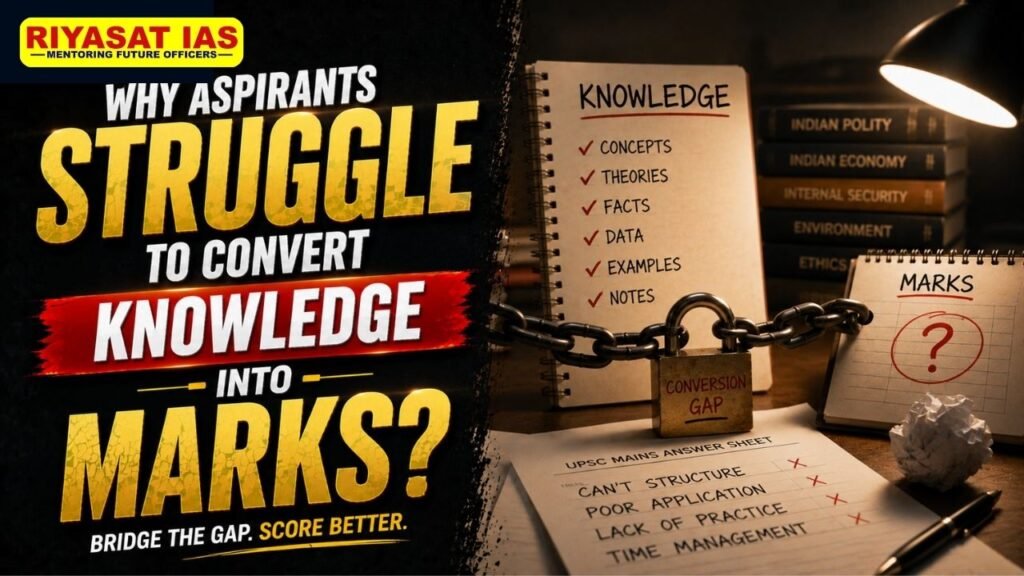
‘I know this topic — I just cannot seem to score well on it.’ This is among the most consistently frustrating experiences in UPSC Mains preparation. An aspirant who can discuss Indian federalism intelligently in conversation, who has read the relevant primary sources, and who is aware of landmark judgments and commission recommendations, produces a GS Paper 2 answer on Centre-State relations that scores 7/15 — not because they lacked knowledge, but because the knowledge did not convert into marks.
The knowledge-to-marks conversion gap is real, common, and specific. It is caused by five identifiable mechanisms, each of which requires a different preparation response. Understanding which mechanisms are affecting your specific preparation is more valuable than adding more knowledge — because adding knowledge to a preparation where the conversion mechanisms are broken produces more of the same disappointing result.
Gap 1: Knowledge Without Analytical Expression
The most fundamental knowledge-to-marks gap: knowing what exists without being able to analyse it. An aspirant who knows that Article 356 has been misused historically, that the Sarkaria Commission recommended it be used only as a last resort, and that the S.R. Bommai judgment made Presidential Rule subject to a floor test — but who describes these facts chronologically rather than using them to evaluate the constitutional safeguards against misuse — has demonstrated knowledge without earning the analytical marks that the question’s ‘critically examine’ directive invited.
UPSC Mains rewards analysis — the specific act of evaluating significance, weighing competing considerations, drawing implications, and reaching principled conclusions. Knowledge is the raw material; analysis is the manufacturing process that converts it into marks. An aspirant who knows a great deal and analyses poorly will score significantly below one who knows somewhat less but analyses what they know precisely and consistently.
The preparation practice that closes this gap: every answer writing session should include a deliberate analytical move — explicitly evaluating a policy’s effectiveness against a criterion, explicitly weighing two competing considerations against each other, or explicitly applying a thinker’s framework to the specific case. These are not natural extensions of knowledge accumulation; they must be practised separately and evaluated by an external reader to develop reliably.
Gap 2: Knowledge Without Named Evidence
An aspirant who knows that welfare schemes have been launched for farmers but cannot name PM-KISAN with its ₹6,000 annual transfer, its direct benefit transfer mechanism, and its 11 crore beneficiary count has policy awareness without policy knowledge. UPSC Mains marks the difference: awareness is credited at the level of a general observation; named, specific knowledge earns the evidence marks that distinguish competitive answers.
The preparation practice: build a subject-wise evidence bank — one line per scheme, judgment, or committee, capturing the name, the key metric, and the GS relevance. This bank is not a comprehensive encyclopaedia; it is 20–30 high-frequency, high-mark evidence items per GS paper, each with enough specificity to cite credibly in an answer. During answer writing, at least two named evidence items per answer must come from this bank — converting policy awareness into policy knowledge that earns marks.



Gap 3: Knowledge That Cannot Be Retrieved Under Time Pressure
An aspirant who knows the content of Article 356 perfectly when studying it at leisure, who can reproduce the S.R. Bommai judgment’s significance accurately in an untimed essay, and who cannot recall either precisely in a 9-minute timed answer has encountered the exam-condition retrieval gap. The knowledge exists; the exam-condition retrieval mechanism does not.
This gap appears exclusively in preparation where answer writing practice has not been consistently timed from the beginning. The specific cognitive skill of rapidly retrieving, organising, and expressing complex legal and constitutional knowledge under 9-minute pressure is not a byproduct of knowing the content — it is a separately practised skill. Aspirants who have only written untimed practice answers arrive at the examination with knowledge that is retrievable under comfortable conditions and unreliable under examination conditions.
The preparation practice: all answer writing practice timed from Month 3, strictly enforced. No exceptions for ‘practice’ answers. The timed constraint is not punitive; it is the practice condition that builds the exam-condition retrieval mechanism.
| Want specific feedback on why your knowledge is not converting into marks? → Explore Answer Writing Mentorship at Riyasat IAS |
Gap 4: Knowledge Applied to the Wrong Question
The fourth knowledge-to-marks gap is demand misidentification: the aspirant knows the topic but applies their knowledge to the general topic rather than the specific question asked. A question asking about ‘the limitations of cooperative federalism in India’ receives an answer about ‘cooperative federalism in India’ — comprehensive, accurate, and off-demand for the specific dimension asked.
This gap is invisible from inside the writing because the aspirant’s knowledge of the topic is genuine and the answer feels complete. From outside — as an examiner reads it — the demand mismatch is immediately apparent: the question asked for limitations; the answer provided an overview with limitations as a section rather than as the primary analytical focus. The marks awarded reflect the demand mismatch, not the knowledge quality.
The preparation practice: the 30-second pre-writing plan that begins by underlining the specific demanded dimension. The preparation habit of writing the demanded dimension at the top of the planning space before any content is planned. A self-check at the midpoint of every practice answer: is what I am currently writing addressing the specific demanded dimension, or the general topic?
Gap 5: Knowledge in an Unread Answer
The fifth gap is the most practically addressable: knowledge that is present in the answer but presented in a way that makes it difficult for an evaluator scanning under time pressure to find and credit. Key constitutional article numbers buried in continuous prose without underlining. Scheme names embedded in dense paragraphs without visible structure. Judgment citations mentioned incidentally rather than highlighted as the primary evidence for a claim.
UPSC evaluators read 20–25 answer booklets per day. The initial scan of each answer is 60–90 seconds — during which the evaluator is looking for structural quality, visible evidence items, and a conclusion that adds rather than restates. Knowledge that exists in the answer but is invisible in the scan may not be credited fully. Presentation — underlining key terms, clear paragraph breaks, visual evidence markers — ensures that the knowledge you have worked to build is findable when the evaluator reads your booklet.
The preparation practice: deliberate underlining of every article number, judgment name, scheme name, and committee recommendation in every practice answer — building the habit before the examination so it operates automatically under exam-day pressure.
Frequently Asked Questions
Which of these five gaps is most common among aspirants with strong content knowledge?
Gap 1 (knowledge without analytical expression) and Gap 4 (knowledge applied to the wrong question) are the most consistent for aspirants with strong content knowledge — precisely because their content confidence makes the absence of analytical focus less visible. An aspirant who knows a great deal can write a complete, content-rich answer that covers the topic without analysing the specific demand, and the content richness makes the demand misidentification harder to self-detect. Gap 3 (time-pressure retrieval) is also highly prevalent among aspirants whose practice has not been consistently timed.
Can closing these gaps significantly improve GS Mains scores without adding more knowledge?
Yes — and for aspirants who have already built strong GS knowledge bases, closing these gaps typically produces larger score improvements than additional knowledge accumulation. The marks lost to Gap 1 (no analytical move), Gap 2 (generic evidence), and Gap 4 (wrong dimension addressed) are not recoverable through reading more. They are recoverable through the specific, practised application of analysis, evidence naming, and demand identification. For a well-read aspirant, these three gaps alone may be worth 15–25 marks per GS paper.
How do I identify which of these five gaps is affecting my specific answers?
The fastest method is external evaluation: submit 2–3 recent practice answers to a mentor or evaluator with the specific request to identify which of the five gaps above is most present. This external reading, conducted within a week, will typically identify 2–3 dominant gaps with specific sentence-level examples from your submitted work. This is significantly more precise than self-diagnosis, which is limited by the same structural inability to read your own work as an examiner reads it.
Conclusion
The knowledge-to-marks conversion gap in UPSC Mains is caused by five specific, identifiable mechanisms: knowledge without analytical expression, knowledge without named evidence, knowledge that cannot be retrieved under time pressure, knowledge applied to the wrong question, and knowledge present in an unread answer. Each has a specific preparation practice that closes it. For aspirants who have already built strong GS knowledge — and are frustrated that the knowledge is not producing the marks it should — closing these five gaps is the highest-return preparation investment available. More knowledge on top of unclosed conversion gaps produces more of what the current preparation is already producing: knowledge that does not convert.
| Riyasat IAS Mentorship — Personal Guidance for UPSC CSE Direct mentorship from Riyasat Ali Sir │ Hindi & English Medium │ 100% Online — Apply Now |


 Ravi Raaz
 Hassan Khan
 Shadab Ali