
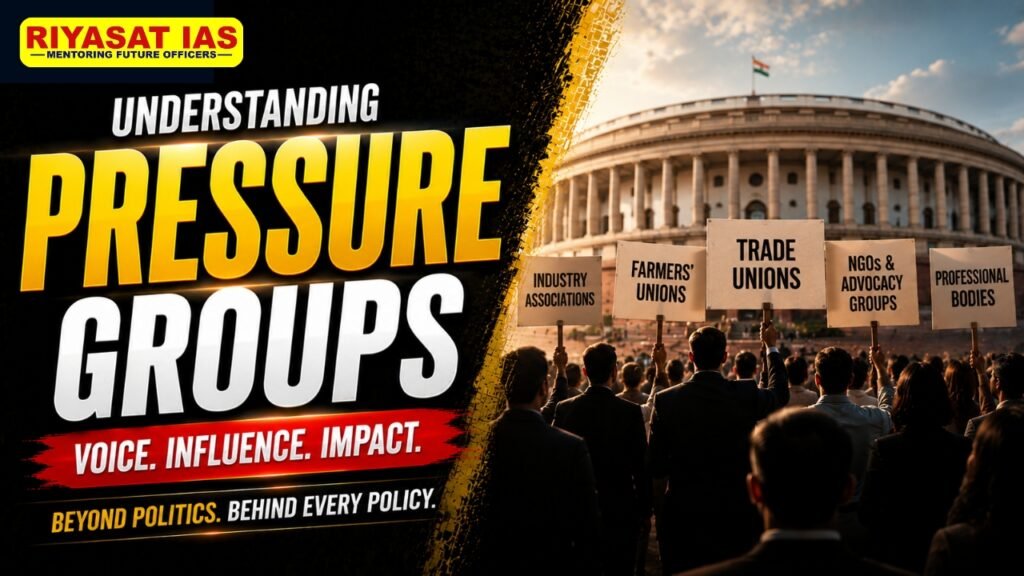
What are Pressure Groups?
· Pressure groups are organised groups of individuals or organisations that seek to influence government policies, laws and administrative decisions in favour of their specific interests without directly seeking political power. They are an important component of interest articulation and participatory democracy.
Types of Pressure Groups
· Business and Industrial Groups: These represent the interests of businesses and industries and seek to influence economic, taxation, trade and regulatory policies. For examples: FICCI, CII and ASSOCHAM.
· Trade Unions: These represent workers and advocate for wages, employment security, labour rights and better working conditions. For examples: INTUC, AITUC and CITU.
· Farmers’ Groups: These represent agricultural interests and influence policies relating to MSP, agricultural prices, subsidies, irrigation and farm laws. For examples: Bharatiya Kisan Union and All India Kisan Sabha.
· Professional Associations: These represent professionals and seek to influence policies affecting their respective professions. For examples: Indian Medical Association and Bar associations.
· Student and Youth Organisations: They raise issues relating to education, employment, examinations and youth welfare.
· Identity-Based Groups: These represent particular caste, tribal, linguistic, regional or religious interests.
· Environmental and Human-Rights Groups: They advocate for environmental protection, human rights, social justice and sustainable development. For examples: Centre for Science and Environment, Narmada Bachao Andolan and Greenpeace India.
· Institutional Pressure Groups: Some groups arise from within existing institutions and seek to influence government decisions concerning their members. For examples: Civil-service associations and teachers’ associations.
Significance of Pressure Groups in India
· Interest Articulation: Pressure groups identify and articulate the demands and concerns of specific sections of society; for example, Bharatiya Kisan Union (BKU) has articulated the concerns of farmers regarding agricultural prices, procurement and farm policies.
· Strengthen Participatory Democracy: They provide citizens with avenues for political participation beyond elections and political parties; for example, Mazdoor Kisan Shakti Sangathan (MKSS) mobilised citizens through grassroots campaigns and public hearings for greater transparency and accountability.
· Improve Policy Formulation: Governments can obtain sector-specific knowledge, technical expertise and ground-level feedback from organised groups; for example, NASSCOM provides industry inputs on policies relating to information technology, digital economy and technology regulation.
· Promote Accountability: Pressure groups monitor government actions and can expose policy failures, corruption and administrative shortcomings; for example, MKSS used social audits and public hearings to expose irregularities in the implementation of rural development programmes.
· Protect Group Interests: They help protect the interests of workers, farmers, consumers, professionals, minorities and vulnerable groups; for example, All India Trade Union Congress (AITUC) works to advance the interests and rights of workers.
· Act as a Link Between Citizens and Government: They communicate public demands to policymakers while also explaining government policies to their members; for example, Federation of Indian Chambers of Commerce and Industry (FICCI) communicates industry concerns to the government and disseminates information about policy changes to businesses.
· Provide Expertise: Specialised groups can contribute valuable technical knowledge during the formulation of complex policies; for example, the Indian Medical Association (IMA) provides professional inputs on healthcare policies, medical regulation and public-health issues.



Pressure Group vs Political Party
| Basis | Pressure Group | Political Party |
| Objective | Seeks to influence government policy. | Seeks to acquire and exercise political power. |
| Electoral participation | Generally does not contest elections to form government. | Contests elections to form or influence government. |
| Scope of interests | Usually represents specific or sectional interests. | Generally addresses a broad range of public issues. |
| Political power | Seeks to influence those in power. | Seeks to become the political power. |
| Accountability | Primarily accountable to its members or supporters. | Accountable to voters through elections. |
| Examples | Trade unions, business associations and farmers’ organisations. | BJP, Congress and other recognised political parties. |
Evaluation of the Role of Pressure Groups
Positive Role
· Deepen Democracy: They enable citizens to participate in governance between elections.
· Improve Representation: They bring diverse interests and specialised concerns into policymaking.
· Strengthen Accountability: They scrutinise government policies and demand corrective action.
· Improve Policy Quality: Expert groups can provide evidence, research and sector-specific knowledge.
· Empower Marginalised Groups: Collective organisation can give weaker sections greater bargaining power.
Negative Role
· Narrow Interest Orientation: Pressure groups may prioritise sectional interests over broader public interest.
· Unequal Influence: Well-funded corporate and professional groups may have greater access to policymakers than poor and marginalised communities.
· Policy Capture: Powerful groups may influence regulations in ways that favour their own interests, resulting in regulatory capture.
· Disruptive Agitations: Excessive protests, strikes or blockades can disrupt public order and economic activity.
· Political Manipulation: Pressure groups may develop close relationships with political parties and influence policymaking through informal channels.
Politicisation of Pressure Groups
Politicisation occurs when pressure groups become closely aligned with political parties or begin pursuing political objectives beyond their original sectional interests.
Causes
- Political patronage.
- Electoral competition.
- Ideological alignment.
- Government dependence on organised support.
- Competition for policy influence.
Consequences
· Positive: Political connections can help legitimate demands reach policymakers more effectively.
· Negative: Excessive politicisation can compromise autonomy, neutrality and credibility and turn genuine interest representation into partisan politics.
· Challenge: Maintain policy influence without becoming an extension of political parties.
Role of Pressure Groups in Governance
· Policy Consultation: Governments can consult pressure groups while designing laws and regulations to understand stakeholder concerns and implementation challenges.
· Policy Feedback: Pressure groups provide feedback regarding the ground-level impact of government policies.
· Social Accountability: They monitor public programmes and expose implementation gaps and administrative failures.
· Participatory Governance: They facilitate the involvement of organised citizens in policy debates and public consultations.
· Conflict Management: Structured engagement with pressure groups can help governments negotiate competing interests and prevent conflicts from escalating.
· Public Awareness: They educate citizens about rights, government schemes, laws and policy issues.
· Evidence-Based Governance: Research-oriented pressure groups can provide governments with data, expert analysis and alternative policy solutions.
Issues and Challenges for Pressure Groups
· Lack of Transparency: The sources of funding, internal decision-making and lobbying activities of some groups may not be sufficiently transparent.
· Unequal Representation: Groups with greater financial and organisational resources may exercise disproportionate influence over policymaking.
· Lack of Internal Democracy: Some organisations may be dominated by a small leadership group, limiting internal participation and accountability.
· Regulatory Uncertainty: Complex legal and compliance requirements can make it difficult for smaller organisations to operate effectively.
· Political Capture: Close association with political parties can compromise their independence and credibility.
· Fragmentation: Multiple groups representing similar interests can weaken collective bargaining power and create conflicting demands.
· Digital Manipulation: Online campaigns can be manipulated through bots, fake accounts, deepfakes and coordinated disinformation.
· Public-Interest vs Sectional Interest: A pressure group’s demand may benefit its members but conflict with wider public welfare or long-term national interests.
Way Forward
· Transparent Lobbying: India should develop a transparent framework for disclosure of lobbying activities, stakeholders and funding sources.
· Equal Access to Policymaking: Government consultations should provide greater opportunities for grassroots organisations and marginalised groups, rather than only well-funded organisations.
· Institutionalised Consultation: Stakeholder consultation should become a regular part of policy and regulatory processes.
· Strengthen Internal Democracy: Pressure groups should adopt transparent leadership selection, financial reporting and decision-making mechanisms.
· Promote Evidence-Based Advocacy: Demands should increasingly be supported by research, data and impact assessments rather than only political mobilisation.
· Responsible Digital Advocacy: Pressure groups should promote fact-based communication, transparency and responsible use of social media.
· Balance Sectional and Public Interest: Pressure-group demands should be assessed within the broader framework of constitutional values, social justice and public interest.
Conclusion
Pressure groups are an essential component of participatory democracy because they articulate diverse interests, provide policy expertise and hold governments accountable. However, their democratic contribution depends on ensuring transparency, equitable access, internal accountability and responsible advocacy, so that organised interests strengthen rather than distort the public interest and constitutional governance.
“A vibrant democracy requires not only free elections but also organised citizens who can continuously engage with and scrutinise the exercise of public power.”
FAQs
Q1. What is the fundamental difference between a pressure group and a political party?
Ans: A pressure group seeks to influence government policy, whereas a political party seeks to acquire and exercise political power.
Q2. How do pressure groups strengthen democracy?
Ans: They strengthen democracy by promoting interest articulation, citizen participation, policy consultation and government accountability.
Q3. What is regulatory capture?
Ans: Regulatory capture occurs when a regulatory institution becomes excessively influenced by the industry or interest group it is supposed to regulate.
Q4. How has social media changed pressure-group politics?
Ans: Social media has reduced the cost and time of mobilisation, enabling pressure groups to rapidly build public support and influence policy debates.
Q5. What is the major challenge posed by pressure groups?
Ans: The major challenge is preventing powerful sectional interests from exercising disproportionate influence at the expense of wider public interest.


 Ravi Raaz
 Hassan Khan
 Shadab Ali